
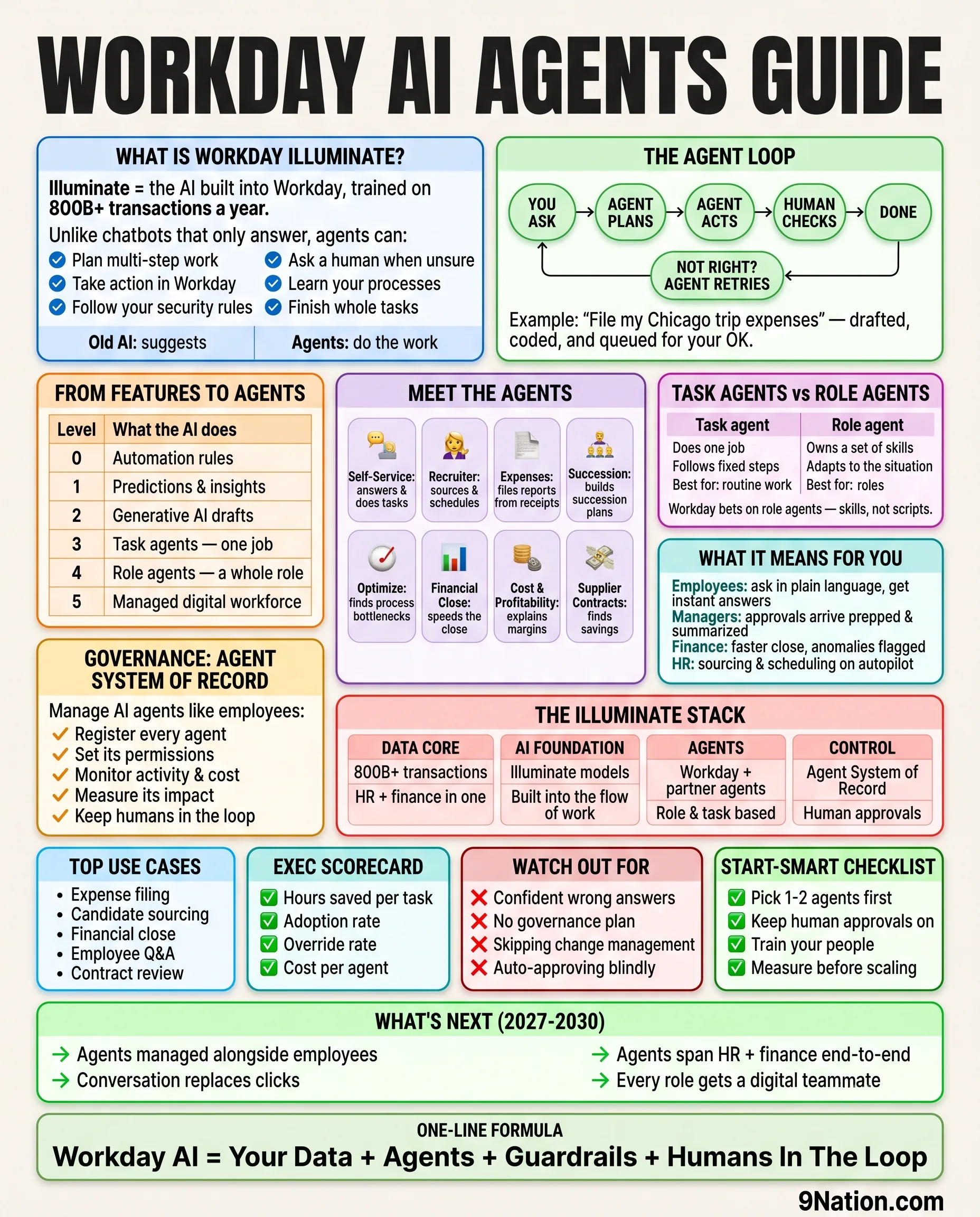
There is a real thing happening here and there is a lot of noise on top of it. The real thing is that software which used to recommend an action now performs it, inside your system of record, under your security model. That is a genuine change in what an ERP platform is, and it deserves to be understood properly rather than through a vendor keynote.
The noise is everything else. So this guide does two jobs. It explains what Workday has actually built, and it puts the published evidence on agentic projects next to it, because the second half is what stops you buying the first half badly.
What Workday Illuminate is
Illuminate is the AI built into Workday, trained on more than 800 billion transactions a year.
Unlike chatbots that only answer, agents can:
- Plan multi-step work
- Take action in Workday
- Follow your security rules
- Ask a human when unsure
- Learn your processes
- Finish whole tasks
| Old AI | Suggests |
| Agents | Do the work |
The third item on that list is the one to hold on to during any vendor conversation. An agent operating inside Workday inherits your security model, which means the governance question is not whether you trust the model. It is whether your security roles were designed well enough to be trusted with an actor that never gets tired and never hesitates. On most tenants that is a genuinely open question, and it is a reason to go and look at your roles before you go looking at agents.
The agent loop
Not right? The agent retries.
Example: file my Chicago trip expenses. Drafted, coded, and queued for your approval.
Notice where the human sits. Step four, after the action and before the record is final. That placement is the entire safety model, and it is also the first thing that gets removed once a team decides the agent is reliable and the approvals are slowing them down. Keep it. The moment you take the human out of the loop you have converted an assistant into an unsupervised employee with no performance review.
The six levels, from rules to a digital workforce
| Level | What the AI does |
|---|---|
| 0 | Automation rules |
| 1 | Predictions and insights |
| 2 | Generative AI drafts |
| 3 | Task agents, one job |
| 4 | Role agents, a whole role |
| 5 | Managed digital workforce |
This ladder is useful for one specific conversation: working out where you actually are. Most organizations talking confidently about agents are operating at level 0 or 1 and have not shipped anything above it. That is not a criticism. It is just worth being accurate about, because the jump from level 2 to level 3 is the point at which the governance question stops being theoretical.
Meet the agents
| Self-Service | Answers questions and completes tasks |
| Recruiter | Sources and schedules candidates |
| Expenses | Files reports from receipts |
| Succession | Builds succession plans |
| Optimize | Finds process bottlenecks |
| Financial Close | Speeds the close |
| Cost and Profitability | Explains margins |
| Supplier Contracts | Finds savings |
Read that list as two lists. The top four are HR, the bottom four are finance, and the reason both sit on one page is the reason Workday is positioned the way it is: one data core underneath both. An agent that can see the workforce record and the ledger at the same time can answer questions neither system could answer alone. That is the actual argument, and it is a decent one.
Task agents against role agents
| Task agent | Role agent |
|---|---|
| Does one job | Owns a set of skills |
| Follows fixed steps | Adapts to the situation |
| Best for routine work | Best for roles |
Workday bets on role agents: skills, not scripts.
Start with task agents anyway. A task agent that files expense reports has a bounded failure mode and an obvious measure of success. A role agent has neither, and it is very hard to tell whether one is working until it has been wrong about something expensive.
Governance: the Agent System of Record
Manage AI agents like employees.
- Register every agent
- Set its permissions
- Monitor activity and cost
- Measure its impact
- Keep humans in the loop
This is the part of the announcement that got the least attention and matters the most. Treat it as an HR process rather than an IT one and it becomes obvious what to do: an agent gets onboarded, gets a defined scope, gets monitored, gets reviewed, and gets removed when it is no longer needed. Organizations that cannot currently produce a list of who has administrator access to their tenant are not going to manage a fleet of agents by instinct.
The Illuminate stack
- 800B+ transactions
- HR and finance in one
- Illuminate models
- Built into the flow of work
- Workday and partner agents
- Role and task based
- Agent System of Record
- Human approvals
The bottom layer is the one you own. Models and agents are Workday's problem. The quality of what sits in your data core is entirely yours, and no amount of model capability compensates for a workforce record with duplicate people in it and a chart of accounts nobody has cleaned since the last merger. If you want one preparation task, it is that one. The AI-ready data piece covers what good looks like.
What it means for the people using it
| Employees | Ask in plain language, get instant answers |
| Managers | Approvals arrive prepped and summarized |
| Finance | Faster close, anomalies flagged |
| HR | Sourcing and scheduling on autopilot |
Where to start, and what to watch
- Expense filing
- Candidate sourcing
- Financial close
- Employee questions
- Contract review
- Confident wrong answers
- No governance plan
- Skipping change management
- Auto-approving blindly
- Hours saved per task
- Adoption rate
- Override rate
- Cost per agent
- Pick one or two agents first
- Keep human approvals on
- Train your people
- Measure before scaling
Override rate is the metric to build your governance around, and almost nobody tracks it. It is the share of agent output a human corrected before approving. A high override rate tells you the agent is not ready. A zero override rate over any real volume tells you the humans have stopped reading, which is worse, because it looks like success on every dashboard you have.
The honest numbers
Sources: Gartner forecast on agentic AI project cancelation; MIT research on generative AI pilot outcomes.
I put these on the page deliberately, because a guide about AI agents written entirely in the vendor's voice is a brochure. Neither number says the technology does not work. Both say that most organizations have been deploying it without a governance model, without change management, and without a measure of success defined before the pilot started, which is exactly the pattern that produced two decades of ERP disappointment.
Pick one agent with a bounded job. Define what success looks like as a number before you turn it on. Keep the human approval step. Track the override rate. Review it after one quarter and decide honestly whether to scale or stop. That sequence is unglamorous and it is the difference between the projects that survive 2027 and the 40% that do not.
What is coming next
- Agents managed alongside employees
- Conversation replaces clicks
- Agents span HR and finance end to end
- Every role gets a digital teammate
All four of those depend on the same foundation, which is a clean data core and a security model somebody actually designed. That is the unglamorous conclusion of a guide about artificial intelligence, and it is why this is the fifth guide in the set rather than the first.
Where to go from here
- Illuminate, the agent catalog, the agent loop, task and role agents, and the Agent System of Record: Workday product announcements and documentation.
- More than 800 billion transactions a year: figure published by Workday. Vendor-reported.
- More than 40% of agentic AI projects expected to be canceled by the end of 2027: Gartner.
- 95% of generative AI pilots producing no measurable return: MIT research.
- Practitioner guidance on override rate, security-role readiness and starting with task agents is the author's own, not drawn from a published study.
Product capability in this area changes faster than anything else on this site. Treat the catalog as accurate at August 2026 and check what is generally available against what is announced before you build a business case on it.