
Implementing payroll: a VP of Payroll, CHRO, and CFO guide to the ten modules
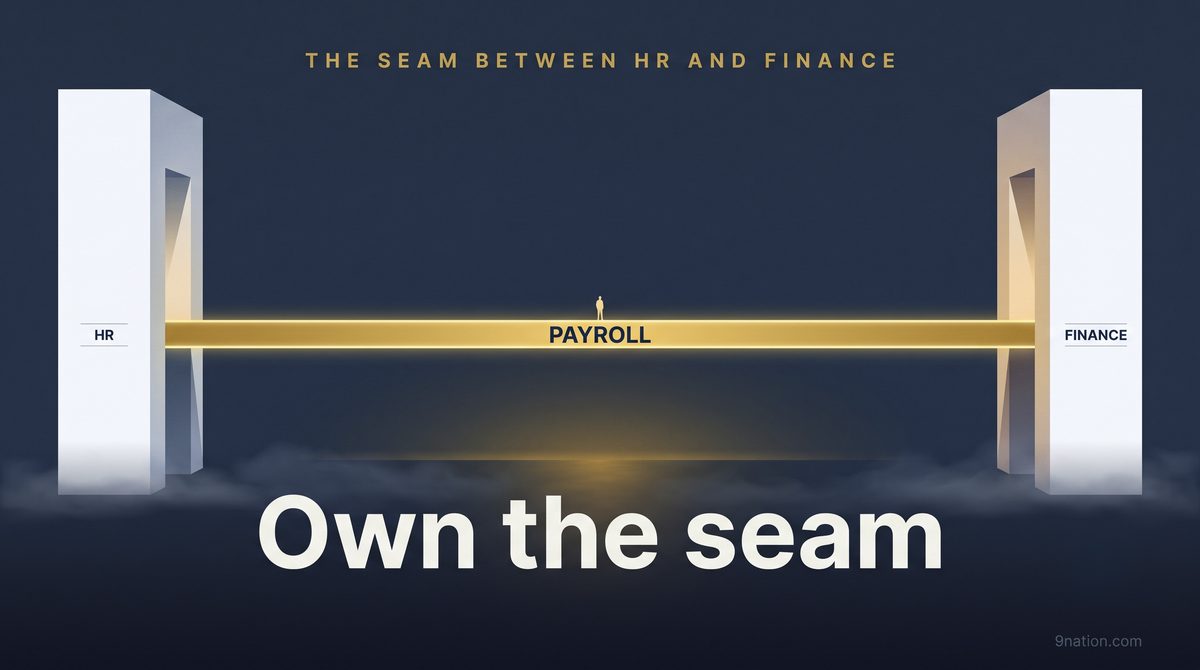
Payroll is the one enterprise system that has to be right the first time, for every person, on a date that never moves. It sits on the seam between HR and Finance, and the seam is where it breaks.
Hold onto thisPayroll has no grace period. It's the one system judged on a single run in front of every employee. Own the seam between HR and Finance and prove it with a clean parallel. The first payday should be boring.
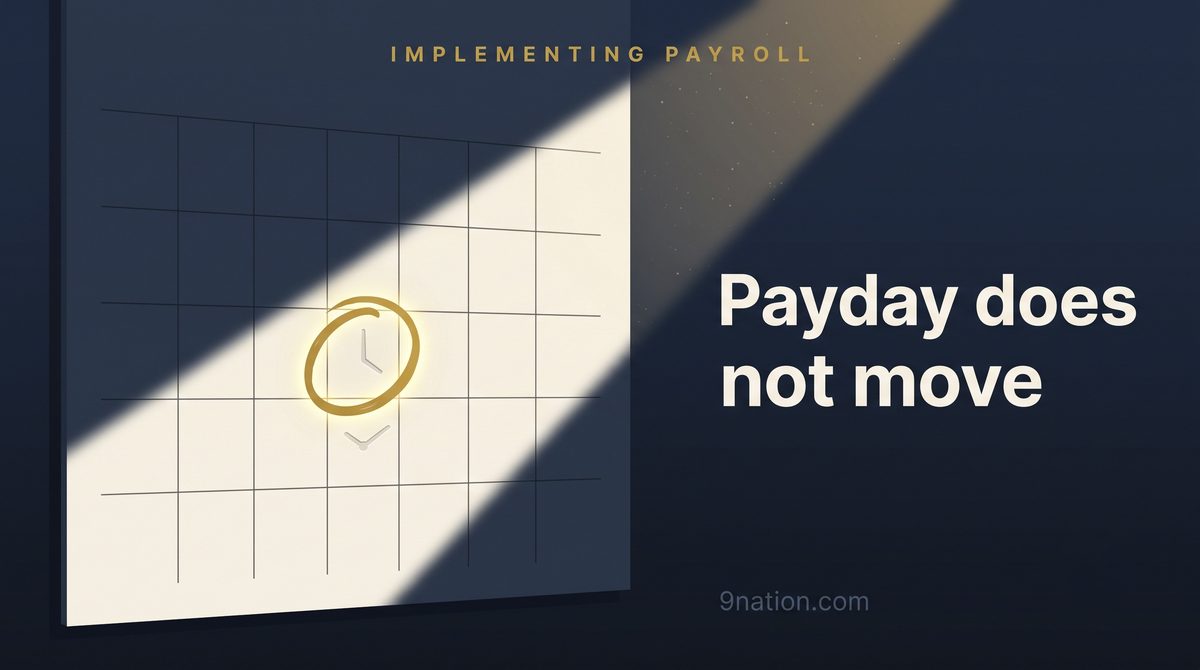
Every other module in the suite can have a soft launch. Payroll can't. One in five payrolls in the United States carries an error, and each fix costs about $291. Two payroll problems are enough to send roughly half of employees looking for another job. Payday still lands on the same date either way.
The people carrying that risk are the VP of Payroll and the Payroll Director who run it, and the CHRO and CFO who answer for it. In most organizations payroll reports through HR and pays through Finance, so it lives on a seam neither side fully owns. It's the deep dive the HCM module guide hands off to. The advice is system agnostic, with Workday Payroll, Oracle Cloud Payroll and ADP brought in where a real example helps.
The gross to net engine, in five steps
- Gross payEvery earning, before anything comes out
- Less pre-tax401k, Section 125, HSA
- Less taxFederal, FICA, state, local
- Less post-taxRoth, garnishments, dues
- Net payWhat lands, and it has to be right
What's really on the line
Payroll is judged on a single event. The run either pays everyone correctly and on time or it doesn't, and everyone knows within the hour. The first live payroll is the real go-live, the same way the first close is the real go-live for finance.
| Line | Each error | Each run | Each year |
|---|---|---|---|
| Cost to fix one | $291 | ||
| Corrections at the average company | 15 | ||
| Payrolls that carry an error | 1 in 5 | ||
| Time and attendance errors, per 1,000 employees | 1,139 | ||
| PTO, sick and vacation errors, per 1,000 employees | 721 | ||
| Errors per employee from the two feeds | nearly 2 |
The two biggest sources are the time feed and the absence feed, which is why two of the ten modules are the feeds. The damage goes well past operations. After two payroll problems about 49% of employees say they'd start looking for a new job, and about 24% would leave after one. Gartner still expects more than 70% of ERP initiatives to fall short of their goals by 2027, and poor data quality alone costs organizations about $12.9 million a year. Payroll is where those failures meet the workforce in person.
24%would leave after one payroll problem
49%would start looking after two
$12.9Ma year, the average cost of poor data quality
The moveName one accountable owner for the payroll seam between HR and Finance before design starts. Most payroll failures come from handoffs nobody owns.
Own the operating model before you configure anything
The first real decision is who operates the run and who owns the compliance work, and it comes before a single setting. Run it in house and you keep the staff, the configuration control and the liability. Move to managed or outsourced payroll and a provider operates it for you, trading some control for a specialist's compliance depth. That choice is separate from the software. ADP GlobalView, for example, lets you process the payroll yourself or have ADP run it on the same platform.
| Question | Run it in house | Managed or outsourced |
|---|---|---|
| Who operates | Your team, on your system | The provider, on their platform |
| Control | Full configuration and data control | Provider standards, less bespoke |
| Compliance | You track every jurisdiction change | Shifted to a specialist, but the liability stays yours |
| Fits | Complex, high control, in house capability | Many jurisdictions, a thin internal team |
The moveScore the decision on jurisdiction count, internal payroll depth and compliance risk, and keep the software's sticker price out of it. Outsourcing moves the work. The legal responsibility stays with you.
Ten modules, and the one decision that decides each
Each module has a handful of decisions that decide whether it works, and almost every one ends at a seam.
-
1
Payroll foundation
Pay groups, calendars, frequencies
43%biweekly, the most common U.S. frequency
The pay group binds a population to a frequency, a calendar and a legal entity, and everything downstream inherits it. Several states set a minimum frequency, so one national calendar won't keep a multi state workforce compliant. Workday models this with pay groups and period schedules. Oracle uses payroll definitions and consolidation groups.
-
2
Earnings and deductions
Taxability flags on every code
$50,000group term life above this is imputed income
The gross to net engine is the hardest part of the build. Every earning and deduction is a pay component with taxability flags, and accumulators build the bases the rest of the calc reads. One mis flagged code silently corrupts thousands of checks. Imputed income is the classic trap: employer group term life over $50,000 is a non cash earning that still has to be taxed for Social Security and Medicare.
-
3
Tax
Location data before the engine
5 stateswith a convenience of the employer rule
Multi state withholding is a location problem before it's a math problem. Reciprocity agreements and the convenience of the employer rule in Connecticut, Delaware, Nebraska, New York and Pennsylvania can double tax a remote worker. Local taxes add another layer. Choose between a native tax engine and a third party like Vertex on purpose.
-
4
Garnishments and involuntary deductions
Federal caps, then state rules
25%of disposable pay, the federal Title III cap
Federal Title III caps ordinary garnishment at the lesser of 25% of disposable pay or the amount above 30 times the federal minimum wage. Child support runs to 50 to 65%. Where a state rule is more protective, the lower garnishment governs. There's no room for hand calculation, so configure the caps and the order of priority in the system.
-
5
Time to payroll
Map every pay code to an earning
1,139errors a year per 1,000 employees
This is the first of the two feeds that break payroll, and the single most common source of error. Every hour type (regular, overtime, shift differential, holiday) needs a pay code mapped exactly to an earning, and time and payroll have to share one overtime and workweek rule set. The usual failure is late approvals and retro edits that arrive after the deadline.
-
6
Absence to payroll
Paid versus unpaid, reconciled
721errors a year per 1,000 employees
The second feed is the second most common source of error. Leave has to reconcile on the balance and on paid versus unpaid treatment, including the payout at termination. Workday calculates the balance with the same engine as payroll and can pay it out at termination. Unpaid leave coded as paid overstates the check.
-
7
Retro and off cycle
Watch the correction volume
15corrections a pay period at the average company
Retro pay recalculates prior periods for backdated raises and late time, and the engine tracks when the event is recognized separately from when it pays out. Off cycle runs bypass the stable controls and change funding and tax treatment. High off cycle and correction volume is a symptom, so track it and fix the feed upstream.
-
8
Banking and payments
Direct deposit, cards, EWA
92.65%of workers paid by direct deposit
Direct deposit is near universal. Under Regulation E a pay card can't be the only option. Earned wage access is the part changing under you. It's a payroll deduction and a multi state compliance obligation, and the state rules are still moving.
-
9
GL posting and costing
The handoff to Finance
100%the costing split has to total in Workday
Every run produces the money movement and the accounting. Costing splits one person's pay across cost centers, projects, grants and funds, and in Workday the allocation has to total exactly 100% or the run won't post. The payroll to GL map is where Finance and Payroll meet. It's also where the close slips.
-
10
Global strategy and year end
Native, partner or aggregator
Jan 31W-2s due to the SSA
Global payroll is a portfolio: a native engine, a partner or an aggregator, chosen country by country, with the HCM kept as the system of record. Year end is the annual test. W-2s go to the SSA by January 31, penalties land per return and again per employee statement, and multi state unemployment means a different taxable wage base in every state.
The moveFreeze the earning and deduction catalog early. Every new code needs an owner, a taxability decision and a test case before it enters the system.
From the fieldName one owner. On one program, finance and procurement data loads kept failing during conversion. The cause was ownership. No single person owned the validation rules across the modules, so every team assumed another team had them. We named one owner and put a date on each item, and the failures stopped. The fix cost nothing.
Payments look solved until earned wage access arrives
Payments look solved because direct deposit is near universal. The parts that still need decisions are cards and earned wage access, or EWA.
| Deposited by | Share shown as a bar | Share of workers |
|---|---|---|
| Direct deposit | 92.65% | |
| Paper check | 3.3% | |
| Digital wallet | 1.83% | |
| Prepaid card | 0.63% | |
| Payroll card | 0.58% |
EWA lets a worker draw wages they've already earned before payday, repaid by payroll deduction. It's big too. About 10 million workers accessed roughly $31.9 billion this way in 2022, and while about 8% of workers receive it today, 28% want it.
10Mworkers used EWA in 2022
$31.9Bin wages drawn early
The regulation is a live 2026 issue. States are legislating fast (Nevada first in 2023, roughly a dozen by mid 2025), and they split on the core question. California and Connecticut treat most EWA as credit, while a December 2025 federal advisory opinion held that covered, employer partnered EWA isn't credit under the Truth in Lending Act. For payroll, an employer partnered EWA program is a deduction the interface handles every cycle and a compliance obligation in every state where employees work.
The moveDecide your EWA position now. If you offer it, treat it as a payroll deduction and a multi state licensing question, and pick the employer partnered model to keep it out of credit territory.
From the fieldFifty on paper, ninety in reality. Discovery listed 50 integrations. The real number was closer to 90 once we mapped every handshake to banks, tax agencies, benefit carriers and downstream apps. Payments and remittances are where the integration footprint hides.
The payroll-to-GL map translates between two different data models
Payroll thinks in pay components and workers. The general ledger thinks in accounts, cost centers and entities. When the definitions differ, a reconciliation can tie at the top line and be wrong underneath, which is a recurring source of close delays.
The per account control
- Beginning liability
- plusAdditions
- lessPayments
- equalsExpected ending
Period end adds accruals, because a biweekly period rarely lines up with a monthly close. One tax nuance trips people up: for federal employment tax, the liability arises on the date wages are paid, whatever date the period ended.
The moveBuild the GL mapping and the per account reconciliation control with Finance in the room, so it never turns into a downstream export nobody owns.
Three delivery models, chosen country by country
Global payroll never resolves to one system. There are three delivery models, and most enterprises use all three at once. Match each country to a model on depth and risk, and keep the HCM as the single system of record.
| Model | Depth | Data | Best for |
|---|---|---|---|
| Native engine | Deepest, few countries | One unified data model | Your biggest countries |
| Partner and ICP | Deep, one country at a time | HCM stays system of record | A country done well |
| Aggregator | Broad, varies by country | One contract, many providers | Many small countries |
The vendors sit in different places. Workday runs native payroll for the U.S., Canada, the UK and France, and reaches more than 180 countries through certified partners under Global Payroll Connect. Oracle offers native cloud payroll for more than 46 countries. ADP runs GlobalView for 40 plus countries and adds the Celergo aggregator for about 140.
The moveKeep the HCM as the single system of record, choose native, partner or aggregator country by country, and plan year end before go live. Penalties land per form and per statement.
What AI actually does in payroll today
The honest win from AI in payroll today is catching a bad run before it pays. ADP Assist flags anomalies in payroll data before an error happens. SAP's Joule can already explain a pay statement to an employee. Workday has a Payroll Agent in early access, and Oracle has announced a Payroll Run Analyst Agent that still carries a future product disclaimer. Read the vendor speed claims as vendor reported.
Real today
- Anomaly detection before the run
- Explain my pay, for employees
- Compliance monitoring and audit
- Drafting and summarizing for the team
Still mostly roadmap
- An agent that runs payroll unattended
- Autonomous garnishment or tax decisions
- A self correcting pay run
- End to end payroll with no human gate
Gartner expects more than 40% of agentic AI projects to be canceled by the end of 2027 on cost, unclear value and weak controls. That caution counts for more in payroll than most places, because the output is money and compliance.
The moveBuy anomaly detection now, and put every agent behind the same approval and audit you'd give a person who can move pay.
Prove it before you cut over
Payroll go-live is judged on one run, so proving it beforehand is the whole game. Parallel testing means running the new system beside the old one and reconciling the results. That's how you know the run will land.
Change management decides whether people use what you built. Initiatives with strong change management are about seven times more likely to meet their objectives (Prosci).
Two more items belong on the 2026 checklist. Pay transparency laws in a growing list of states now pull pay range and comp data into the compliance perimeter, internal moves included. The other is the target itself: a boring first run.
| Mock runs, at least | 3 |
|---|---|
| Error on the final run | under 2% |
| Finance reconciles | to the cent |
Meet or exceed objectives
Excellent change management88%
Poor change management13%
The moveDon't go live without a clean parallel. Reconcile to the cent for three cycles before you cut over.
From the fieldOne role stalled the test. An end to end testing cycle once stopped for a full week because one security role exposed compensation data far wider than intended. Every test script that touched pay had to pause. The build was fine. The design decision behind the role caused it, so treat pay data security as a design task and settle it long before go live.
The red flags to run before every gate review
Ten exceptions, each cleared by its correcting entry.
| Number | Exception | Correcting entry |
|---|---|---|
| 1 | Pay codes don't match | Reconcile the mapping |
| 2 | One calendar, many states | Segment pay groups |
| 3 | Open earning catalog | Freeze it, test each code |
| 4 | Stale location data | Build a location standard |
| 5 | Manual garnishments | Configure caps and priority |
| 6 | Off cycle creep | Fix the feed upstream |
| 7 | Only one clean parallel | Run three, tie to the cent |
| 8 | Orphan GL map | Own it with Finance |
| 9 | EWA bolted on | Treat it as compliance |
| 10 | Year end surprise | Plan it before go live |
The vendors are capable and the implementers are skilled. What they can't do is decide how your payroll should run, or own the seam between HR and Finance for you.
Payday doesn't move
A payroll program is a sequence of decisions that live on the seam between HR and Finance: which operating model, which pay groups, which taxability flags, which interfaces reconciled, which delivery model per country, and which parallel proves it. Make those calls early and treat the first live run as the real go-live. Get it right and the best outcome is that nobody notices.
Sources. External figures synthesize public research and documentation from the U.S. DOL, IRS, SSA, BLS, the CFPB, PayrollOrg, Tax Foundation, EY (commissioned by Paycom), the Workforce Institute, Prosci, Gartner and Everest Group, plus Workday, Oracle, ADP and SAP product and AI documentation. Field examples come from real, fully anonymized enterprise programs. This article is general guidance, not legal, tax or accounting advice.
9Nation ConsultingPayroll field guide
DatePayday
Pay to the order ofYour program
Right the first time
For every person, on a date that never moves
MemoOwn the seam between HR and Finance
David ApollonAuthorized signature