
Program leadership · PMO · Operating handbook
The client-side PMO
Your systems implementer is accountable for their scope. Nobody on the org chart is accountable for your whole program unless you make somebody accountable. That expensive gap is where large technology programs go wrong.
- Written for
- The sponsor, CIO, CFO or CHRO about to commit to a major program, and the program managers who'll staff the office.
- Applies to
- ERP as the anchor case, and CRM or any other business-critical technology program.
The first principle
You can contract out the work. You can't contract out the accountability.
If your accountable executive has no client-side machinery, they're accountable for something they can't see.
The implementer's accountability is written down. Their statement of work defines it, their engagement manager manages to it and their PMO reports against it. Yours is written down only if somebody on your side has been made to own it.
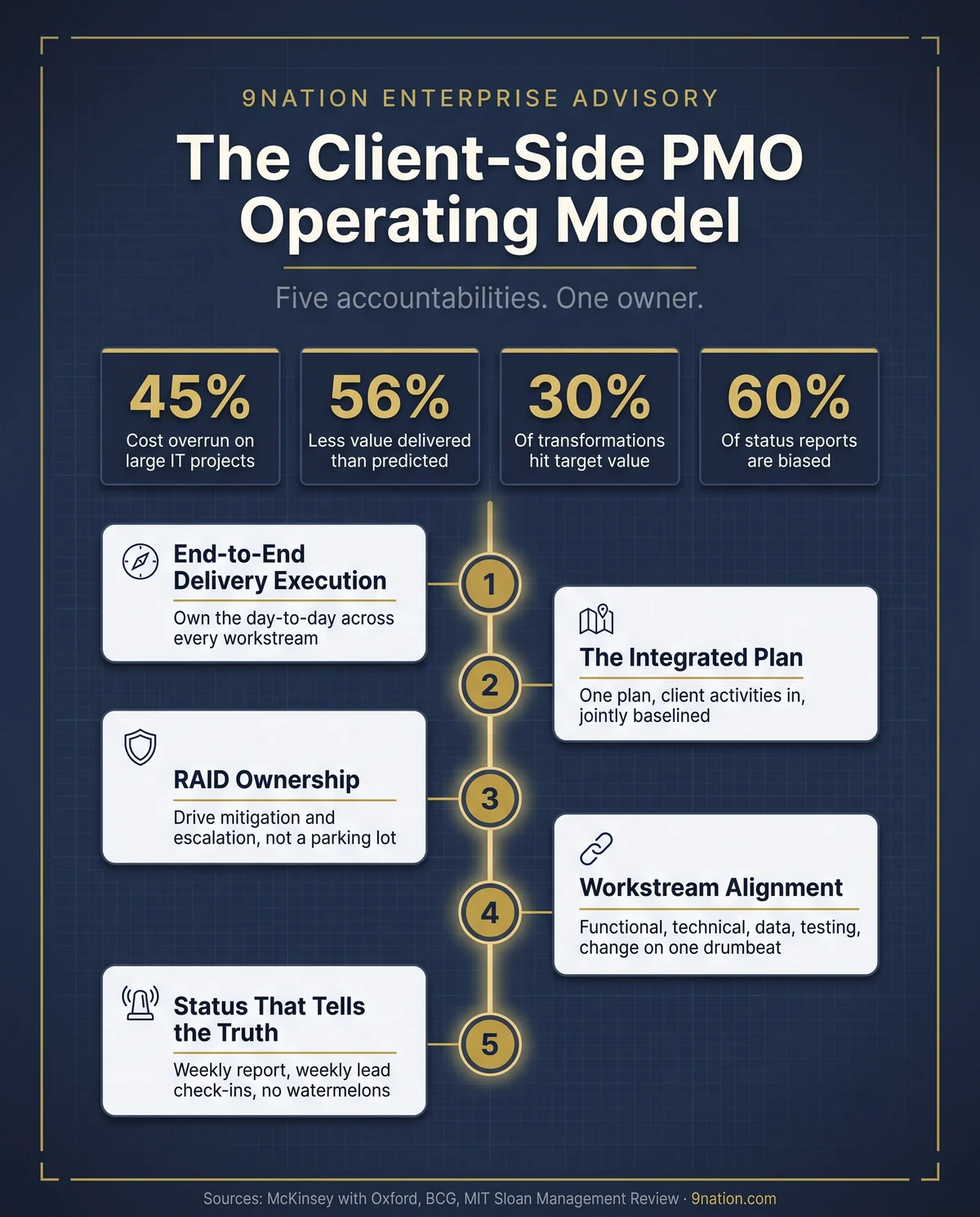
The cost of that gap is measurable. McKinsey and the University of Oxford studied more than 5,400 IT projects and found large ones run 45% over budget and 7% over schedule while delivering 56% less value than predicted. Gartner predicts that by 2027, more than 70% of recently implemented ERP initiatives will fail to fully meet their original business goals.
The value number is the one to watch. It's bigger than the cost overrun, and value is the owner's problem. No implementer's contract pays out on whether your close got faster or your people stopped working around the system.
Section 1 · The empty seat
Every large program has a seat nobody fills
A large program has an implementer who knows their software, internal leads who know the business, and a sponsor who signed the business case. On paper that looks complete. In practice a set of activities belongs to nobody: keeping one plan that covers both sides, chasing the decisions that are late, holding risks until they're actually closed, and telling the steering committee what's true.
The implementer won't do this work, and saying so is no criticism of them. Their engagement manager is measured on their firm's scope, margin and delivery method. When your data cleansing slips, that's your task on your side of the line. They'll note the dependency, flag it and keep moving, which is the correct behavior for them. The note goes into their log and the slip stays on your side. No single person is holding the arithmetic of what that slip does to your go-live.
The evidence points the same way from three independent angles. McKinsey attributes roughly 90% of cost overrun to four management dimensions: strategy and stakeholders, technology and content, team effectiveness, and core project-management practice. BCG studied 895 transformations and found only 30% met or exceeded their target value. Their conclusion was blunt: the technology matters, but the people dimension is usually what decides the outcome. Panorama's 2026 ERP survey found the most common cause of schedule overrun was organizational issues, which it defines as governance, resistance to change and process redesign. Fewer than a quarter of organizations reported an intense focus on change management. Every one of those causes is a management gap, and management was never in the implementer's scope.
The lever
Before the contract is signed, name the person accountable for the whole program on your side and fund the role properly. If you can't name them, you've found your first risk.
Section 2 · Three PMOs
What a client-side PMO is, and isn't
The term PMO covers three different things, and mixing them up does real damage.
- Enterprise PMO
- Governs a portfolio. It sets standards, manages the pipeline and reports across many initiatives. It's useful, though it works above the altitude of a single program.
- SI PMO the systems implementer's PMO
- Runs the implementer's delivery method. It tracks their tasks, manages their consultants, produces their status and protects their commercial position. It's competent and it's necessary. It's also scoped to their contract.
- Client-side PMO
- Runs your program. It owns the integrated plan covering both sides, drives risks and issues to closure, keeps the workstream leads aligned and reports to your leadership on your outcomes. It's the mechanism your accountable executive uses to discharge their accountability.
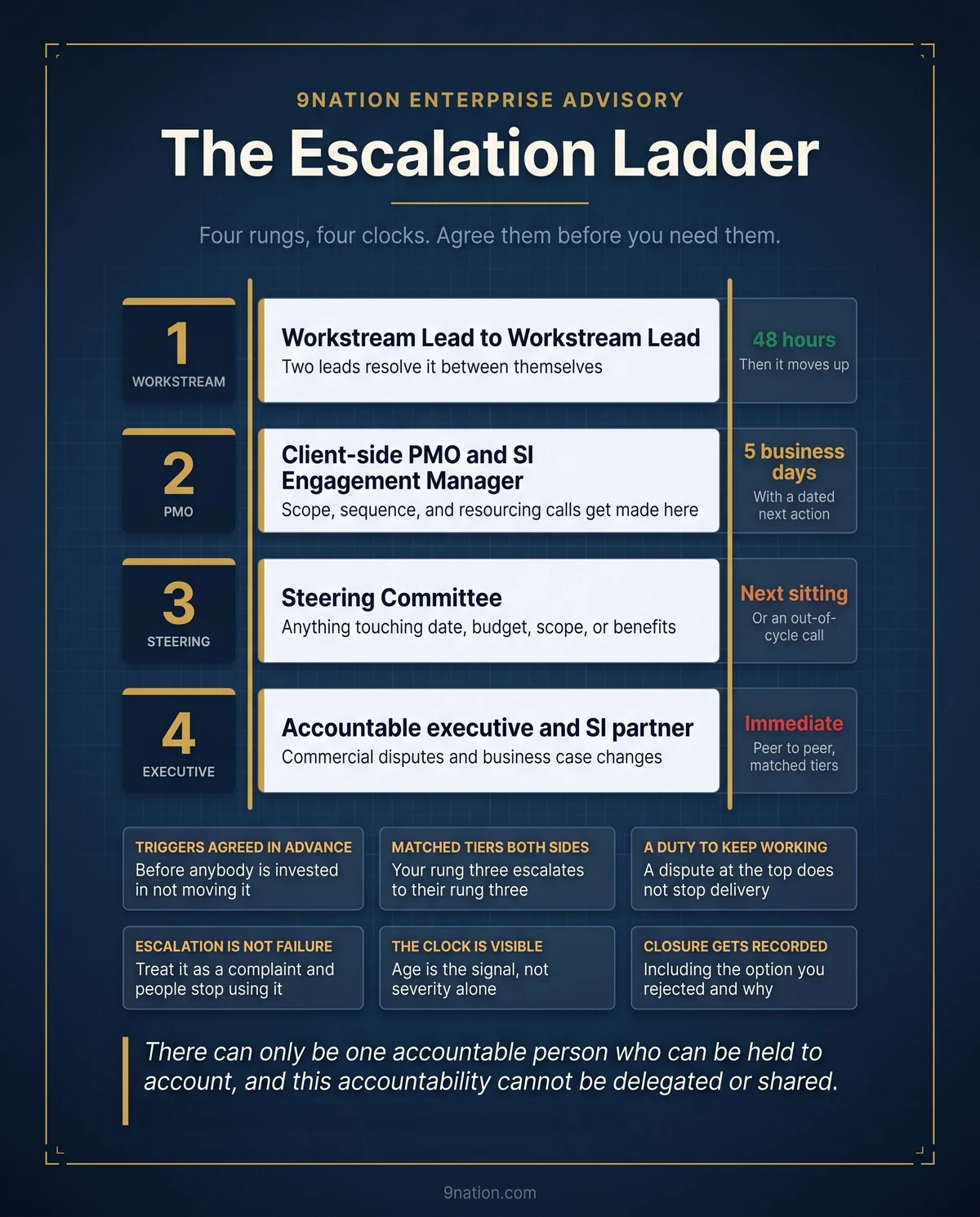
UK government guidance on the senior responsible owner states it flatly: there can only be one accountable person who can be held to account, and this accountability cannot be delegated or shared. The same guidance makes the SRO the owner of the business case and accountable for all aspects of governance, and notes they remain accountable after the program ends.
Governance is the mechanism by which the investing organization exerts financial and technical control over the deployment of the work.
Association for Project Management, Body of Knowledge
The investing organization is you. The supplier only delivers the work. The control belongs to you.
| Topic | The SI PMO | The client-side PMO |
|---|---|---|
| The plan | Plans the implementer's contracted tasks | Owns one integrated plan covering both sides |
| Risk | Logs risk and flags dependencies on the client | Drives mitigation to closure and owns escalation |
| Done means | The deliverable was accepted | The business outcome was achieved |
| Scope | Change orders protect their commercial position | Challenges scope and tests necessity |
| Reporting | Against contracted scope | On business goals, including bad news |
| A blocker | Escalates it and keeps moving | Owns getting the decision made |
| At go-live | Knowledge leaves with the team | Capability stays in your organization |
- PlanStand upStand up the office, one plan, first honest status
- ArchitectBaselineBaseline jointly, agree change control
- ConfigureControlChase decisions, hold the integration points
- TestProveProtect the window, prove readiness
- DeploySustainOwn cutover, then own the benefits
The lever
Write the client-side PMO into the program org chart and the budget before the implementer mobilizes. The first slipped milestone is too late to start.
Section 3 · The five duties
Five things somebody has to own end to end
Strip away the tooling and the templates and the job comes down to five accountabilities. Read as a list they look administrative, but each one is the point where a specific failure mode gets caught.
End-to-end delivery execution
Accountable for day-to-day delivery across all workstreams, and for meeting the milestones as well as tracking them.
LeverName the owner before the implementer mobilizes.
Integrated plan ownership
Owning, managing and updating one program plan for the duration, feeding the client's own activities into it and baselining it jointly with the implementer's engagement manager.
Without itNobody sees the cascade.
LeverRefuse a Client Readiness summary bar.
RAID ownership
Owning the risk, assumption, issue and dependency log, and driving mitigation and escalation instead of keeping a record.
Without itRisks age without anyone noticing.
LeverIn the review, look at the trigger before the wording.
Workstream coordination
Keeping functional, technical, change, data and testing leads aligned, integrated and delivering to plan.
Without itIntegration problems surface during testing.
Lever15 minutes per lead, per week, no audience.
Status reporting
Producing and delivering the weekly report to program leadership, and holding a weekly check-in with every workstream lead.
Without itThe steering committee can't act while acting is still cheap.
LeverReport last week, this week and next week.
Section 4 · One plan
Two plans means you don't have a plan
If your activities and the implementer's live in different plans, what you have is two forecasts that have never been tested against each other.
The integrated plan is the most useful artifact the client-side PMO owns, and the one most often fudged. Nearly every program has something called an integrated plan. Fewer have one with client tasks at the same level of detail as implementer tasks, real dependencies between them, a genuine critical path and a baseline both parties signed.
Client activities go in at working detail. Data cleansing, policy decisions, security role sign-off, legal review, backfilling the people you seconded to the program, communications, training delivery, environment access. These are your tasks. If they appear as one summary bar called Client Readiness, the plan can't compute anything useful.
It's baselined jointly. The client-side PMO and the implementer's engagement manager agree the baseline together. It's an uncomfortable conversation and worth having, because that's where the assumptions each side has been carrying get said out loud.
It's change controlled. A plan that gets redrawn every time something slips is a record of optimism. The UK National Audit Office lists the warning signs of an unrealistic schedule. In each of them the plan bends to protect a date:
- Persistent re-planning to meet the same deadline
- Removing scope
- Shortening test windows
- Staging the go-live at the last minute
This matters more than it sounds because of interdependency. Research on 5,392 IT projects found cost overruns follow a power-law distribution with a fat tail, and proposed the mechanism: a problem in a single component triggers chain reactions through interdependent components. The authors put it starkly. The average cost overrun for IT projects does not exist and cannot be calculated. Your contingency is a guess against a distribution with no meaningful average. The only defense is seeing the chain before it fires, and you can't see a chain that spans two plans.
Section 5 · RAID
A risk log records. A RAID process manages.
A RAID process is a management system with owners, dates and escalation triggers. Programs fail with tidy logs.
Every program has a RAID log. Most of them are parking lots. Items get raised, assigned to a workstream, given a mitigation sentence and then reviewed in a meeting where the update is that it's being worked.
The outcomes sit in the difference between logging and driving. A study of risk management maturity found the least mature attribute across organizations was risk analysis: they record risks and skip the thinking. The NAO makes the program-level version of the same point, criticizing organizations for focusing on individual project risks instead of stepping back to assess the totality of risk facing the program.
Its worked example is instructive because it looks like success. On a major UK defense program the team had tracked progress, monitored risks and identified interdependencies. A radar subsystem still landed 18 months late, because the department didn't oversee its contract with the supplier effectively and wasn't aware of the subcontractor's lack of progress until it was too late. The dependency had been on the register the whole time.
- A named human owner who can be asked what happened this week. A workstream can't be asked.
- A mitigation with a date and a next action. "Monitor" doesn't count. The test is whether you can say what will be different by Friday.
- A pre-agreed escalation trigger, decided in advance so nobody has to make the judgment call at the moment everybody is most invested in not making it.
- Dependencies managed as commitments between named people, with both names and a date.
- Assumptions with expiry dates. The A in RAID is the one everybody skips, and planning assumptions turn into facts without anyone deciding they should.
Escalation matters because delay compounds mechanically. Research on large projects found that each year of delay after the decision to build adds 4.64 percentage points to cost overrun. The same body of work found 9 out of 10 projects have cost overrun, and estimates haven't improved across the 70 years studied.
- 1Workstream lead to workstream leadWithin 48 hours
- 2Client-side PMO and SI engagement managerWithin 5 business days
- 3Steering committeeNext sitting, or an out-of-cycle call
- 4Accountable executive and SI partnerImmediately
Agree the rungs before you need them. Deciding what warrants escalation in the moment it's needed is how issues age. The ladder works when the triggers are agreed in advance, the tiers match on both sides, everyone has a duty to keep working while it climbs, nobody treats escalation as failure, the clock is visible and closure gets recorded.
The lever
Give every open risk a named owner, a dated next action and a pre-agreed escalation trigger. In the review, look at the trigger before you look at the wording.
Section 6 · Workstreams
Integration problems are cheap in a workshop and expensive in test
The weekly lead check-in is the mechanism that moves them earlier.
Workstream coordination sounds like scheduling. In practice it's the early warning system, and it works because problems between workstreams show up in conversation weeks before they show up in a deliverable.
The structure that works is unglamorous:
| Weekly | A standing check-in with each lead, individually |
|---|---|
| Weekly | An integration point with the leads in the same room |
| Monthly or at each stage gate | A readiness review with real criteria |
The individual check-in is the part people cut first and should cut last. In a group setting, a lead who's behind will describe the position carefully. One to one, with 15 minutes and no audience, the same person will tell you what's actually happening. None of this is a character flaw. Research on status reporting shows the effect is structural: the stronger the perceived power of the sponsor or project leader, the less inclined subordinates are to report accurately, and the greater the power distance between the reporter and the recipient, the greater the level of misreporting.
The integration points that matter recur on every program.
- Data to functional. Configuration decisions change what the data has to look like, and data leads find out late.
- Functional to technical. A configuration choice made to avoid a workaround creates an integration change nobody costed.
- Testing to everything. Test scenarios expose process assumptions that have been baked in for months.
- Change to functional. Training built on a moving design teaches the wrong thing.
- Security to everything. It's chronically late, because it depends on final design and gates testing.
Section 7 · Status
Status that tells the truth
Status reporting is the sensing mechanism your leadership uses to act while acting is still cheap, and it's systematically biased toward good news.
It's the accountability that looks softest and matters most, because everything else in the handbook is worthless if what reaches the steering committee is wrong.
The bias has been measured. Researchers reviewed the records of 56 experienced software project managers and found project managers write biased reports 60% of the time, with bias more than twice as likely to be optimistic as pessimistic. The same body of work names five uncomfortable findings. One is worth sitting with: putting a senior executive in charge of a project may increase misreporting. Another is that executives often ignore bad news when they receive it. There's a documented mum effect (reluctance to pass bad news up) and a documented deaf effect (refusal to act on it once it's passed).
- Selective highlighting
- Accurate information is reported in a way that makes it hard to find.
- Reclassifying
- Uncompleted work moves into a newly created phase two so the current phase can close.
- Redefining deliverables
- The release schedule holds while the functionality inside each release shrinks.
- Working with the labels
- Work is packaged just below the threshold that triggers oversight.
None of that requires anyone to lie. Every individual statement stays true.
There's a second force underneath. HM Treasury instructs UK government appraisers to apply optimism bias uplifts to project estimates. For equipment and development projects, the category that covers ICT and software, the upper-bound uplift on capital expenditure is 200%. The guidance says to start with the upper bound and reduce it only where mitigation is demonstrably evidenced and independently verified. A government treasury tells its own people to assume the technology estimate could be wrong by a factor of three.
- A RAG written down before you need it, so the color reports criteria instead of a mood.
- Movement as well as position. A milestone that's been 90% complete for 3 weeks is the most useful signal in program reporting, and a position-only report hides it completely. Between 30% and 40% of IS projects show some degree of escalation, and the theory that best explained the pattern was the completion effect, the pull of a finish line that looks close.
- The decisions you need, with dates.
- Named risks with named owners, instead of a count.
- What changed in the plan and why, so re-planning can't become invisible.
Then there's the cultural half, which no reporting format can fix. The research found that trust in the supervisor had the strongest and most significant effect on a project manager's willingness to expose a challenged project. When trust is low, adding aggressive auditing may produce more misreporting. If the first red is met with a search for who's at fault, the second red arrives much later and much redder.
| Symptom | Fix |
|---|---|
| The plan | |
| Client tasks live in a separate spreadsheet from the delivery plan. | One plan, both sides at working detail, with real cross dependencies. |
| Client work shows as a single summary bar called Client Readiness. | Break it into extract, cleanse, validate, reconcile and sign off, each dated. |
| Nobody can explain the critical path without opening the file. | Test it by asking what has to be true for the next milestone to land. |
| The plan is redrawn each time something slips, to protect the date. | Make every re-baseline visible, dated and explained to the steering committee. |
| RAID | |
| Risks are assigned to a workstream instead of a named person. | Assign a person. A workstream can't be asked what happened this week. |
| The mitigation has read "monitor" or "working with vendor" for 3 weeks. | Write a dated next action you can describe as different by Friday. |
| What warrants escalation gets decided in the moment escalation is needed. | Pre-agree the trigger, before anybody is invested in not pulling it. |
| Planning assumptions were captured once and never revisited. | Give each one an expiry date, then convert it to a risk when it lapses. |
| Cadence and status | |
| One weekly group status meeting is the only forum with the leads. | 15 minutes per lead, one to one, no audience. |
| A workstream has reported 90% complete for three reporting cycles. | Report movement: last week, this week, next week. |
| Green means whatever the reporter feels comfortable saying that week. | Write the RAG criteria down before the first report goes out. |
| The first red was met with a search for who was at fault. | Make the first red a non-event, or the second one arrives much later. |
Section 8 · First 90 days
The PMO earns its authority in the first 90 days
It does that mostly by producing one plan and one honest status that people trust.
Days 1 to 30Establish the facts
- Read the business case, the statement of work and the delivery method.
- Find out what the implementer has actually committed to and what they've assumed you'll do.
- Meet every workstream lead individually.
- Get the plan into one place, even if the first version is ugly.
- Stand up the RAID log with real owners.
- Publish the first status even if it's thin. The cadence starts on day one, and cadence is the thing that becomes normal.
Days 31 to 60Establish control
- Baseline the integrated plan jointly with the engagement manager.
- Agree change control for both plan and scope.
- Set the governance calendar: weekly leads, weekly integration, monthly steering.
- Define RAG criteria and escalation triggers in writing.
- Agree the decision log, and how a decision gets made when the meeting doesn't produce one.
- Test the critical path by asking what has to be true for the next milestone.
Days 61 to 90Establish the drumbeat
- Run the cadence until it's boring.
- Close the first cohort of risks so people see the log means something.
- Take the first real issue through escalation and back, so the mechanism has been proven.
- Run a stage-gate readiness review with real criteria.
- Look ahead two stages and start the work with a long lead time, usually security roles, environments and data.
The staffing question comes up immediately, and the benchmark is more forgiving than most people expect. PM Solutions found the median PMO operating cost sits at about 3% of the value of the portfolio it supports, roughly unchanged over a decade. Experience is what separates the high performers from the rest.
On-budget improvement
Project management experience of PMO staff
There's also a cost the client side routinely forgets to count. A US audit of a federal modernization program found the cost estimate considered work in the contractor's performance work statements but left out government and system operations costs, and concluded that a cost estimate missing cost elements will underestimate the total. The client costed the implementer's work and forgot to cost its own.
Section 9 · Capability
A program PMO delivers a program. A capability outlives it.
The difference is whether anything is left in the building at go-live.
Most client-side PMOs are stood up for one program and dissolved at hypercare. That's a choice, and often a defensible one. Make it deliberately, though, because the alternative is worth real money. The capability view has nine blocks, and all nine sit inside one loop.
- Governance
- Documented authorities and a decision management method
- PM best practices and tools
- Repeatable capability producing predictable outcomes
- Training integrated with HR
- Growing intellectual capital
- Reporting, analysis and trending
- Assembles into a portfolio view
- Operations
- A centralized, repeatable service set
- HR competency management
- Anticipating resourcing needs before they bite
- Strategic sourcing
- Using PMO scale and partnerships
- Community of interest
- Developing project management as a discipline
- Information and knowledge management
- A sustainable framework for what the program learns
For a single program, the classic project management function map still works as a checklist. Each area has its planning, execution and control processes. It's a poor outline for an article and an excellent test for a PMO charter. Run down the list and ask who owns each one on your program. The gaps are usually procurement, quality and communications, and they're usually assumed to belong to somebody else.
- Integration
- Scope
- Time
- Cost
- QualityUsual gap
- Human resources
- CommunicationsUsual gap
- Risk
- ProcurementUsual gap
Maturity is where the evidence gets thinner. Research on maturity models and delivery outcomes is limited, and the studies that exist are largely qualitative. One multiple case study of OPM3 found a positive contribution to project performance in scope, schedule, cost and stakeholder communication. It also noted openly that little evidence exists in the academic literature on the impact of maturity models on project performance. Maturity models are useful as a structured conversation about what's missing. No published effect size backs them as a lever, and anybody who tells you otherwise is selling an assessment.
Capability retention is what does have evidence behind it. The NAO, having assessed over 350 government commercial arrangements across two decades, expects knowledge and experience of underlying contract issues to be retained throughout the lifecycle of the relationship. Its case study is a nuclear decommissioning contract terminated 9 years early. The client commissioned a review specifically to improve its intelligent client capability, and strengthened its commercial and contract management team before changing the contracting arrangements. It had to rebuild the client side before it could fix the supplier side.
Section 10 · Program types
The five accountabilities hold across every program type
What changes from one type to the next is the integration points and the failure modes.
- CRM programs
- They fail on adoption more than on configuration. The system works and the sales team keeps its real pipeline somewhere else. Adoption measures belong in the plan as milestones with dates, where a change management workstream running alongside can't hide them. Data quality moves from a conversion problem to a permanent operating problem, because nobody trusts a CRM with 10% duplicate accounts, and a CRM that isn't trusted isn't used.
- HCM and payroll programs
- They carry a hard external calendar. Payroll parallel runs are pass or fail against reality, and the fiscal or tax year doesn't move. The plan is far less negotiable at the back end, which means slack has to be found early or not at all.
- Finance transformation
- It lives on the close calendar and on reconciliation. Reporting is the visible surface, and reporting requirements arrive late and multiply. Nailing the reporting inventory early is the highest-value planning act.
- Custom development and platform programs
- They carry interdependency risk in its purest form, where one component's problem cascades. Interfaces are the risk surface. The client-side PMO's contribution is insisting that integration testing gets a real window of its own, so it isn't squeezed into the gap between build and go-live.
Two things stay constant across all of them. The implementer is scoped to their contract, and the value is realized on your side after they leave.
Somebody has to run yours
Your implementer will run their machine well. That's what you hired and, in most cases, that's what you'll get. The question that decides your outcome is whether anybody is running yours.
The evidence converges from every direction. Accountability can't be delegated or shared. Governance is the mechanism by which the investing organization exerts control. After reviewing hundreds of contracts, the UK's national auditor recommends departments strengthen their intelligent client function. It defines that as an in-house capability that can monitor, challenge and verify what the supplier does, with the explicit warning that it needs adequate capacity to be resourced. Where that capability is thin, audit bodies find governance boards that don't meet, business cases never completed and cost estimates missing the client's own costs.
Three questions for your next steering committee
- Does one person own an integrated plan that contains both sides at working detail?
- Who challenges the implementer's estimate, and are they resourced well enough to do it credibly?
- When the status is green, do you know what would have to be true for it to be red?
If those answers are uncomfortable, that's useful information, and it's much cheaper now than at test.
Sources. External figures are drawn from McKinsey with the University of Oxford (2012), Gartner, BCG (2020), Panorama Consulting (2026), the UK Government Project Delivery Function guidance on the senior responsible owner (2025), the Association for Project Management Body of Knowledge, the UK National Audit Office (2020, 2021, 2025), HM Treasury Green Book supplementary guidance on optimism bias, Flyvbjerg and colleagues in the Journal of Management Information Systems (2022), Keil and colleagues in MIT Sloan Management Review (2014), Keil, Mann and Rai in MIS Quarterly (2000), PM Solutions (2022), and the US Government Accountability Office (2025). Field examples are drawn from real, fully anonymized enterprise programs.
The client-side PMO toolkit, ready for your first 90 days.
A first 30, 60 and 90 day stand-up checklist, plus a pitfall-by-pitfall quick reference across the plan, RAID, workstream cadence, status and governance. Built to bring straight into your first week.
Put an experienced owner on your side of the program.
If you're about to commit to a major ERP, CRM or transformation program, the client-side PMO is the role that decides whether you get what you paid for.