
Bill of lading
Supply chain · SCM modules
Implementing supply chain ERP modules: a CSCO and VP Supply Chain guide
A supply chain go-live is a physical event. When it goes wrong, you can't ship, and customers feel it the same week. 10 modules, the decisions that decide the date, and an honest read on AI.
1 Shipper
The integrator
Executes the build and gets paid on milestones.
2 Consignee
Operations
The plants, the DCs and the floor. The decisions are theirs.
3 Notify party
Customers and suppliers
Told about the cutover window early, because it threatens order fill and revenue.
4 Port of loading
Legacy systems
5 Port of discharge
Go-live
6 Carried by
The cutover and the first shipments
7 Special instructions
A supply chain go-live is a physical event. You often stop receiving and shipping, count inventory and restart operations. Own the operational decisions, govern the master data, and treat the cutover and the first shipments as the real go-live.
9 Claim on file, 1999
A candy company couldn't ship its own product for Halloween. Hershey had gone live with a new integrated system right as orders poured in, and the order fulfillment breakdown that followed cut quarterly sales by more than 12%. The software worked. It was the cutover that failed.
- Quarterly sales
- down 12.4%
- Halloween orders
- missed
- Record
- SEC filings
10 Nature of goods
Supply chain ERP programs fail in the same places: master data, cutover, and the handshakes to warehouses, carriers and trading partners that nobody counted.
Unlike a finance or HR go-live, when this one breaks you can't ship. The revenue hit lands the same week, in full view of customers. Gartner still expects more than 70% of ERP initiatives to fall short of their goals by 2027, and in a supply chain that shortfall shows up as missed shipments. The cautionary tales are public. The field notes are mine, anonymized.
11 Declared value
What's really on the line
The history reads like a warning label. Nike lost more than $100 million in sales and watched its stock fall roughly 20% after a demand planning system misfired. Lidl walked away from a 500 million euro program after 3 years. Revlon told the SEC an ERP go-live left it unable to fulfill about $64 million of shipments and produced a material weakness in its financial controls. None of those were really software failures.
The ground keeps shifting under you, too. Shocks are now a standing cost of running a supply chain, and the system you put in has to help you run through them.
Disruption, per McKinsey
3.7 yearsbetween supply chain shocks lasting a month or more, for the average company
~45%of one year's profits, what disruptions cost over a decade
30 to 50%of a year's earnings, wiped out by one severe 100-day shock
Handling instructions
Put the operations and planning leaders on the steering committee with named accountability from week one. The team that runs the warehouses and plants has to own the go-live plan outright.
12 Routing
Pick the deployment shape, and respect the physical risk
A big-bang flips everything on one date. It's faster and cheaper, with no fallback. A phased approach goes site by site, which contains the blast radius but means running two worlds in parallel for longer. For supply chain, three things decide it: how many plants and DCs you run, how much you can afford to stop shipping, and how complex your trading partner network is.
Nike is the instructive recovery. After its planning failure, it rolled SAP out by geography on successive quiet weekends, Canada first as a small slice, then the rest, and reported no disruption from the staged rollouts.
Routing factors
| Factor | Points to |
|---|---|
| Number of plants and DCs | Phased |
| Cost of stopping shipping | Phased |
| Trading partner network | Phased |
| Speed and budget pressure | Big-bang |
Handling instructions
Sequence waves by network complexity, and take one hard site early so the expensive lessons are cheap to reuse. Don't let the program run so long it never lands: every extra year on a large program adds about 15% to the overrun.
13 Contents and labeling
Master data is the foundation, and the usual cause of failure
Item, supplier and BOM data feed planning, inventory and orders. Bad master data doesn't fail loudly on day one. It quietly misroutes product and miscalculates replenishment at scale.
Target Canada is the definitive cautionary tale. An internal review found an astounding number of errors in the item data. Product wouldn't fit the shipping containers or the shelves, while the replenishment logic kept executing on corrupt data. The result was the paradox that defined the failure: full warehouses and empty shelves. Target lost billions and exited the country.
Item data defects found
- Dimensions entered in inches instead of centimeters
- Dimensions entered in the wrong order
- Wrong currency
- Missing tariff codes
Handling instructions
Stand up a data governance body before configuration starts, with named owners for the item and supplier master. No item goes live until it passes the enrichment and approval workflow.
From the field
The dirt is worse than discovery admits. On a recent program, 10% of the active records were duplicates or carried data that contradicted physical reality. That surfaced in profiling. The demo never showed it. Clean at the source before the first load, and keep cleaning through every cycle.
14 Description of goods
Ten modules, and almost every one ends at a seam
Each module has a handful of decisions that decide whether it works. Almost every one ends at a seam: order to warehouse, warehouse to carrier, or a feed to an outside trading partner.
1
Item and product master
The single definition of everything you buy, make, move and sell. A buy-in-cases, stock-in-eaches mismatch is the classic unit of measure failure.
- Organization and master-child hierarchy
- Item classification
- Units of measure and conversions
- The governance workflow
- Legacy items loaded with no de-dup
- Confusing an item organization (no stock) with an inventory organization (holds stock)
4 get right
2 watch
Marks Oracle auto-assigns master-level items to child organizations under a master org. SAP drives field selection from the material type.
2
Procurement and sourcing
Requisition to PO to receipt to pay, plus sourcing and contracts.
- Catalog coverage
- Approval routing that matches your delegation of authority
- The link from negotiated price to the PO
- Thin catalogs that drive maverick spend
- Punchout integrations that slip, because each one is a supplier-by-supplier build
3 get right
2 watch
Marks Oracle uses content zones, with punchout loaded via CIF or cXML. SAP carries source of supply in the info record, source list and outline agreements.
3
Supplier management
The supplier lifecycle: onboarding, qualification, risk, performance and the portal.
- The relationship gate before a supplier can receive spend
- Qualification design and re-qualification cadence
- Risk and diversity tagging
- Qualify once and forget
- Duplicate records that fracture spend analytics
3 get right
2 watch
Marks Oracle gates suppliers as prospective or spend-authorized. SAP models the supplier as a Business Partner.
4
Inventory management
What stock exists, where it sits, what it's worth and how it moves.
- Storage structure
- Receipt routing
- Valuation and costing method
- Lot and serial control
- Counting policy
- The wrong valuation method for the material class
- Over-broad serialization that slows the floor
5 get right
2 watch
Marks Oracle separates storage from receiving subinventories, with Standard, Direct or Inspection routing. SAP posts every movement with a movement type and values stock by price control.
5
Order management
Capture the order, price it, promise it and orchestrate fulfillment.
- Availability and promising rules
- The pricing engine
- The orchestration flow
- Back-to-back and drop-ship setup
- Treating available-to-promise as a switch when it's a policy, which makes every promise date optimistic
4 get right
1 watch
Marks Oracle runs Global Order Promising. SAP uses Advanced Available-to-Promise, with a Release for Delivery step for constrained stock.
6
Warehouse management
The physical work inside the four walls: receive, put away, pick, pack and ship. Design the RF flows around how pickers actually walk the floor, or adoption dies.
- Wave and task design
- Putaway and slotting
- Cycle counting
- The RF flows
- The staging-to-ship-confirm handshake
- Wave rules that create too much travel
- Slotting copied from a template when it should come from real velocity
5 get right
2 watch
Marks Oracle releases work as a pick wave. SAP EWM groups deliveries into waves and warehouse tasks.
7
Transportation management
Turn shipments into the cheapest compliant transportation plan, then execute and settle.
- Network and lanes
- Rate master data
- Carrier selection logic
- Freight settlement
- Dirty rate data that makes optimization confidently wrong
- A settlement loop that never closes, so savings leak back at the invoice
4 get right
2 watch
Marks Oracle Transportation Management plans shipments and rates carriers. SAP TM builds freight units into orders and picks the lowest-cost carrier per lane.
8
Manufacturing and production
Turn a demand signal into a released work order, tell the floor what to build, and record consumption back to inventory and cost.
- BOM and routing accuracy
- The discrete versus process decision
- The material consumption method
- The supply orchestration flow
- Garbage BOM data, which produces confident wrong plans and costs
- Over-backflushing, which leaves the floor clean and the inventory records fiction
4 get right
2 watch
Marks Oracle combines BOM and routing into a Work Definition. SAP keeps them separate and brings them together in the production order.
9
Demand and supply planning
Produce the forecast, turn it into a feasible plan, and run the S&OP cadence that commits one number.
- Clean demand history and hierarchies
- S&OP roles and cadence, settled before the tool
- Supply constraints
- A single source of the number
- Buying a planning tool to make up for dirty ERP data
- Implementing the tool and skipping the decision cadence
4 get right
2 watch
Marks Oracle Demand Management and Supply Planning cover this natively. SAP IBP and best-of-breed options like Kinaxis and o9 add scenario speed at the cost of an integration layer.
10
Cost management
Value inventory and work in process, apply the costing method, capture landed cost and hand the accounting to the general ledger.
- Costing method per book
- Standard cost and rollup
- Landed cost as a real workflow
- Subledger-to-GL reconciliation
- Stale standards that turn every transaction into a variance
- Landed cost expensed when it should be capitalized, which understates inventory value
4 get right
2 watch
Marks Oracle layers cost organization, cost book and valuation structure. In SAP S/4HANA the Material Ledger is mandatory, even with actual costing off.
Handling instructions
Insist the implementer configure each module to your policies. Your valuation methods, matching tolerances and promising rules are where the value and the risk live, and the demo defaults know none of them.
From the field
No owner, so the loads kept failing. On one program, item and supplier loads kept failing during conversion. The software was fine. No single person owned the validation rules across the modules, so every team assumed another had it. We named one owner, put a date on each item, and the failures stopped. The fix cost nothing.
15 Loading sequence
Convert the data, then count the warehouse
Supply chain conversion is harder than finance conversion because you reconcile to physical inventory as well as a trial balance. On-hand has to tie out by unit and by dollar, at every location. Load in dependency order, so each load lands on the ones it needs.
- 1Item master
- 2BOMs and routings
- 3Supplier and customer data
- 4Open POs
- 5Open sales orders
- 6On-hand by location, lot and serial
- 7In-transit
Sealed by the physical count
Reconcile with rigor. On-hand has to match the physical count by record, by unit quantity and by financial value, per location. Run several mock conversions, and treat the cutover physical count as the bridge between the converted balance and live operations.
Conversion decision: opening balances or full history
| Option | Opening balances plus open items the default | Full history rare |
|---|---|---|
| Loads | Current on-hand, open POs and orders, item master | Years of transaction and movement history |
| Risk | Faster, cleaner, reconciles to the count | Slow, error-prone, a huge reconciliation surface |
| History | Stays in an accessible archive | Lives in the new system, and you'll need a real reason to justify it |
Handling instructions
Set a numeric conversion gate: named owners per data domain, on-hand reconciled to the unit and the dollar, and a maximum exception count before go-live is approved. Make it a go or no-go criterion.
16 Dock hold
You usually can't ship during the cutover, so the freeze is the plan
The cutover is the riskiest part of a supply chain program, because you usually can't ship during it. Most cutovers enforce a blackout. Tell customers and suppliers about the window early, because it directly threatens order fill and revenue.
The blackout, in order
- Receiving and shipping stop, or run under tight control
- Open work is cleared
- Final data loads
- The physical count validates it
- Controlled execution resumes

Rehearse the cutover at least twice, once early for sequencing and once late for real timing. Then expect a ramp. History shows revenue can take a hit for months after an enterprise go-live, so plan the ramp-down and ramp-up of order volume and don't count on full speed on day one.
Release for go-live
Make "the physical count reconciles and the loads run clean" the gate. Before the production load runs, confirm the count is done, the loads run clean and configuration is loaded. Then decide go or no-go, with a command center staffed by named owners.
- Count done
- Loads run clean
- Configuration loaded
- Go or no-go decided
- Inventory owner
- Warehouse owner
- Transportation owner
- Trading partner interfaces owner
17 Transfer points
The integration footprint is bigger than the story
A supply chain core never stands alone. It talks to WMS, TMS, MES, e-commerce, tax, banks, and every supplier, carrier and 3PL by EDI. Three seams cause more slippage than any single module: order to warehouse, warehouse to transportation, and EDI to the outside world. Map every standard transaction to a system owner and a partner, and test with real partner data.
The number that surprises leaders is the lead time. A simple EDI partner runs about 10 to 14 days to first live transaction. With ERP integration in the loop, it stretches to roughly 60 to 90 days per partner. Multiply that by your high-volume partners and trading partner enablement becomes the path to go-live, ahead of the ERP config.
Standard transactions on the seams
| 850 | Purchase order |
| 856 | Advance ship notice |
| 940, 945 | To a 3PL |
| 204, 214, 210 | To carriers |
Days to first live transaction, per partner
From the field
50 on paper, 90 in reality. Discovery listed 50 integrations. The real number was closer to 90 once we mapped every handshake to suppliers, carriers, 3PLs and downstream systems, and the plan had been built on the wrong number from day one. Rate each one by criticality and cutover timing, and treat the close-critical ones as their own mini projects with owners on both sides.
18 Restricted cargo: AI
What AI actually does in supply chain today
AI in supply chain is real for forecasting, exception triage and optimization. Autonomous action on inventory and orders mostly still waits on a human, and for good reason: the ceiling is your master data. Most generally available capability today is advisor grade. It summarizes, recommends and drafts, and a human executes. Oracle shipped SCM advisor agents in late 2025. SAP is building an autonomous supply chain across 2026. The planning platforms (Kinaxis, Blue Yonder and o9) have shipped agentic features with human-in-the-loop guardrails by design.
The adoption data says be selective.
Adoption, per Gartner and MIT
Inspection: where supply chain AI earns its keep today
| Use | Status |
|---|---|
| Demand forecasting and anomaly explanation | Real today |
| Procurement spend analysis and sourcing | Real today |
| Warehouse robotics and labor optimization | Real today |
| Logistics and route optimization | Real today |
| Autonomous control towers that act without a human | Heldstill mostly a promise |
| Agents committing inventory on untrusted data | Heldstill mostly a promise |
| A self-correcting, unattended plan | Heldstill mostly a promise |
| End-to-end autonomous order fulfillment | Heldstill mostly a promise |
Where AI pays, McKinsey estimates AI-enabled operations can cut logistics cost 5 to 20%, inventory 20 to 30% and procurement spend 5 to 15%. Tariffs made this urgent. As of late 2025 the US average effective tariff rate hit 16.8%, the highest since 1935, and it moved in days. The real AI value here is scenario modeling: tariff-adjusted landed cost across a few weighted scenarios, and fast network and supplier redesign. The honest gap is that most organizations can size the exposure in days but still take weeks to align a response.
Where AI pays: cut, per McKinsey
Handling instructions
Scope "assistant" versus "agent" honestly in the contract. Turn on the embedded AI now, use the vendor's native capability over a custom build, and require a named human checkpoint for any action that moves inventory, orders or money.
19 Mode of carriage
Planning native or best-of-breed is the strategic call in the program
Native is simpler, cheaper and tightly coupled to execution. Best-of-breed wins when network complexity, scenario speed or a multi-ERP estate exceed what the ERP planner handles, and it costs you a heavier integration layer. The wrong reason to buy best-of-breed is dissatisfaction that's really a master data or process problem.
The number behind the planning investment comes from the E2open benchmark study: the typical demand forecast is about 51% accurate, with 49% error. With a forecast only about half right, the value is in how fast you sense and respond.
Demand forecast accuracy, E2open
Architecture decision
| Measure | Native ERP planning | Best-of-breed planning |
|---|---|---|
| Fits | Simpler networks, tight execution coupling | Complex global networks, fast what-if, multi-ERP |
| Cost | Lower, one platform | Higher, plus a real integration layer |
| The trap | Outgrowing it on complexity | Buying it to mask dirty data |
Handling instructions
Decide the planning architecture early and govern it. If you go best-of-breed, staff the ERP integration as a first-class workstream and name which system owns which number.
20 Proof of delivery
Adoption happens on a mobile gun, mid-shift, with targets still running
Plant and DC adoption is the hardest in the enterprise, and it's where the value is won or lost. Nike is the proof in both directions. The big-bang planning failure cost more than $100 million in sales and a 20% stock drop. The recovery ran on adoption mechanics: 140 to 180 hours of training per user, a lockout that kept people off the live system until they finished, and rollouts staged by geography on quiet weekends. It was slower on the calendar and faster to value.
Governance decides the rest. The cleanest recent turnaround put a business executive in charge, gave the program lead a direct line to the C-suite, and tied a third of the integrator's fee to milestone delivery. The rule that carries over: the business owns the config decisions and the named data owners, while the integrator executes and is held to milestone-gated payment.
Delivery measures
| Measure | Baseline | Review |
|---|---|---|
| Perfect order fulfillment | to set | Monthly |
| On-time-in-full (OTIF) | to set | Monthly |
| Cash-to-cash cycle time | to set | Monthly |
| Inventory turns | to set | Monthly |
| Inventory accuracy | to set | Monthly |
| Forecast accuracy | to set | Monthly |
The SCOR standard's measures, plus inventory accuracy.
$100M+in lost sales from the big-bang planning failure
20%stock drop that came with it
140 to 180hours of training per user in the recovery
Handling instructions
Attach the business case to named KPIs with a baseline and a cadence, and review them monthly. When the timeline gets tight, protect the frontline training budget.
21 Exceptions
The red flags to run before every gate review
| Ref | Exception noted | Remedy |
|---|---|---|
| Master data and conversion | ||
| A | Bulk-loading legacy master data to clean up later | Govern it first: named owners, enrichment before go-live |
| B | Conversion reported green, but on-hand doesn't tie to the count | Reconcile to the unit and the dollar, per location |
| Cutover and integrations | ||
| C | Cutover is a weekend task list owned by IT | Run it as an operational event: freeze, count, gate, restart |
| D | EDI and 3PL onboarding started late | Start EDI early, since it runs 60 to 90 days per partner |
| Planning and AI | ||
| E | A planning tool bought to mask dirty ERP data | Fix the master data first, and decide native or best-of-breed on need |
| F | An autonomous AI agent on the critical path | Keep a human on every action that moves stock |
| Config, adoption and governance | ||
| G | Modules built to demo defaults | Configure to your tolerances and promising rules |
| H | Frontline training is a slide at the end | Fund it as a workstream, because the floor has to trust the system |
| I | The program lead doesn't report into operations | The business owns the decisions, and the SI fee is tied to milestones |
22 Received
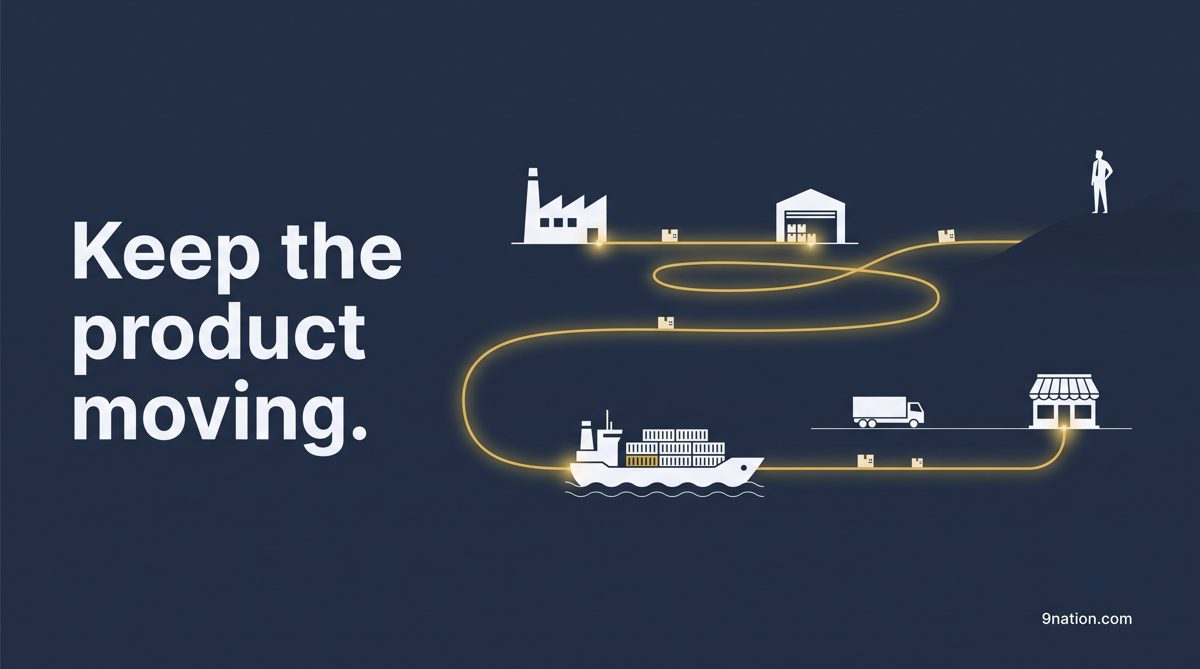
Keep the product moving
A supply chain ERP program is a sequence of decisions that belong to operations: which modules, in what order, on what master data, converted to what standard, cut over how, and adopted how. Make those calls early, govern the data, and treat the cutover and the first shipments as the real go-live.
The vendors are capable and the implementers are skilled. What they can't do is decide how your supply chain should run, or make the floor trust the system.
Attached
Implementing finance ERP modules, implementing HCM and HR ERP modules, implementing payroll, and data conversion and integrations.
Sources. External figures synthesize public research and documentation from Gartner, McKinsey and the University of Oxford, the E2open benchmark study, ASCM SCOR, TrueCommerce, the SEC filings and CIO reporting on the Hershey, Nike, Target Canada, and Revlon programs, and Oracle, SAP, and Workday product documentation. AI capability claims cite Oracle, SAP, Kinaxis, and o9 announcements plus Gartner and MIT research. Field examples are drawn from real, fully anonymized enterprise programs. This article is general guidance, not legal or accounting advice.