
This article has a companion poster: The Workday AI Agents Guide, Illuminate, the agent loop, the six levels and the governance layer on one page. Free, no form.
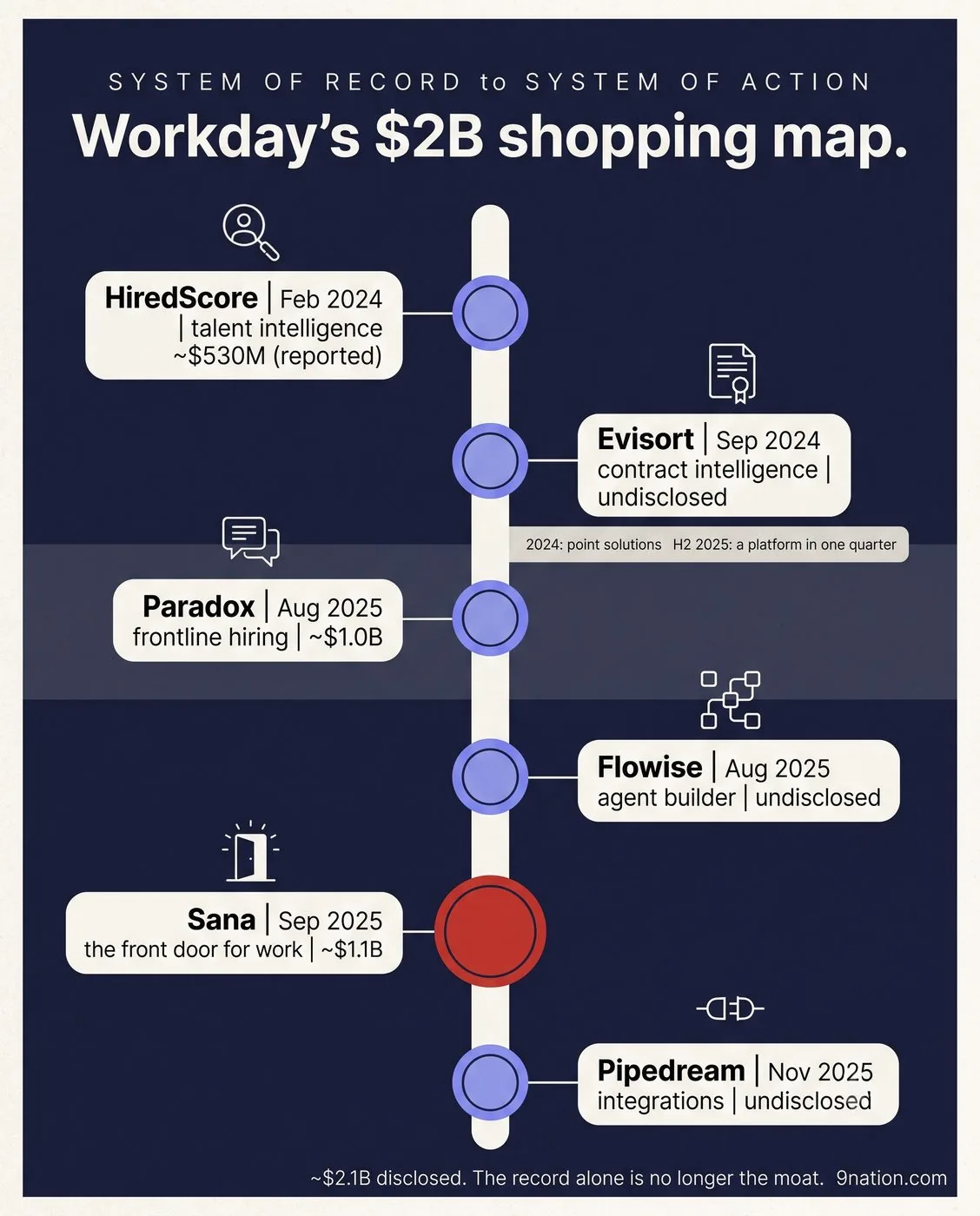
In under 2 years, Workday bought six AI companies. Two of the deals were disclosed at about $1 billion each. The rest were quieter. Put together, it is one of the clearest strategy statements a platform vendor has made this decade, and most of the customers I work with have never seen it laid out in one place. So here is the map, deal by deal, with what each one actually does and what it tells you about where Workday thinks it is exposed.
I have led more than 20 Workday programs. I am not writing this to knock the platform. I am writing it because the AI story changes what you are buying, and you should read it from the buyer's side before an account team reads it to you.
| Deal | Closed | Price | What it bought, and what it admits |
|---|---|---|---|
| HiredScore | Spring 2024 | ~$530M, reported | Talent intelligence. Ranks and rediscovers candidates, surfaces internal mobility. Now powers the recruiting agent. The pattern starts here: buy a capability, fold it into the record |
| Evisort | Oct 2024 | Undisclosed | Contract intelligence, shipped as Contract Intelligence in March 2025. The tell is direction: contracts are documents, not tidy HR records. The system of record was reaching past its own edges |
| Paradox | Oct 2025 | ~$1B | Conversational AI for high-volume frontline hiring, and it brought its own applicant tracking system. The first billion-dollar check, for a category Workday did not own |
| Flowise | Aug 2025 | Undisclosed | A low-code, open-source agent builder. Not a feature: the workshop where agents get made, plus a developer community. On the roadmap for the first half of 2026, so a promise rather than a product in your tenant |
| Sana | Nov 2025 | ~$1.1B | Enterprise knowledge and AI-native learning, positioned as the new front door for work. Where an employee asks, finds an answer, and kicks off an action |
System of record to system of action, in six deals

HiredScore. Announced February 2024, closed that spring. Workday did not disclose the price; it was reported at around $530 million, so treat that number as press, not fact. HiredScore is talent-intelligence AI: it ranks and rediscovers candidates and surfaces internal mobility. It has shipped, rebranded as Workday's recruiting and talent-mobility AI, and it now powers the Illuminate recruiting agent. First move, and the pattern is already visible: buy a capability, fold it into the record.
Two things are worth tracking per acquisition and neither is the price. First, has it shipped into your tenant or is it a roadmap item. Second, what does the purchase admit about where the system of record could not reach on its own. The second question is the one an account team will never frame for you.
Evisort. Announced September 2024, closed by the end of October. Price undisclosed. Evisort is contract intelligence: it reads unstructured agreements and pulls out the terms, obligations, and dates. Workday shipped it as Contract Intelligence, generally available in March 2025. The tell here is direction. Contracts are documents, not tidy HR records, and Workday wanted to act on documents. The system of record was reaching past its own edges.
Paradox. Announced August 2025, closed October 2025, disclosed at about $1 billion. Paradox is conversational AI for high-volume frontline hiring, and it brought its own applicant tracking system. This is the first billion-dollar AI check Workday wrote, and it bought a category Workday did not own: the hourly, high-turnover hiring that runs on text messages, not careers pages.
Flowise. Announced August 2025, already closed when announced, price undisclosed. Flowise is a low-code, open-source builder for AI agents. Workday did not buy a feature here. It bought the workshop where agents get made, plus an open-source developer community. The planned Workday Flowise Agent Builder is on the roadmap for the first half of 2026, so this one is a promise, not yet a product in your tenant.
Sana. Announced September 2025, closed November 2025, disclosed at about $1.1 billion. Sana is enterprise knowledge and AI-native learning, and Workday positions it as the new front door for work: the place an employee asks a question, finds an answer, and kicks off an action. Sana from Workday reached general availability in March 2026. This is the second billion-dollar deal in 5 weeks, and it is the most strategically loaded of the six. More on why in a moment.
Pipedream. Announced November 2025, expected to close by the end of January 2026, price undisclosed. Pipedream is an integration platform with thousands of pre-built connectors. If Sana is the front door and Flowise is the workshop, Pipedream is the wiring that lets an agent reach out and act in the other systems your business runs on. It is the last piece of a platform, and as of this writing it is the newest and least shipped.
What the pattern says
Line the deals up and the sequence tells the story better than any press release.
In 2024, Workday filled functional gaps: talent intelligence, then contract intelligence. Point solutions, folded in.
In the second half of 2025, over about 14 weeks, Workday stopped buying features and started buying a platform. Flowise for building agents, Sana for the knowledge front door, Pipedream for reaching into every other system. That is not a shopping list. That is an agent platform assembled in one quarter.
The through-line is a move from system of record to system of action. Workday's own words, from the executive who leads the platform work, are that the promise of enterprise AI is not insights but action. For 20 years Workday's moat was holding the authoritative record of your people and your money. The uncomfortable truth behind this spending is that the record alone is no longer a moat. If a general-purpose AI assistant can sit on top of any system and answer questions, the value moves to whoever owns the front door and the ability to act. Workday spent $2 billion to make sure that is still Workday.
Six acquisitions, slotted around the core you already run
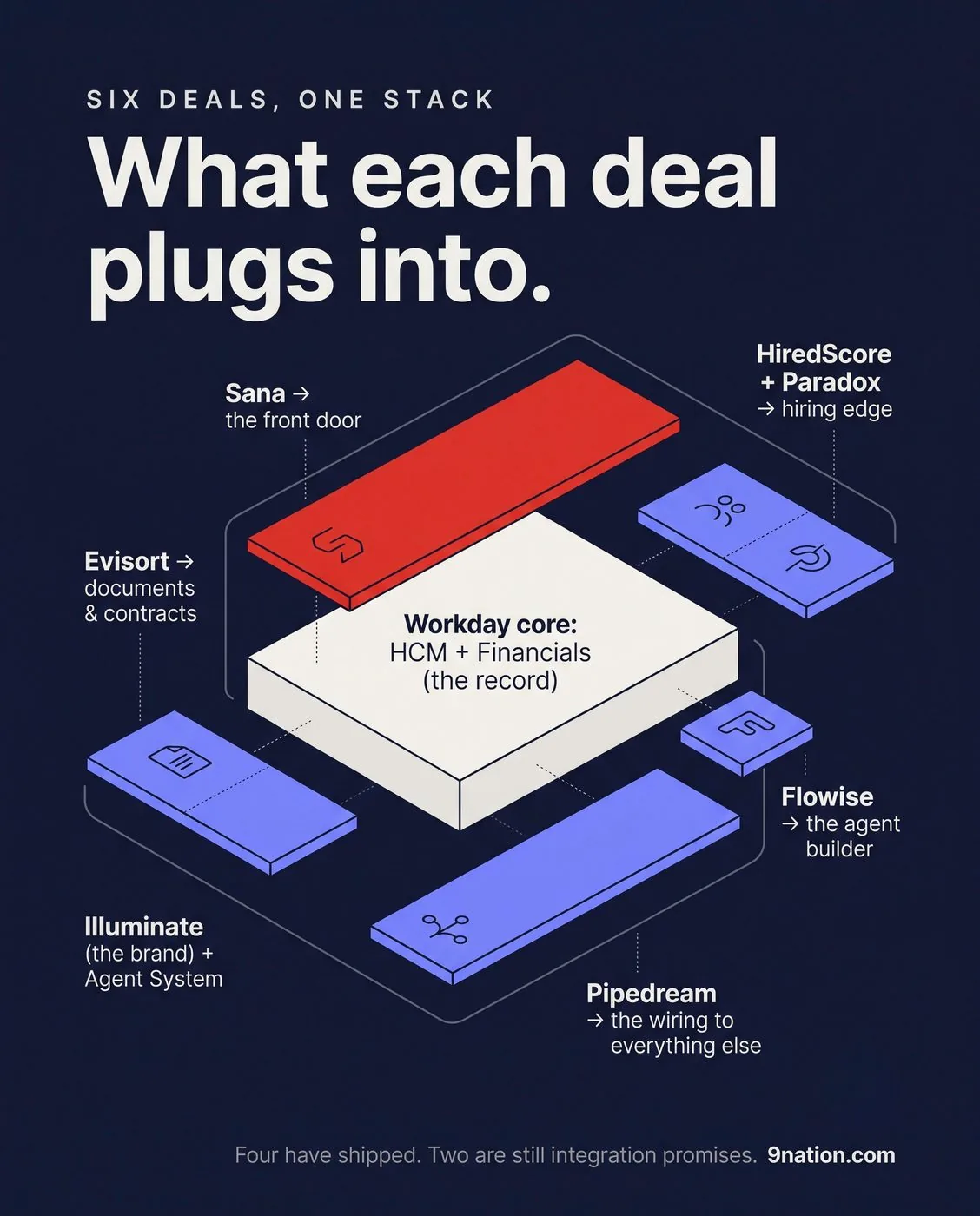
Picture the Workday core you already run: HCM and Financials, the record. Now slot the six in around it. HiredScore and Paradox plug into the hiring edge. Evisort plugs into the document and contract edge. Sana sits on top as the front door, the thing your employee actually talks to. Flowise sits to the side as the builder that makes new agents. Pipedream runs underneath as the connective tissue to everything outside Workday. Illuminate is the brand wrapped around the whole assembly, and the Agent System of Record is the layer that manages the agents once they exist.

Four of the six have shipped into product. Two, Flowise and Pipedream, are still integration promises with dates attached. That distinction matters when an account team walks you through the roadmap, because the roadmap slide does not distinguish between what is in your tenant today and what is coming later this year.
| Where it slots | Which deal | What it does to your estate |
|---|---|---|
| The hiring edge | HiredScore, Paradox | Two different hiring motions: professional and internal mobility, then hourly and high turnover running on text messages |
| The document edge | Evisort | Acting on unstructured agreements, which is the record reaching past its own edges |
| On top, the front door | Sana | Where an employee asks and starts an action. Changes your support model, not just your UI |
| To the side, the builder | Flowise | Where new agents get made, plus an open-source developer community |
| Underneath, the wiring | Pipedream | Connective tissue to everything outside Workday. Newest and least shipped |
The install base is the accelerant
Workday sits inside more than 11,000 organizations, a large share of the Fortune 500. That install base is why this strategy is credible. A startup with the same six capabilities has to go find customers. Workday already has the customers, the data, and the contracts. When it ships an agent, it ships to 11,000 tenants at once. That is the fastest distribution in enterprise software, and it is the real asset the AI layer is designed to monetize.
Read it with clear eyes
One more fact belongs on the map, because leaving it off would make this a brochure. This coherent, expensive bet is now being defended under a leadership change. In February 2026 Workday replaced its CEO, bringing back co-founder Aneel Bhusri, during a year in which the stock fell around 40% and the company cut roughly 375 roles. The AI business is real, with reported AI annual recurring revenue above $400 million and growing fast. The market is skeptical anyway, worried that general-purpose AI erodes the pricing power of application vendors.
None of that means the strategy is wrong. It means the strategy is unproven and contested, and its original architect is already gone. For you, that is not a reason to dismiss the AI roadmap. It is a reason to read the fine print yourself instead of taking the confident version.
Do this week: take the six deals and mark which ones touch a module you run live today. For each one you mark, ask your account team one question: is this in my tenant now, or on the roadmap, and is it included in my subscription or metered as consumption? Six deals, two questions each. The answers tell you what you actually bought.
Sources
Workday Newsroom: HiredScore intent to acquire, Feb 26, 2024 (link; ~$530M reported, not Workday-disclosed); Evisort agreement, Sep 17, 2024 (link); Paradox agreement ~$1.0B, Aug 21, 2025, completed Oct 1, 2025 (link); Flowise acquisition, Aug 14, 2025 (link); Sana agreement ~$1.1B, Sep 16, 2025, GA Mar 17, 2026 (link); Pipedream agreement, Nov 19, 2025 (link).
Workday, install base of more than 11,000 organizations, customer facts. CEO transition, Aneel Bhusri returns, Feb 9, 2026, newsroom.workday.com; AI ARR above $400M, Q4 FY26, CNBC, Feb 24, 2026.
Prices labeled disclosed vs. reported vs. undisclosed per source throughout.
