
The independent voice that keeps your ERP program honest.
9Nation is David Apollon, 25 years leading large-scale Workday and ERP/CRM programs, steering executive governance, and getting clients and their implementation partners to the outcome everyone signed on for.
25+ years · 76 engagements · Workday-deep, platform-agnostic

Including a $25M Workday big-bang across HCM, Finance, Supply Chain, and Payroll at a multi-hospital health system.
Trusted on programs across 25 years
A representative cross-section of organizations served across 76 engagements and 16 industries.

















































Every program has plenty of people accountable for the build. Someone independent has to be accountable for the whole outcome.
That's the seat I take, executive program leadership with no software to sell and no incentive but your go-live. I run governance, cutover, and change at the scale where a single bad quarter costs millions, and I tell you the truth the status deck won't.
| Workstream | Reported | On the floor |
|---|---|---|
| Scope | Green | Amber |
| Schedule | Green | Red |
| Budget | Green | Green |
| Data conversion | Green | Red |
| Testing | Green | Green |
Services across the full delivery lifecycle
Program Leadership & Governance
Executive steering, status discipline, and the RAID and decision rigor that keep a program decision-ready.
Phase Zero & Strategy
Assessment, business case, and mobilization that de-risk the program before the first dollar is spent.
Change & Enablement
Change strategy, communications, and end-user training delivered at enterprise scale.
Quality & Go-Live
Testing and independent V&V, cutover command center, go/no-go discipline, and hypercare.
Delivery Mechanics
Data conversion, integration management, and the requirements and solution design underneath it all.
Vendor & SI Management
Selection scorecards, SOWs, and the client-side discipline that keeps the partnership on track.
Workday-deep, platform-agnostic. Workday · Salesforce · ServiceNow · Oracle · Microsoft · PeopleSoft · ADP · UKG · Tableau · See all practice areas →
From selection to hypercare, accountable the whole way.
Selection
The right platform and SI, with scorecards and SOWs that protect you.
Phase Zero
Assessment, business case, and governance that de-risk the program before build.
Build & govern
Executive steering, decision discipline, and a partnership managed to scope.
Test & IV&V
Independent validation, payroll parallels, and an honest go/no-go.
Go-live
Cutover command center, contingency, and a controlled landing.
Hypercare
Stabilization through the first real cycles, then a Center of Excellence.
16 industries, one standard of delivery
Programs under pressure, delivered
A $25M Workday big-bang go-live
Led a multi-hospital big-bang across HCM, Finance, Supply Chain, and Payroll, alongside a parallel UKG rollout and a concurrent Epic EMR go-live, to a stable single go-live.
A statewide ERP modernization business case
Built the assessment and business case that de-risked a multi-agency transformation and won executive sign-off.
Global testing & cutover command
Ran the global testing strategy and the cutover command center for a multi-region, follow-the-sun go-live.
Trusted in the room where it counts
David was the only person in the room willing to tell us the program was off track while we could still fix it. Vendors said it was possible, but they were only looking at their own resources. That candor saved our go-live.
Deployment went surprisingly smoothly. David's calm, decisive approach, independent of our SI, gave us confidence we were on the right track.
We brought David back for a second phase after he delivered a successful big-bang implementation 3 years ago. Once again, he delivered. His leadership on our Review-and-Recommend ERP initiative was exactly what our steering committee needed to make the right call.
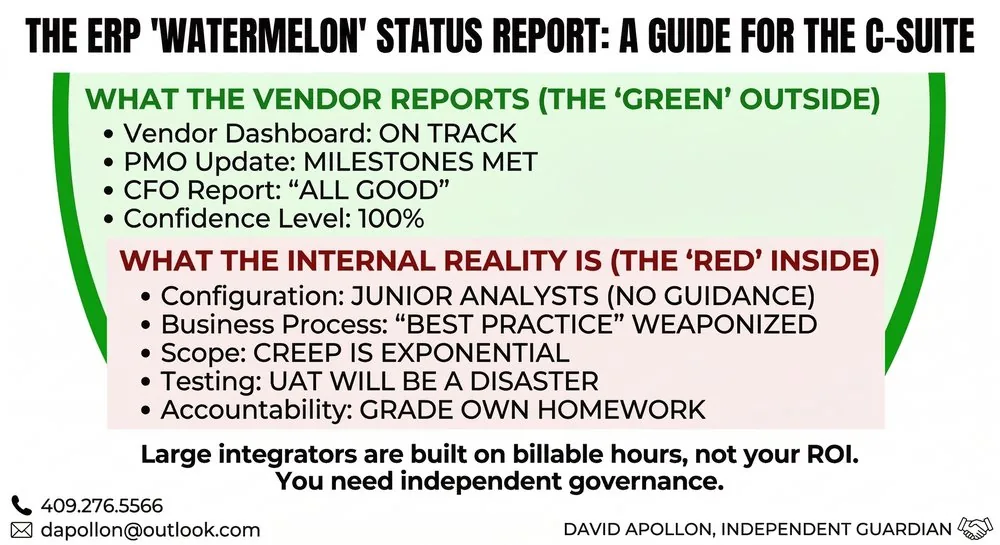
A status report that's green on the outside and red on the inside is the most expensive document in your program.David Apollon, 9Nation
Field notes from the program trenches
Grants and student on Workday: the modules where programs stall
HCM and Finance are the easy part. Grants and Student are where research-university programs stall. Where they break, how they wire into the ERP, and what separated the go-lives that worked.
The cutover playbook: how Workday and ERP go-lives get done
18 months of build, decided in the last 10 days. The tenant chain, the freeze, the go/no-go, the command center, the rollback call, and the first payroll. The tactical version.
The client-side PMO
Your implementer is accountable for their scope. Nobody owns your whole program unless you make somebody accountable. The five accountabilities, and how to stand one up in 90 days.
ERP analytics: from report factory to decision engine
Governance, the semantic layer, staying in suite or going best of breed, and what changes in 2027 when agents start reading the data first. Workday Prism, Oracle, and SAP.
Implementing payroll: a VP of Payroll's guide
10 payroll modules, the one decision to get right in each, where they break, and what AI actually changes. Written for the leader who has to make payday land.
Implementing supply chain ERP modules: a CSCO's guide
10 supply chain modules, the one decision to get right in each, where they break, and what AI actually changes. Written for the leader who has to keep product moving.
Implementing HCM and HR ERP modules: a CHRO's guide
10 HR modules, the one decision to get right in each, where they break, and what AI actually changes. Written for the HR leader who has to own the result.
Implementing finance ERP modules: a CFO and controller's guide
9 finance modules, the one decision to get right in each, where they break, and what AI actually changes. Written for the finance executive who has to own the outcome.
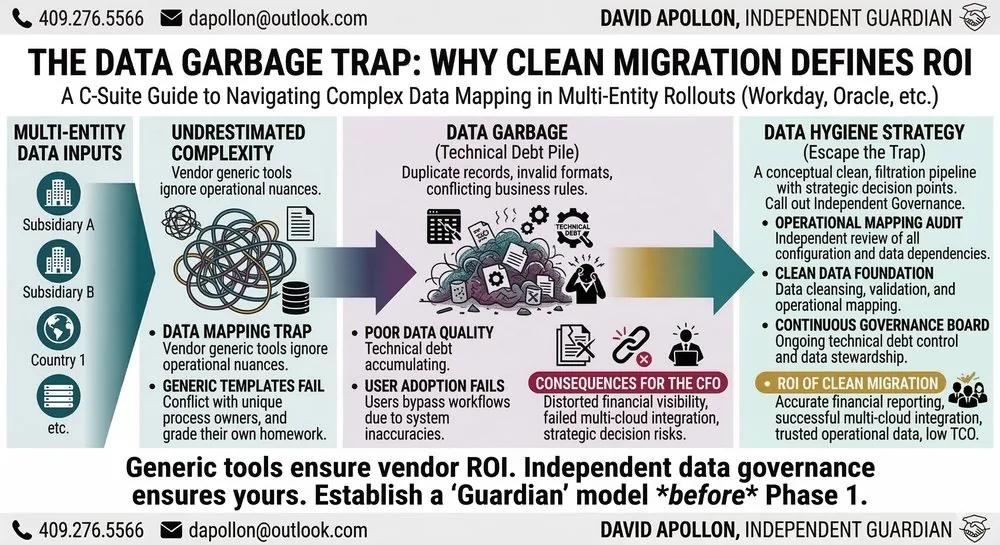
Data conversion and integrations: the workstream that decides your go-live
The software is rarely the risk. The data going in and the connections coming out are. How to scope, own, sequence, and reconcile them so your date holds.
What Workday really costs
Workday publishes no price list. Over 5 to 10 years the subscription is under half of the total. How it prices, where the money hides, and the levers that move the number.
Negotiating with your System Implementer
The contract is the operating system for the whole program, and your leverage is gone the moment you sign. The 10 areas to negotiate before you do.
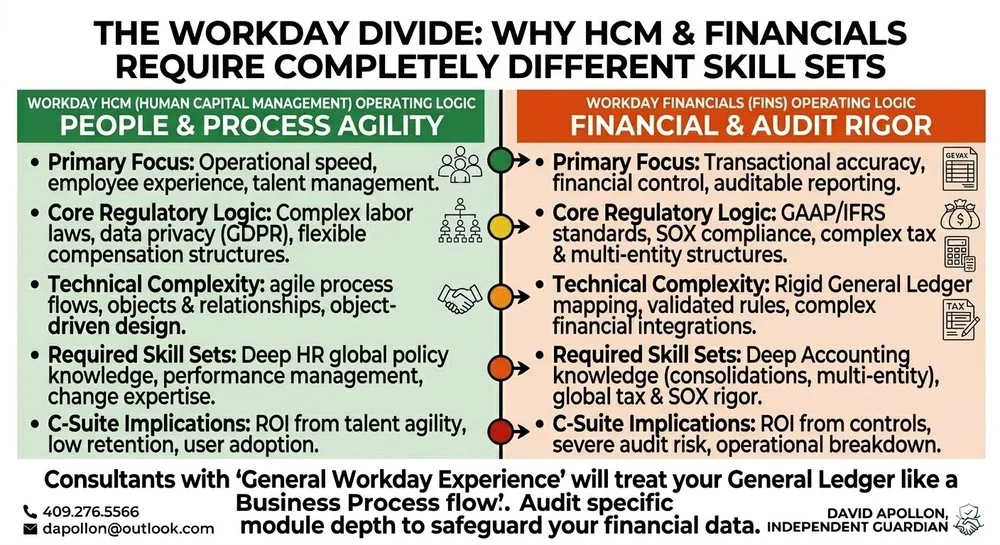
Workday is one system. Your organization is not.
Where unified HR and Finance deployments strain, the data model, the calendars, the politics, and how to govern the seams.
The watermelon status report
Why green-on-the-outside programs fail, and how to read the red underneath before it costs you a quarter.
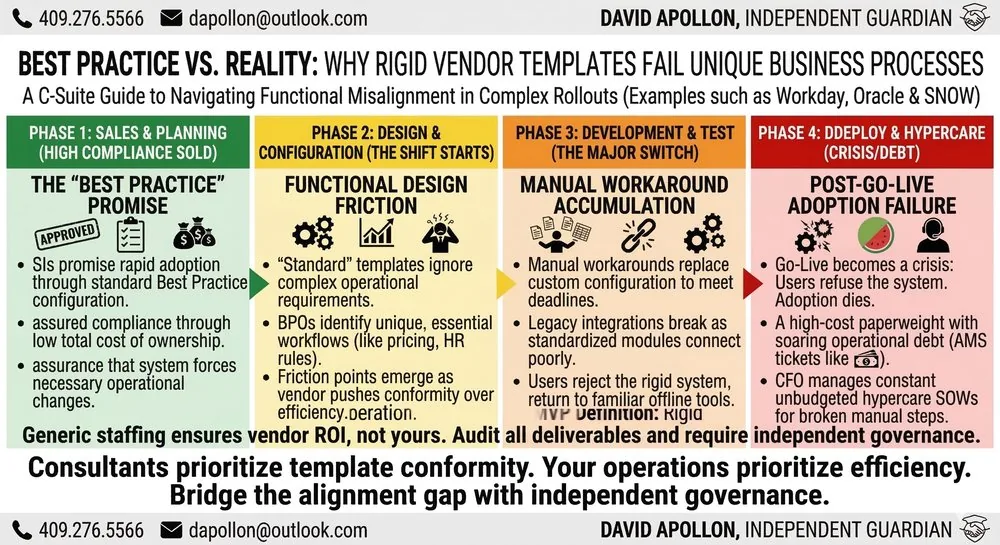
Choosing and managing your SI
The independent-voice approach to selecting your SI, shaping the SOW, and making the partnership work.
The Workday Guides
Five one-page guides covering the whole lifecycle. Understand it, buy it, deploy it, run it, then the agents. Every number on them is sourced. Free, no form, no gate.
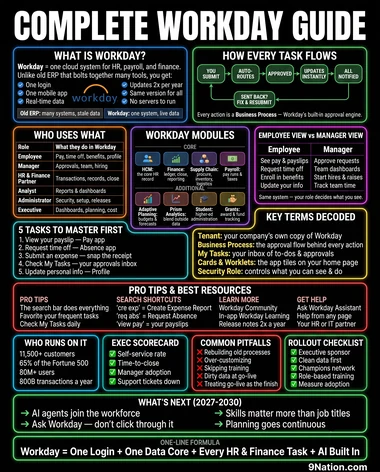 01 UnderstandThe Complete Workday GuideWhat it is, and how a task flows through it.
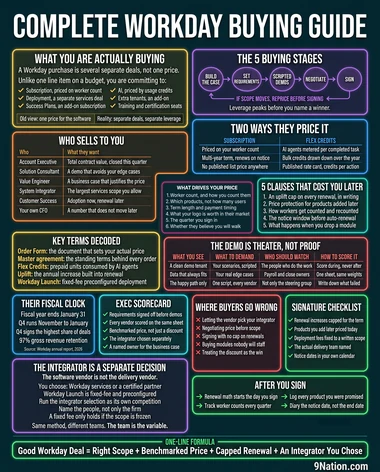 02 BuyThe Buying GuideFive stages, and the clauses that cost you later.
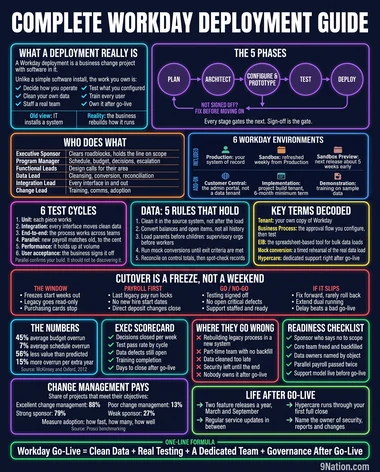 03 DeployThe Deployment GuideCutover is a freeze, not a weekend.
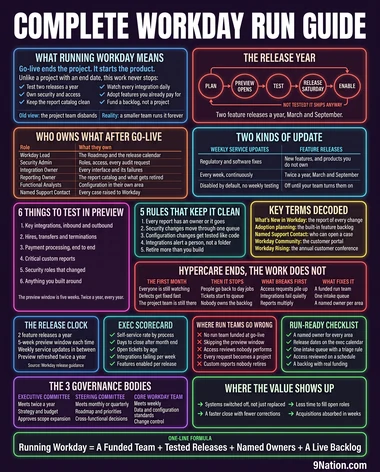 04 RunThe Run GuideGo-live ends the project. It starts the product.
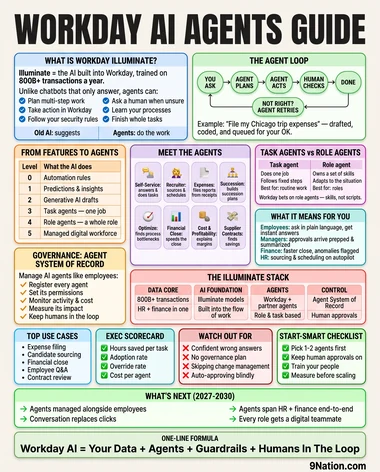 05 AIThe AI Agents GuideAgents do not suggest. They act.
Hard lessons, one slide at a time.
A peek at the visual library, click through for the full set.
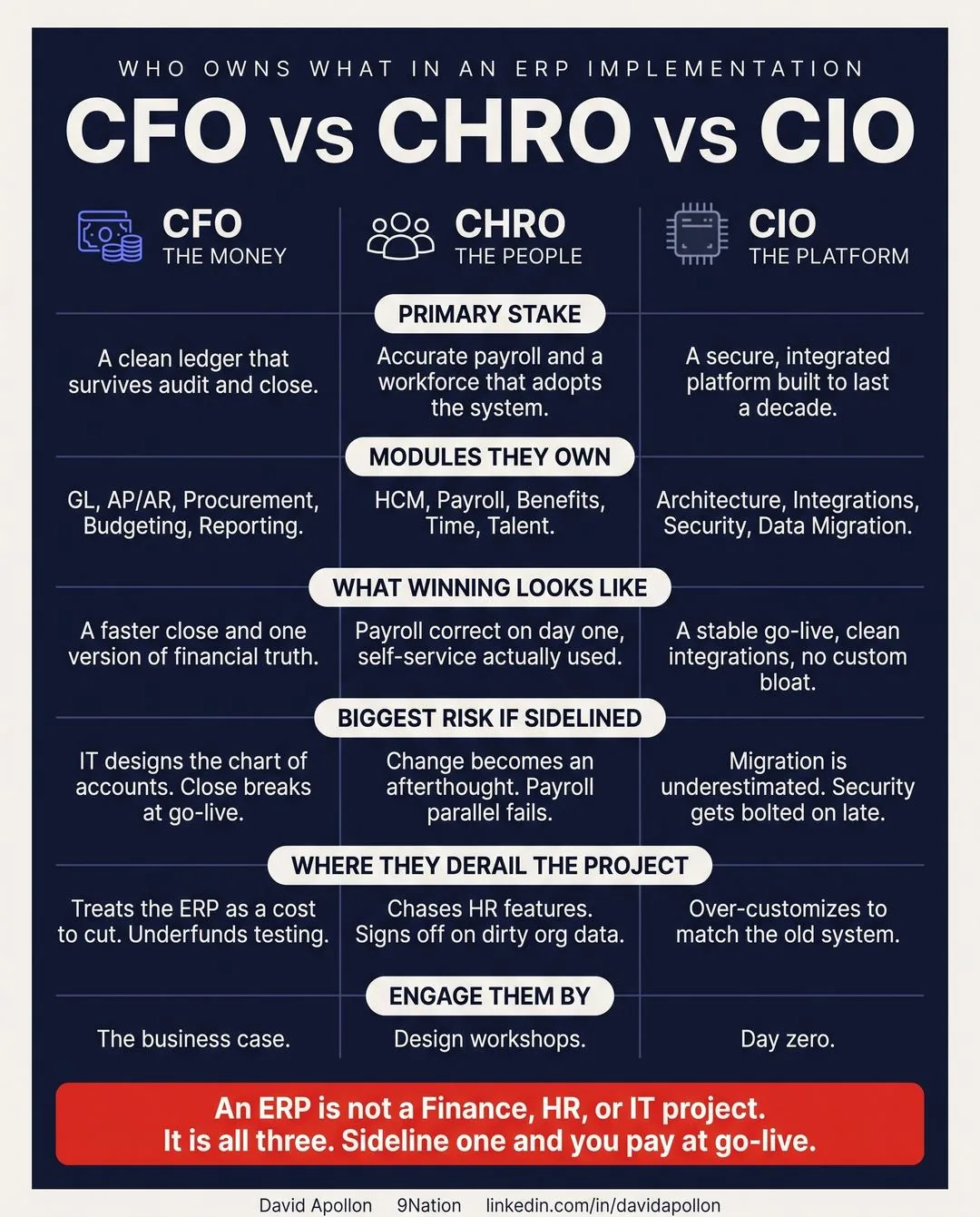
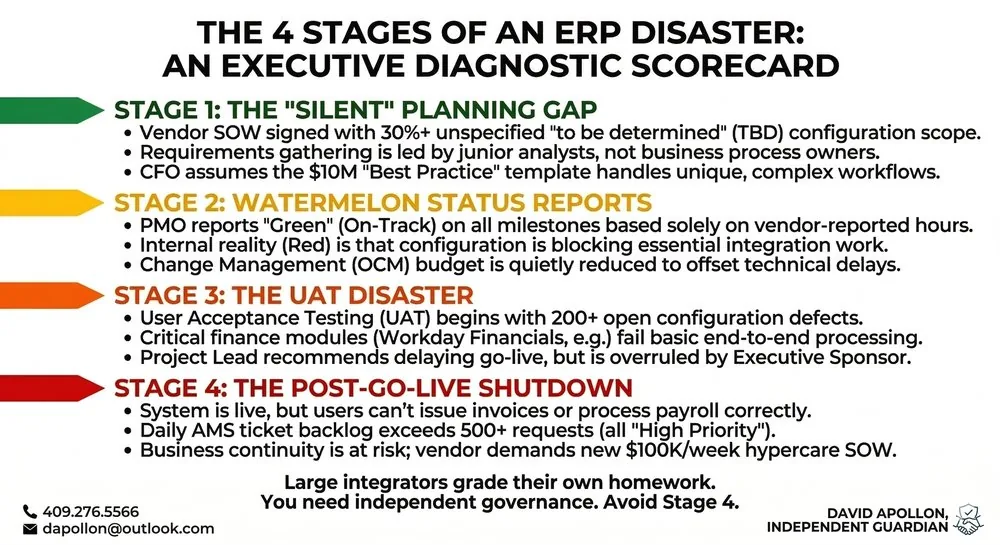
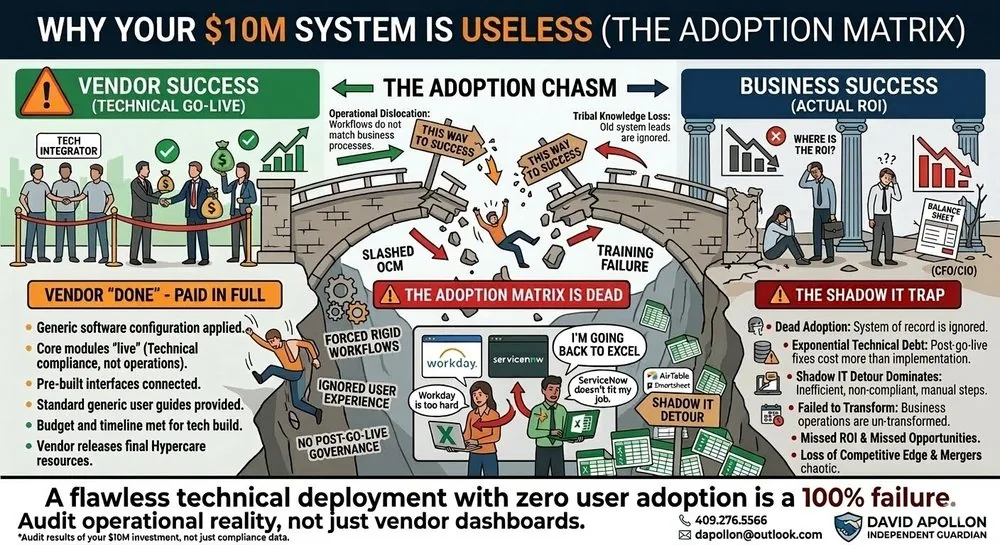
The things executives ask me first.
Why independent, what does that add alongside our SI?
Your SI is accountable for their scope, and a good one delivers it. What they can't be is the independent senior voice on your side of the table. I take that seat, running governance, cutover, and change, so decisions get made with the whole program in view, not one workstream.
How do you work alongside our existing SI?
As a partner, not a replacement. I sit on the client side, keep the program honest, accelerate decisions, and make sure knowledge transfers to your team so you own the platform when the SI rolls off.
When should I bring you in?
Earlier is cheaper. Phase Zero and selection are ideal. However, I'm as often brought in mid-flight to reset a stalled program or run an independent go-live readiness assessment.
What platforms do you cover?
Workday-deep, platform-agnostic, with depth in Salesforce, ServiceNow, PeopleSoft, and ERP across 16 industries.
How do engagements start?
Usually with a short, candid call and a focused read on where your program stands. Book a 15-minute intro call to start.
Keep your program honest.
If you're betting tens of millions on an ERP program, put an independent set of eyes on it, before the status deck turns from green to red.