Six practice areas. Three platforms, three disciplines.
Platform depth in Workday, Salesforce, and ServiceNow. Program leadership in PMO development, IT and strategic programs, and acquisition integrations. 25 years, more than 76 engagements, 16 industries.
Three platforms. Each connected to the others.
Most consultants own one platform. The programs I run most often require all three to work together: Workday as the system of record, Salesforce as the front-office layer, ServiceNow as the service delivery engine. The integration between them is where programs get into trouble. It is also where my background is different.
The foundation of most of what I do. Across 76 engagements I have led Workday HCM, Financials, and Payroll programs from Phase Zero through hypercare, including a $25M Workday big-bang across HCM, Finance, Supply Chain, and Payroll at a multi-hospital health system, delivered alongside a parallel UKG rollout and a concurrent Epic EMR go-live. Workday is where I go deepest, and it is the system of record that everything else in the stack connects back to.
What Workday really costs →Data conversion & integrations →
Negotiating your SI contract →
Client-side PMO →
Cutover & go-live readiness →
I lead enterprise Salesforce implementations integrated with Workday Financials. When a deal closes in Sales Cloud, the Workday Financial Management Connector automatically creates the corresponding project, resource demand lines, contract, and billing setup in Workday. Running that correctly requires someone who understands both sides of the pipe. Across programs I have onboarded more than 100,000 users where Salesforce and the ERP have to function as one system.
I direct full-cycle ServiceNow HRSD implementations wired into Workday HCM as the system of record. Case management, the Employee Center portal, and the HR knowledge base, integrated so onboarding and offboarding workflows flow cleanly between the service layer and the HCM platform. Results across programs: 25 to 35% faster HR case resolution, 40% Tier 1 ticket deflection through self-service.
The module field guides. Pick your seat at the table.
Seven definitive guides from 76 programs, one for each executive who has to own the outcome. Each walks the decisions one by one: the call to get right, the place it quietly breaks, and what AI actually changes. Every guide ships with a free readiness toolkit.
HCM & HR modules
Core HR · Recruiting · Talent · Learning · Comp · Benefits · Time · Absence · Payroll · Analytics
HR systems fail on adoption, worker data, and payroll, not the software. Get pay wrong twice and half your people start job hunting. 10 modules, the payroll parallel gate, and the bias rules AI hiring tools now carry.
Finance modules
GL · Close · AP · AR · Assets · Cash · Expenses · Tax · Projects & Revenue
Finance ERP fails on decisions the CFO was best placed to make: the chart of accounts, controls designed in, and a first close that ties out. 9 modules, the conversion gate, and where AI genuinely earns its keep in finance.
Supply chain modules
Item Master · Procurement · Supplier · Inventory · Orders · WMS · TMS · Manufacturing · Planning · Cost
Supply chain programs fail on master data, cutover, and the seams nobody counted. Hershey could not ship Halloween candy to prove it. 10 modules, the inventory freeze, and the EDI lead times that set your real critical path.
Payroll modules
Foundation · Earnings · Tax · Garnishments · Time · Absence · Retro · Banking · GL · Global
Payroll has no grace period. It is judged on one run, in front of everyone, on a date that never moves. 10 modules, the gross to net engine, and the earned wage access rules changing in 2026. It is the deep dive the HCM guide hands off to.
Analytics
Governance · Data Quality · Semantic Layer · Blending · Report Rationalization · In-Suite vs Best of Breed · AI & Agents
Analytics programs fail on a governance decision that got deferred until it became a crisis. Gartner says 80% of them will by 2027. Workday Prism, Oracle FDI, SAP Datasphere, the semantic layer, and what changes when agents read the data first.
Grants & Student
Award Model · FDM · F&A · Effort · Billing · Student Records · Financials · Financial Aid · Reporting
The two hardest modules in a research university, where a federal compliance regime and an academic calendar meet the ledger. The grant object, the F&A base, the effort audit seam, and the four seams that wire grants and student into the rest of the ERP.
Workday Adaptive Planning
Levels · Dimensions · Accounts · Versions · Actuals Feed · Workforce Plan · Consolidation · OfficeConnect
The model gets built in weeks. Eight decisions made before it decide whether the variance report is trusted at the first close. The level structure, the mapping from Financials, the version strategy, and the last cycle in the old world.
The ERP stack, one layer at a time
ERP is not software. It is a stack, and every layer holds up the one above it. Most programs buy the top and underfund the foundation, then wonder why the go-live wobbles.
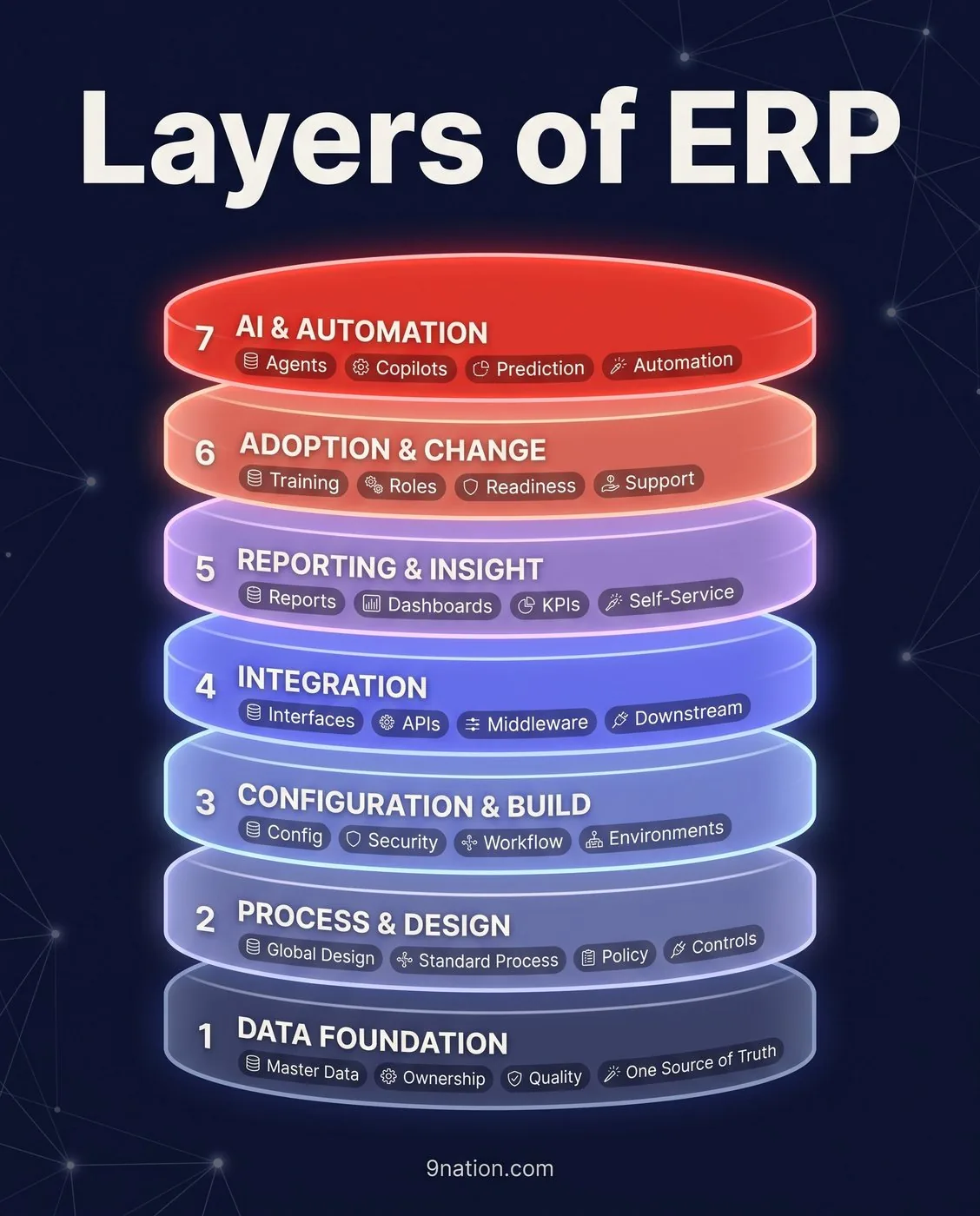
The integration between Workday, Salesforce, and ServiceNow is not a technical problem. It is a program leadership problem. The data breaks when no one is accountable for both sides of the pipe at once.David Apollon, 9Nation
Three disciplines that hold every program together.
The platforms are where I go deep. These are the disciplines I have thrived in across 25 years, and they hold regardless of the technology stack underneath them.
I stand up program management offices and build them to hand back. Across 25 years I have built more than a dozen PMOs at organizations like AT&T, Credit Suisse, Baxter, Iron Mountain, and the State of Georgia. Governance frameworks, RAID and decision logs, steering committee cadences, and status discipline the team can run without me the day the engagement ends.
The governance model is not ERP-specific. I lead digital transformation, cloud migration, cybersecurity, and infrastructure programs with the same rigor: executive accountability set early, delivery measured against real milestones, and honest go/no-go calls at every gate, whatever the technology stack.
When a company acquires another, the systems have to come together with it. Across more than 15 acquisitions I have run the integration program: absorbing acquired entities into Workday HCM and Financials, migrating legacy ERP, Salesforce, and ServiceNow estates, mapping org structures, positions, and chart of accounts, and sequencing Day 1 readiness so payroll runs and the books close on time. Workday to Workday, legacy to Workday, or a platform migration on its own, the discipline is the same.
The other side of the deal. When a business is spun off, sold or carved out, it inherits people and obligations but not the systems that ran them, and it has to stand up its own HR, payroll and ERP against a date set by contract with its former parent. I run that program: the separation matrix that inventories everything the parent quietly did for you, the standalone platform underneath it, the transition services agreement exit, and the parallel payroll proof that gets you to a first pay cycle nobody notices.
How I run an acquisition integration.
An acquisition integration is a business transformation wearing an IT costume. Five things decide whether the combined company runs clean on Day 1.
Set the tenant strategy early
Decide up front whether to consolidate the acquired company into your existing tenant, run separate instances for a while, or build a new unified environment. If you consolidate, locking down a pristine GOLD tenant for the build is a critical early milestone. Every delay here compounds downstream.
Map and harmonize the data
Acquired companies rarely categorize data the way you do. Cost centers, job profiles, and financial dimensions will conflict. I run a dedicated data-translation workstream and get the data clean and validated before testing, so test cycles validate workflows instead of chasing bad data.
Govern the testing
Testing is how you protect business continuity, not a checkbox. Clear entry and exit criteria for unit, end-to-end, and user acceptance testing, with the acquired team in the cycles. They are the only people who know their legacy data and edge-case business processes.
Align change and process
The acquired employees are losing familiar systems. I pull power users from the acquired company into configuration and testing early, so they champion the new workflows to their peers. A technically flawless deployment still fails if the users reject it.
Run cutover from a command center
Go-live runs on minute-by-minute sequencing: extraction, lockdown, load, validation. A well-resourced command center triages issues and stays active through the first combined month-end close. It stands down only when stability and adoption metrics are firmly met.
Put independent eyes on your program.
Whether the program runs on Workday, Salesforce, ServiceNow, or a stack you inherited, the governance model is the same.