
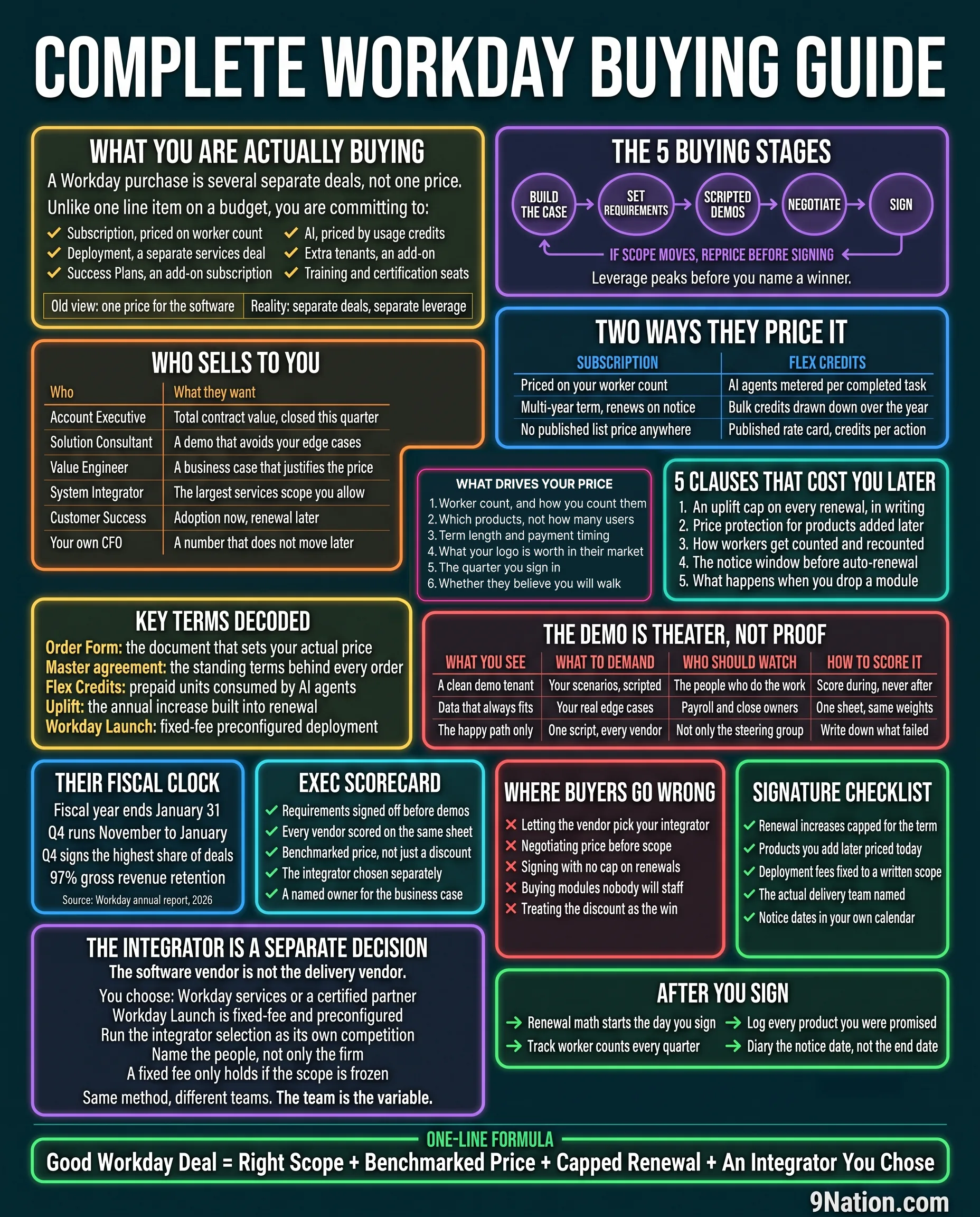
Almost every buying mistake I have watched a client make came from the same place. They treated the purchase as one negotiation about one number, when it was really four or five negotiations happening at once, only one of which anyone was paying attention to.
The subscription is the number the board sees. It is rarely the number that hurts. What hurts is the renewal three years out with no cap on it, the products added in year two at a price nobody protected, the services contract that was signed on a scope that had already moved, and the worker count definition that turned out to include contractors. None of that is hidden. It is just in a different document from the one everybody read.
What you are actually buying
A Workday purchase is several separate deals, not one price.
- Subscription, priced on worker count
- AI, priced by usage credits
- Deployment, a separate services deal
- Success Plans, an add-on subscription
- Extra tenants, an add-on
- Training and certification seats
| Old view | One price for the software |
| Reality | Separate deals, separate leverage |
Read that list as a list of separate conversations, because that is what it is. Each one has its own owner on the vendor side, its own timing, and its own room to move. Bundling them into a single approval paper is convenient for procurement and expensive for you.
The five buying stages
If scope moves, reprice before signing.
Leverage peaks before you name a winner.
That last line is the whole guide in six words. The moment you tell a vendor they have won, every remaining conversation is a conversation you are having from a weaker position. Buyers give that away constantly, usually by accident, usually in an email that says we are moving forward with you subject to contract.
Scope moves during negotiation on nearly every deal. That is normal. What is not normal, and what costs real money, is letting the scope move without repricing. If you add a module, a country, or a population after the number was agreed, the number is no longer the number. Send it back.
Who is on the other side of the table
| Who | What they want |
|---|---|
| Account Executive | Total contract value, closed this quarter |
| Solution Consultant | A demo that avoids your edge cases |
| Value Engineer | A business case that justifies the price |
| System Integrator | The largest services scope you allow |
| Customer Success | Adoption now, renewal later |
| Your own CFO | A number that does not move later |
None of these people are villains. They are all doing the job they are compensated to do, and most of them are good at it. The point of the table is that your side needs someone whose only job is your interest, sitting across from all six, keeping track of which conversation is which. On most deals that person does not exist, which is why the six of them end up negotiating with each other.
The two pricing models
| Subscription | Flex Credits |
|---|---|
| Priced on your worker count | AI agents metered per completed task |
| Multi-year term, renews on notice | Bulk credits drawn down over the year |
| No published list price anywhere | Published rate card, credits per action |
The right column is newer and behaves differently from anything on a traditional ERP paper. Credits are consumed when an agent completes a task, not per user and not per token, and there is a public rate card behind it. That makes the AI line the one part of the deal you can actually benchmark against a published number. Use that. It is rare.
The left column is the opposite. There is no published list price, and every per-worker figure circulating online traces back to a reseller or an advisory firm selling negotiation services. I have deliberately kept all of those numbers off this guide. Quoting one at a vendor tells them you have been reading marketing, not that you have done your homework.
What actually drives your price
- Worker count, and how you count them
- Which products, not how many users
- Term length and payment timing
- What your logo is worth in their market
- The quarter you sign in
- Whether they believe you will walk
Items one and six are the ones buyers underuse. Worker count sounds like an input you cannot control, but the definition of a worker is contractual, and whether seasonal staff, contractors, and dormant records fall inside it is negotiable. As for the sixth: it is not a bluff if you have actually run a second option far enough to price it.
The five clauses that cost you later
- An uplift cap on every renewal, in writing
- Price protection for products added later
- How workers get counted and recounted
- The notice window before auto-renewal
- What happens when you drop a module
Here is the argument for spending your negotiating capital here rather than on the headline discount. Workday's own annual report puts gross revenue retention at about 97% for the fiscal year ended January 31, 2026. Almost nobody leaves. That is a compliment to the product and a warning to the buyer: whatever terms you accept in year one are, in practice, the terms you live with permanently. A capped renewal compounds. A one-time discount does not.
Their fiscal clock
Source: Workday annual report on Form 10-K, fiscal year ended January 31, 2026.
This is the single most useful fact on the poster and it is sitting in a public filing that almost no buyer reads. Their year ends on January 31. Their pressure peaks in November, December and January. If your own procurement calendar has you signing in June because that is when your budget year turns, you are negotiating in their quietest quarter and paying for the privilege.
The demo is theater, not proof
- A clean demo tenant
- Data that always fits
- The happy path only
- Your scenarios, scripted
- Your real edge cases
- One script, every vendor
- The people who do the work
- Payroll and close owners
- Not only the steering group
- Score during, never after
- One sheet, same weights
- Write down what failed
Every vendor demo you will ever see is a rehearsed performance in a tenant built to make the software look effortless. That is not dishonest. It is what a demo is. The mistake is treating it as evidence.
The fix costs you a week and is the highest-return week in the whole evaluation. Write your own scripts from your own ugliest transactions, hand the identical script to every vendor, and put the people who actually run payroll and month-end in the room. Score in the room, on one sheet, with the same weights for everyone. Scoring after the fact is scoring on how much you liked the presenter.
The integrator is a separate decision
The software vendor is not the delivery vendor.
- You choose: Workday services or a certified partner
- Workday Launch is fixed-fee and preconfigured
- Run the integrator selection as its own competition
- Name the people, not only the firm
- A fixed fee only holds if the scope is frozen
Same method, different teams. The team is the variable.
Workday states that customers may deploy with Workday's own services organization or with a trusted partner, using the same methodology. Read that carefully. If the method is common, the method is not what you are choosing between. You are choosing a team, and teams vary enormously inside the same firm.
So name them. Put the individuals in the contract, with a clause that says a replacement needs your approval. The single most common failure mode in ERP delivery is that the people who won the work are not the people who show up, and that is entirely preventable at signature. The detail of how to structure that sits in the SI contract negotiation guide.
What good looks like, and where buyers go wrong
- Requirements signed off before demos
- Every vendor scored on the same sheet
- Benchmarked price, not just a discount
- The integrator chosen separately
- A named owner for the business case
- Letting the vendor pick your integrator
- Negotiating price before scope
- Signing with no cap on renewals
- Buying modules nobody will staff
- Treating the discount as the win
- Renewal increases capped for the term
- Products you add later priced today
- Deployment fees fixed to a written scope
- The actual delivery team named
- Notice dates in your own calendar
After you sign
- Renewal math starts the day you sign
- Track worker counts every quarter
- Log every product you were promised
- Diary the notice date, not the end date
The fourth one catches people every year. The date that matters is not when the contract ends, it is the last day you can give notice before it renews itself. Those are different dates, the gap between them is often months, and the notice window lives in the master agreement rather than the order form. Find yours, and put it in a calendar that survives the person who signed the deal leaving the company.
Where to go from here
- Fiscal year end of January 31, fourth-quarter signing seasonality, gross revenue retention of about 97%, and Success Plans as an add-on subscription: Workday annual report on Form 10-K, fiscal year ended January 31, 2026.
- Flex Credits metered per completed task, bulk credits and the published rate card: Workday Flex Credits page and the published Flex Credit Rate Card.
- No published list price: verifiable by absence. Workday publishes no price list, and every per-worker figure in circulation originates with resellers or advisory firms rather than with Workday.
- Workday Launch as fixed-fee and preconfigured, and the choice between Workday services and a certified partner using the same methodology: Workday Launch, deployment and partner pages.
Deliberately excluded: per-worker dollar figures, implementation-to-subscription cost multiples, typical discount percentages, the widely repeated 120-day notice window, and any standard contract term length. None of them survive sourcing, and quoting one at a vendor weakens your position rather than strengthening it.