
Finance systems · ERP modules
Implementing finance ERP modules: a CFO and controller's guide
9 modules, one fixed deadline: the first month-end close. What to get right in each module, where the audit finds the gaps, and where AI earns its keep in finance.
The close that took 5 days now takes 15. And a number the board already saw has to be walked back.
That's how a finance ERP fails. There's no outage, just a slow close and a restated slide. Neither is a technology problem. Both come down to ownership, design and sequencing, and all three belong to finance. Gartner says 70% of ERP initiatives will miss their business goals by 2027, and it puts the average annual cost of poor data quality at $12.9 million.
The finance modules are where an ERP program's risk concentrates. Payroll has to run, the books have to close and the auditors have to sign. Every other function can absorb a rough go-live with workarounds. Finance can't, because the first month-end close lands on a fixed legal deadline whether the system is ready or not. There are 9 finance modules and one owner for all of them: the CFO and the controller. The examples here are Workday and Oracle. The discipline is identical on SAP or anything else. The field notes are mine, anonymized.
The one idea to hold onto
A finance ERP is a finance program with an IT component. Run it as an IT purchase with a finance user and you inherit the 70% outcome. Own the decisions that belong to finance, prove readiness with numbers, and treat the first close as the real go-live.
Before the build
Accounts 1100 to 1300Every extra year a large IT project runs costs real money
The economics are unforgiving. McKinsey's dataset shows every extra year a large IT project runs adds roughly 15% to its cost overrun, and 17% of large IT projects go so badly they threaten the existence of the company. McKinsey documented one bank that brought its finance department into the transformation only a few months before go-live. The late accounting-module changes that followed delayed the launch by more than 3 months, at a cost of more than $8 million.
The public sector shows the same pattern at scale. The U.S. Government Accountability Office found the Navy had largely wasted about $1 billion on four separate ERP pilot efforts, with the failures traced to weak discipline in requirements, testing and data conversion.
15%more cost overrun for every extra year a large IT project runs
17%of large IT projects go badly enough to threaten the company
$1Blargely wasted by the Navy on four ERP pilots
The sharpest exposure is your own numbers. When controls get bolted on late, the audit finds the gap, and a material weakness is public. Deloitte's count of the material weaknesses disclosed over the past 12 months shows the same three roots again and again, and a finance ERP built without controls in mind makes each one more likely.
- Documentation98%
- Inadequate personnel64%
- Technology61%
The move
Put the controller and a finance program lead on the steering committee with named accountability from day one. If they only review the design after the implementer has frozen it, there's little left for them to change.
From the field
The reporting layer lies about its own size. On one program, 400 critical legacy reports collapsed to 90 once we checked them against the actual run logs. Nobody asked for the other 310 again. Finance teams routinely carry forward a reporting footprint no one has validated, then pay to convert and rebuild all of it.
Pick the deployment shape before you pick anything else
A big-bang implementation takes all modules and units live on one date. A phased approach sets several smaller go-live dates by module, by entity or by geography. Big-bang is faster and cheaper when it works, and it removes the cost of running legacy and new systems in parallel. It also removes your safety net.
For finance the deciding variables are the number of legal entities, the number of statutory and tax regimes, and whether you can roll back. Rollback in finance is rarely a clean switch back. More often it means delaying go-live, extending dual-running, or running a controlled contingency until you can try the cutover again.
| Factor | Big-bangOne date, no net | Phased or waveA contained blast radius |
|---|---|---|
| Fits | A single entity, one country, a simpler close | Many entities and several statutory regimes |
| Cost | Faster, lower run cost, no parallel systems | Slower, higher run cost from dual-running |
| Risk | One date carries the whole enterprise | You learn on a small footprint before you scale |
| Rollback | Little room, and the contingency is manual | Try again on the next wave |
| First close | Every entity closes on the new system at once | A subset closes first and the rest learn from it |
The move
Sequence your waves by business-model similarity and legacy state. Take one genuinely complex entity early, while the hard lessons are still cheap to learn and easy to reuse.
From the field
One workstream nearly took the whole date down. On a large program this year, one data conversion ran so far past its window it nearly pushed go-live and blocked the first payroll run. In a big-bang, that single slip is the whole enterprise. Scope your approach to the workstream most likely to run long.
Design the financial data model before you touch a module
The chart of accounts is the one decision that touches every module, every report and every close for the next decade. The failure pattern is well documented. Companies expand the chart over time by encoding product, region and location into accounts, and end up with an unwieldy structure that slows the close and produces data-quality issues that can lead to misstatements. The fix is to keep the natural-account list short and push managerial detail into dimensions.
In Oracle those dimensions are chart-of-accounts segments, each with a value set and a segment label, and up to three balancing segments for legal and management views. In Workday they're worktags. Account posting rules map worktags to the ledger account behind the scenes, so a clean worktag design decides whether you get correct postings or a mess you can't unwind.
Two constraints decide the design. You can't budget below the level of your chart of accounts, so any dimension you want to control has to exist as a segment or worktag. And the design has to survive reorganizations and acquisitions, so segments need room to grow. A chart of accounts is only as good as the organization's ability to govern it, which is why the governance body should include controllership, FP&A, tax, compliance and technology.
The move
Redesign the chart of accounts. Lifting the old one into the new system imports every workaround you've accumulated and wastes the one clean-slate moment you get.
From the field
The dirt is worse than discovery admits. On a recent program, 10% of the active worker records were duplicates or carried termination dates that contradicted payroll history. That's payroll-tax and compliance exposure. Master data quality is a controllership issue, and it surfaces the moment you try to convert.
The nine modules
Accounts 2100 to 2900Nine modules, and four or five decisions inside each
This is the core of the scope conversation. Each finance module has four or five decisions that determine whether it works. Get those right and the rest is configuration. Miss them and you pay a permanent tax of exceptions and manual work.
The move
Insist the implementer configure each module against your actual policies. The demo defaults run on clean data and vendor-favorable assumptions. Your tolerances, your matching levels and your policy hard-stops are where the value and the risk live.
From the field
No owner, so the loads kept failing. On one program, finance and procurement data loads kept failing during conversion. The software was fine. No single person owned the validation rules across the modules, so every team assumed another had it. We named one owner, gave each item a date, and the failures stopped. The fix cost nothing.
General ledger and ledger design
Get right ledgers, books and posting rules
Beyond the chart of accounts, the decisions are the ledger and book structure and how postings are controlled. Define primary and secondary ledgers and the reporting currencies each entity needs, and decide the multi-book strategy so statutory, GAAP, IFRS and tax views run in parallel. In Workday every transaction carries a book code, and operational transactions post to a common book, which lets you keep multiple accounting bases without duplicating data. In Oracle, the Subledger Accounting engine generates journals from Payables, Receivables, Assets and external feeds against a rules repository, so the subledger-to-GL logic is itself a design decision.
Watch for
Over-engineering the ledger, and subledger-to-GL rules that no one fully owns.
Financial close and consolidation
Get right eliminations and currency translation
Get the consolidation structure and elimination logic right, along with currency translation rules by rate type with a defined cumulative translation adjustment, intercompany matching with disciplined partner-entity tagging, and close-task orchestration with owners and dependencies. Workday close delivers intercompany eliminations, non-controlling interest, equity pickup and retained-earnings calculations in real time. Oracle's Financial Consolidation and Close lets you override translation rules per account.
Watch for
Intercompany that never nets to zero because partner data isn't captured at the source.
Accounts payable and procure-to-pay
Get right match level, tolerances and the supplier master
Govern the supplier master with deduplication and an approval workflow for new suppliers and bank details. Set the matching level at the PO shipment (two-way to the PO, three-way adding the receipt, four-way adding inspection) and vary it by supplier or category. In Oracle, out-of-tolerance invoices take a matching hold that blocks payment until released, and bulk-loading through File-Based Data Import without validating holds can auto-create payees you didn't intend.
AI is most mature in this module. It's worth measuring your straight-through rate against the top teams, who process invoices touchless at more than twice the rate of their peers.
Watch for
Matching holds set too tight or too loose.
Accounts receivable and order-to-cash
Get right transaction types, remit-to data and cash rules
Define transaction types by class and the accounting rules that derive the GL accounts for each. Load remit-to, tax and derivation data before go-live. Oracle's AutoInvoice rejects any invoice where it can't derive a remit-to address, so that setup is a hard prerequisite. Then set receipt application and cash-matching rules and the collections strategy.
Watch for
Unapplied and on-account cash piling up because the matching rules are weak.
Fixed assets
Get right separate GAAP and tax books
Keep the GAAP and tax books separate, each with its own depreciation method, convention and life. Workday Asset Books and Oracle Assets both hold a corporate book and independent tax books. In Oracle, capital-project costs collected in Project Costing transfer into Assets as asset lines.
Watch for
The two books drifting apart because in-service dates were set inconsistently at conversion, and legacy assets migrated with the wrong accumulated depreciation.
Cash management and treasury
Get right bank formats and auto-match rules
Confirm the bank statement formats and delivery for every bank, commonly BAI2 or SWIFT MT940, and set the auto-reconciliation matching rules and rule sets per bank account. Oracle supports one-to-one, one-to-many, many-to-one, many-to-many and zero-amount matching. Set amount and date tolerances so near-matches clear without manual review.
Watch for
A low auto-match rate that dumps volume onto the team.
Expenses
Get right which policies warn and which hard-stop, and the card feeds
Decide which policy rules warn and which hard-stop. Oracle lets each expense-type policy either warn the user or block submission, with warning and error tolerances, plus receipt-requirement rules, corporate-card cash limits and an Audit Expense Report role.
Watch for
Policies set to warn everywhere, so nothing actually blocks, and card-feed mapping errors that create unmatched transactions.
Tax
Get right a native or a third-party engine
Decide native versus third-party. Oracle Fusion Cloud has certified integrations with Vertex, Avalara and Thomson Reuters ONESOURCE, and Workday integrates with the same engines. If you use a partner engine, the regime-to-rate setup, the business-unit subscription, the partner registration and the master jurisdiction data all have to be in place.
Watch for
Missing jurisdiction data, and partner-setup gaps that make tax silently fail to calculate at go-live.
Projects and revenue recognition
Get right the five-step model, and billing kept apart from recognition
Set the project types so capital projects accumulate construction-in-progress and transfer to Assets, while billable projects flow to billing and revenue. Configure the ASC 606 5-step model explicitly, and separate billing from revenue with standalone selling prices for multi-obligation contracts. Oracle Revenue Management creates the contracts and performance obligations and recognizes revenue at a point in time or over time.
Watch for
Billing mistaken for revenue. You may bill four milestones of $250,000 each and still recognize the full million only when the obligation is satisfied.
Proving it
Accounts 3100 to 3300Convert the data, then prove it to the dollar
Data readiness means ownership, quality thresholds and reconciliations that work every time you run them. A finished migration on its own proves none of that. Finance conversion objects typically include the chart of accounts and hierarchies, suppliers and customers, open AP and AR items, open orders, fixed assets, bank balances, and historical balances for comparatives.
The first real decision is what you convert and what you archive. Most finance conversions load trial-balance opening balances and open subledger items, keep limited comparative history live, and hold full history in an accessible archive instead of migrating years of transactions.
- Trial balance
- Open AP items
- Open AR items
- Fixed assets
- Bank balances
Legacy extract
- Trial balance
- Open AP items
- Open AR items
- Fixed assets
- Bank balances
New ledger
Reconciliation has to be engineered and repeatable: control totals for counts and amounts, subledger-to-GL balance tie-outs, and sampling for high-risk objects such as bank accounts, supplier bank details and customer credit data. Prove it through mock conversions with rising bars. Early mocks prove the extraction logic, middle mocks prove completeness and reconciliation, and late mocks simulate the real cutover sequence and timing.
The bar is at least two successful mock conversions. In practice finance should target three, with the final mock under a 2% error rate and control totals reconciled to the dollar before anyone calls the data ready for go-live.
The move
Set a numeric conversion gate in the plan: named reconciliation owners, a minimum tie-out success rate, and a maximum error threshold that has to be met before go-live is approved. Make it a go or no-go criterion that can actually stop the date.
Build the controls in from the start
All too often, controls are an afterthought in ERP design, and finance teams believe they can improve system controls later. They can't do it cheaply, and the audit finds the gap. Over the past 12 months, 61% of companies disclosing a material weakness had a technology component in it, and material weaknesses tied to IT general control failures have risen every year since 2021.
Segregation of duties has to be designed in. Reporting on it after the fact is too late. Engineer out the classic conflicts: supplier-master maintenance against invoice entry against payment release, customer credits and refunds, manual journal posting, and configuration changes. Grant least privilege and avoid broad super-user roles for convenience. Automated controls can be relied on only when the underlying IT general controls work, so bring your external auditor into the design while it can still change.
The move
Make the auditor's acceptance of the segregation-of-duties model and the evidence approach a named go-live gate. If provisioning and recertification are weak, the ERP becomes a recurring audit finding no matter how good the workflows are.
From the field
One unowned security call stalled the whole test cycle. I once watched an end-to-end testing cycle stop for a full week because one security role exposed compensation data far wider than intended. Every test script that touched pay had to pause. The build was fine. The design decision wasn't.
Rehearse the close before you trust it
The first month-end close after go-live is the highest-risk event in a finance ERP program. It compresses every weakness into a fixed deadline. Cutover is the moment the program stops being a project and becomes the operating backbone of the business, and the safety net disappears. It fails when it's treated as a weekend task list owned by IT, and it works when finance and IT lead it jointly as a controlled operational event.
Run at least two full cutover rehearsals, one earlier to prove sequencing and one later to simulate the real timing and staffing. Add a rehearsal close: run the close calendar and produce the close pack on the new reporting architecture before go-live.
For the first close, build a calendar more detailed than your steady-state target, reconcile the close-critical accounts early, and run a close control tower, which is a daily meeting chaired by controllership. Excess manual journals in a first close are normal. Unmanaged ones become permanent. Hypercare should end when the operating model can absorb issues through normal support, and only after the first close completes successfully. The period ending on the calendar doesn't count.
The move
Schedule go-live to a clean period boundary with real runway before the first close. Make "first close completed successfully" the exit criterion for hypercare, in place of a fixed number of weeks.
Getting the value
Accounts 4100 to 4300What AI actually does in finance today
Separate what ships from what's announced. As of mid-2026, the strongest AI is in assistive and embedded features, and autonomous agents are mostly still on roadmaps. Microsoft's Finance in Microsoft 365 Copilot reached general availability in October 2025 with financial reconciliation, while variance analysis remains in preview. SAP has shipped general-availability finance features such as AI-assisted payment-advice processing.
Several headline agents haven't shipped. Workday's three Illuminate for Financials agents were announced for availability in 2026, and Oracle's finance agents for payables, ledger, planning and payments are described as planned. Microsoft's own account-reconciliation agent inside Dynamics is a production-ready preview the vendor has to activate manually, and it recommends actions on a narrow set of exceptions. It doesn't close the books unattended.
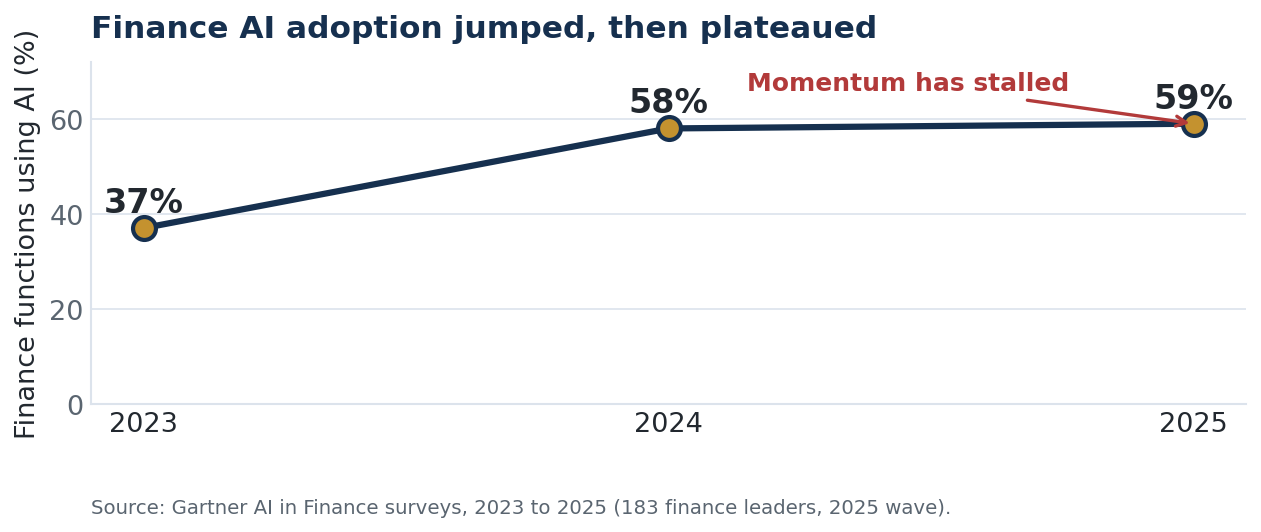
The adoption data says be selective. Gartner found finance AI adoption rose from 37% in 2023 to 58% in 2024, then flattened at 59% in 2025, and named data quality and data literacy as the biggest obstacles. The most common finance use cases are knowledge management at 49%, accounts-payable automation at 37%, and error and anomaly detection at 34%.
49%Knowledge management
37%Accounts-payable automation
34%Error and anomaly detection
The cautions come from the same analysts the vendors quote. Gartner expects more than 40% of agentic AI projects to be canceled by the end of 2027 on cost, unclear value and weak risk controls. An MIT study found that 95% of enterprise generative AI pilots delivered no measurable return, a figure Workday itself cites. AI in finance ERP is genuinely productive at reading, extracting, matching, explaining and drafting. At deciding and posting unattended it's still mostly a promise. Every vendor keeps a human on the approval step, and so should you.
The move
Treat AI agents as a governed part of scope with their own access design and audit trail, and fund them on a consumption model with a cost cap. Keep any agent that hasn't shipped off the critical path for the close. Pilot one bounded, high-volume process, use the vendor's native capability, and measure the result before you widen.
Most of the fixes have nothing to do with the technology
Across stalled programs, the fixes keep coming back to governance, ownership and authority. The best-documented turnaround makes the point. A country CFO took over a multi-year ERP program that had spent its budget and launched a single pilot entity. The fixes were structural. The program lead was made to report directly to the group CFO, which gave the authority to move fast, and a template committee including local CFOs had to approve changes above a threshold.
Those two changes cut program duration by around 30% and saved double-digit millions, with no new software and no added headcount. Authority compresses schedule, and schedule is money. Every extra year a large program runs adds roughly 15% to its cost overrun (account 1100), so governance is the one lever that buys years back.
The move
Put the program's reporting line into the CFO's office and give finance the authority to approve scope changes above a threshold.
After go-live: the value you actually signed up for
Go-live is where the value story starts. Many programs get trapped in hypercare and keep postponing the changes that deliver the case: retiring manual work, tightening controls, speeding up the close and improving working capital. Protect the core in the first 60 to 90 days, then go after the value levers. Reduce manual journals by removing root causes, raise straight-through processing in AP by cutting match exceptions, and improve cash-application match rates.
Decommission the legacy reports, duplicate interfaces and shadow spreadsheets on a defined timeline. If you leave the old tools available, people will use them under pressure and adoption slides back.
The number to move is days to close. APQC puts top-quartile finance teams under 5 days to close the monthly books, the median at 6.4 days and the bottom quartile at 10 days or more. A finance ERP that doesn't shorten the close hasn't paid for itself.
The move
Attach the business case to named KPIs with a baseline, a target and a reporting cadence: days to close, AP straight-through rate, days outstanding and manual-journal volume. Benefits nobody measures tend not to arrive.
Red flags
Accounts 5100 to 5400The red flags to run before every gate review
Data and the chart of accounts
The old chart of accounts lifted forward unchanged
Redesign it and push detail into dimensions. see 1300
Conversion shows green on a spreadsheet that never tied out
Use a numeric gate: control totals to the dollar, under 2% error. see 3100
Controls and audit
Controls and segregation of duties left for after go-live
Design the controls in and bring the auditor into the build. see 3200
Broad super-user roles granted for convenience
Grant least privilege and engineer out the conflicts. see 3200
Testing and the first close
Cutover run as a weekend task list owned by IT
Rehearse twice and run a full close before go-live. see 3300
Governance and AI
The program lead doesn't report into the CFO's office
Give finance authority over scope changes. see 4200
Modules built to demo defaults instead of your policies
Configure to your own tolerances and hard-stops. see 2010
An AI agent that hasn't shipped sits on the critical path
Pilot AI on one bounded process and measure first. see 4100
Closing entry
The decisions belong to finance
A finance ERP program is a sequence of decisions that belong to the CFO and the controller. Which modules, in what shape, on what data model, converted to what standard, controlled how, closed how, and measured against what. Make those calls early, prove readiness with numbers, and treat the first close as the real go-live. Everything else is configuration.
The software vendors are competent and the implementers are capable. What they can't do is decide how your finance function should work, and that's the decision that determines whether you land in the 70% that miss or the minority that get the value.
Related: implementing payroll, data conversion and integrations, Workday pricing and total cost of ownership, and negotiating with your System Implementer.
Sources. External figures synthesize public research and documentation from Gartner, McKinsey and the University of Oxford, APQC, Deloitte, Panorama Consulting, the U.S. GAO, the Umbrex Finance ERP Playbook, PwC, and Workday and Oracle product documentation. AI capability claims cite Workday, Oracle, SAP and Microsoft announcements and Gartner and MIT research. Field examples are drawn from real, fully anonymized enterprise programs. This article is general guidance, not legal or accounting advice.
Score your finance program before the SI does.
A pre-implementation readiness checklist across the whole program, plus a module-by-module quick reference: the common pitfall, the better move, and why it matters. Built to keep beside your program plan.
Put independent eyes on your finance ERP scope.
If your close, your controls and your first go-live ride on getting these modules right, a candid review of the plan before the build is the cheapest insurance you'll buy.