
Data & AI strategy, ERP analytics
ERP analytics: from report factory to decision engine
What it takes to implement analytics people trust, inside Workday, Oracle or SAP, and what changes in 2027 when agents start reading the data before you do.

ERP analytics
Most analytics programs fail on a decision nobody wanted to own
ERP analytics programs usually fail on a governance decision that got put off until it turned into a crisis. Gartner predicts 80% of data and analytics governance initiatives will fail by 2027, and it names the reason plainly: no real or manufactured crisis forced anyone to own them. The same research puts a price on it. That figure heads the statement of data quality.
Getting analytics to survive contact with the business comes down to five things: the stack, the governance model, the build versus buy call, the change management nobody budgets for, and the shift already under way from dashboards you look at to agents that tell you.
Letter
My examples lean on Workday Prism Analytics, the most actively evolving native analytics layer in ERP right now. The lessons hold for Oracle Fusion Data Intelligence and SAP Datasphere too.
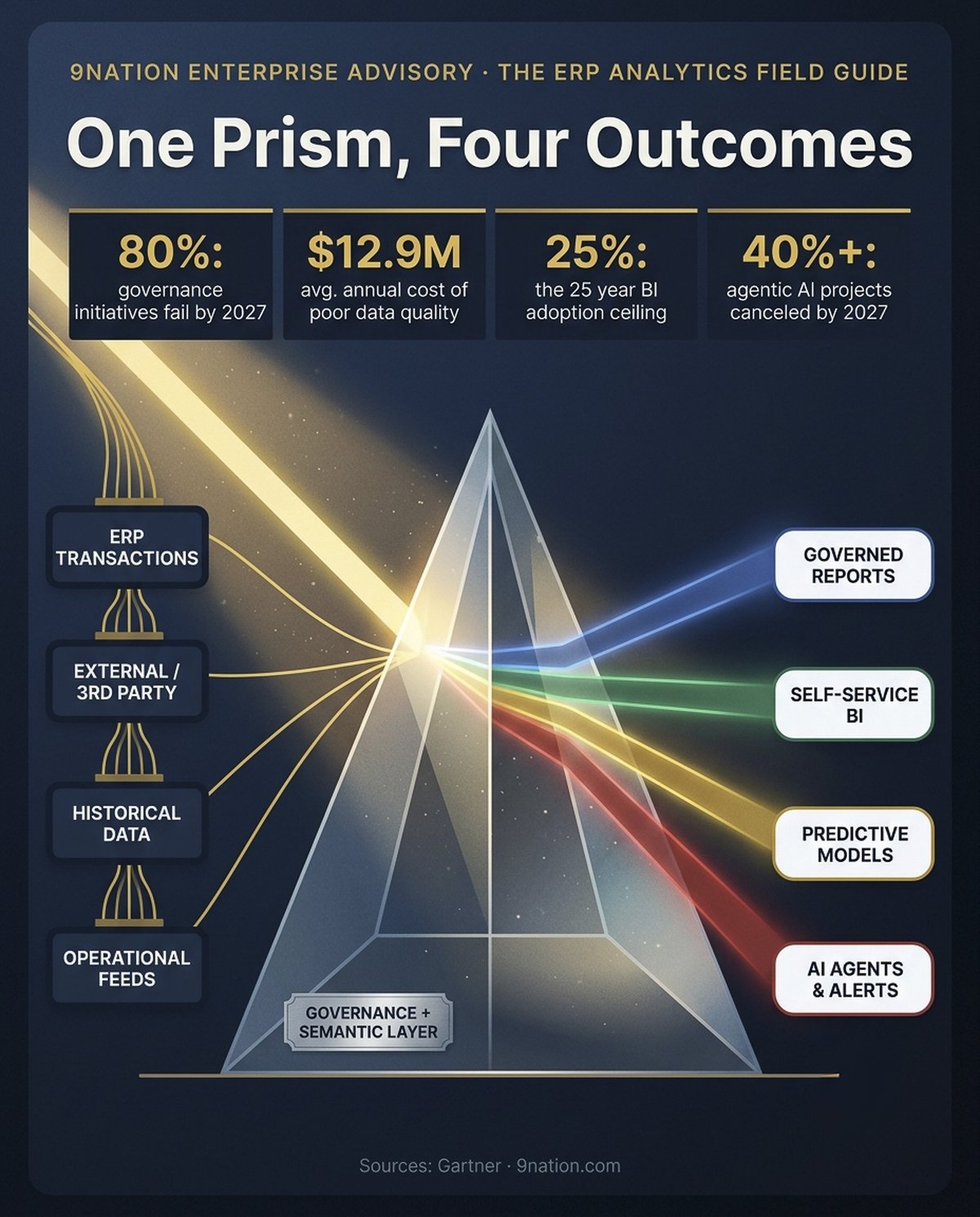
A prism is the thing light passes through to split into its true parts. A governed analytics layer does the same to enterprise data. Raw transactions and external feeds go in, and what comes out is clear enough to act on. Most programs skip the governance work and then wonder why the light never separates.
David Apollon9Nation Consulting
ERP analytics
Highlights
Employee BI adoption has barely moved in 25 years
Share of employees using BI tools
Gartner for 1998 to 2019, BARC and Eckerson Group for 2022. Note 6
From the notes
- 450%Increase in adoption Microsoft reported after adopting Prosci ADKAR for its BI rolloutNote 8
- 18Months for Workday, Oracle and SAP to converge on zero-copy accessNote 4
- 60%U.S. businesses still running meaningful parts of their operation through Excel in 2023Note 6
- 57%ECC customers projected to finish S/4HANA before the 2027 cutoff, by one analysisNote 5
ERP analytics
Primary statements
Statement of data quality
Gartner research
| Line | Figure | Note |
|---|---|---|
| Cost of poor data quality to the average organization, per year | at least $12.9m | 1 |
| Data and analytics governance initiatives expected to fail by 2027 | 80% | 1 |
| Organizations that don't measure their own data quality | 59% | 1 |
Schedule of data readiness grades
From the field: a recent AI-readiness assessment
| Area | Grade |
|---|---|
| Ownership | D |
| Duplicates | F |
| Completeness | C |
| Metric definitions | D |
| Access and security | B |
| Lineage | C |
| Legacy baseline, before anyone starts cleaning | |
| Duplicate-record rate | about 10% |
| Field error rate | about 22% |
That baseline wasn't unusual. Every grade was fixable, and none of them had been graded before.
Primary statements
Reconciliation of legacy reports
One migration, from the field
| Line | Reports | Note |
|---|---|---|
| Legacy reports in scope for rationalization | 400 | 6 |
| Less: consolidated, replaced by self-service or retired | (310) | 6 |
| Rebuilt because someone could show a real, current use | 90 |
Nobody missed the retired ones.
Statement of data flows
Raw data in, one governed pass through, four outcomes out
| Flow | Line | Note |
|---|---|---|
| In | ERP transactions, the system of record | 2 |
| External data, blended with the ERP data | 4 | |
| Through | Governance and the semantic layer | 3, 5 |
| Out | Governed reports, one definition of truth | 5 |
| Self-service BI | 6 | |
| Predictive models | ||
| AI agents, only as good as the data beneath them | 9 |
ERP analytics
Notes to the statements
Notes
Note 1
Why analytics programs fail before they start
Every ERP analytics program starts the same way: a go-live, then a request for "just a few more reports," then a hundred more. Nobody assigns an owner to the data quality behind those reports, because assigning an owner feels like a delay and building the report feels like progress.
The pattern shows up early and it shows up late. Early, it looks like duplicate vendor records and three different definitions of "active employee." Late, it's an executive asking why the AI agent gave a different headcount than last week's dashboard, and nobody in the room can answer.
PolicyName a data governance owner and a data steward for each domain before the first dashboard ships, well before the tenth complaint about one.
Figures: statement of data quality and the readiness grades.
Note 2
Strip the marketing and all three vendors share one architecture
Under the marketing, Workday, Oracle and SAP run close to the same architecture: source systems, a blending or preparation layer, a semantic layer that defines what the numbers mean, and a delivery layer for reports and dashboards. There's now a fifth layer that reads the modeled data and acts on it directly.
The vendors differ in how they package the blending and preparation work.
| Workday | Prism Analytics, a governed data hub that blends transactional and high-volume external data with native Workday data, for reporting beyond what standard Workday reporting can do. Since the 2025R1 release it's tables-based, with stronger lineage and a visual pipeline view. |
|---|---|
| Oracle | Two products, on purpose. Oracle Analytics Cloud is the build-your-own layer. Oracle Fusion Data Intelligence is the buy-it-built layer: four separately licensed modules for ERP, SCM, HCM and CX, shipping prebuilt pipelines and dashboards. |
| SAP | A parallel split between S/4HANA Embedded Analytics, BW/4HANA, and SAP Analytics Cloud paired with SAP Datasphere, the newer unified data and semantic layer. |
PolicyMap your current reporting tools to these five layers before you buy a sixth one. Most sprawl comes from filling the same layer twice.
Note 3
Data governance comes first
The clearest guidance on Prism implementation is also the least glamorous: build governance first. Define security roles, access controls, ownership and publishing workflows before you expand usage, because Prism's value scales with the governance model underneath it.
The same discipline applies outside Workday. A recurring finding in Oracle Fusion Data Intelligence implementations is that success comes down to sequencing. Don't start until clean, complete data is available in the source system. And don't force the tool on people who don't yet feel the reporting pain it solves.
- Control that comes built in
- Prism inherits Workday's own security model and enforces separation of duties between whoever creates a dataset and whoever publishes it. Most organizations would otherwise have to invent that control themselves.
PolicyGrade your data before you pilot AI on it. A grading exercise costs a week. Finding out the grade inside a failed agent pilot costs a quarter.
Note 4
All three vendors landed on zero-copy access within 18 months
Within about 18 months of each other, all three major ERP vendors converged on the same idea: zero-copy access to external data platforms instead of moving everything into one place.
The shared lesson: the platform that wins governs its data well enough that copying it becomes unnecessary.
- September 2025
- Workday announces Workday Data Cloud, built on zero-copy sharing with Snowflake, Databricks and Salesforce Data Cloud.
- First half of 2026
- Workday Data Cloud reaches early-adopter customers.
- Oracle
- Solves the reverse problem with a Custom Extractor Framework, so customers can self-serve ingestion of unsupported data sources into Fusion Data Intelligence.
- SAP
- SAP Datasphere, which SAP's own CTO describes as the foundation for a "business data fabric": data, semantics and process connected in one governed layer, without duplication wherever possible.
Note 5
The layer most programs skip is the one Gartner now calls mandatory
Most ERP analytics programs skip the semantic layer. Gartner's March 2026 top predictions say that by 2030, universal semantic layers will be treated as critical infrastructure, alongside data platforms and cybersecurity, specifically to keep AI systems from inheriting and amplifying "multiple versions of the truth."
Inside Oracle's ecosystem the confusion has a specific name: OTBI versus BI Publisher versus OAC versus FDI. They're four tools with different jobs, and more often than not they get picked without a plan.
- December 31, 2027
- Mainstream maintenance ends on SAP BW 7.5, the same date as ECC mainstream support. One analysis projects only around 57% of ECC customers will complete their S/4HANA transformation before that cutoff.
PolicyDefine your top ten metrics once, in a governed semantic layer, before a single new dashboard gets built on top of them.
Note 6
Employee BI adoption has barely moved in 25 years
Employee-level BI adoption was around 19% in 1998, 22% in 2009 and 35% in 2019, per Gartner, then back down to 25% in a 2022 BARC and Eckerson Group study. One explanation: analytics tools are built for analysts, and analysts are roughly a quarter of any workforce, so a tool built for that quarter caps out around that quarter.
The predictable side effect is shadow IT. As of a 2023 update, roughly 60% of U.S. businesses were still running meaningful parts of their operation through Excel.
Migrations put the sprawl in a single number, because every legacy report has to be triaged at once. On one real program, 400 legacy reports came into scope for rationalization. Ninety were rebuilt because someone could show a real, current use. The rest were consolidated, replaced by self-service or simply retired.
PolicyBefore migration, run every legacy report through one question: who opened this in the last 90 days, and can you name them? If the answer is no, retire it before rebuilding it.
Figures: the adoption chart and the reconciliation of legacy reports.
Note 7
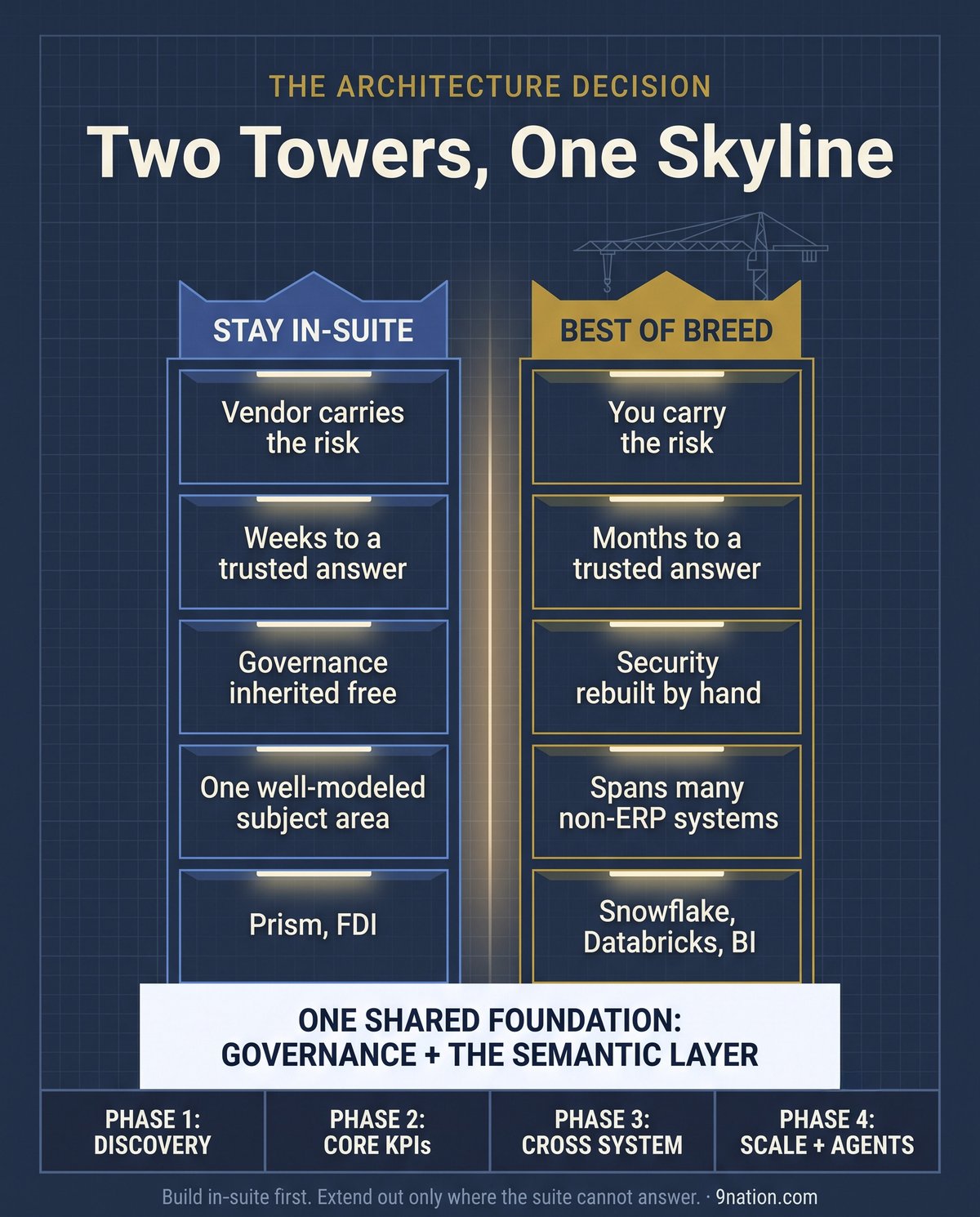
Treat the suite versus best of breed call as architecture
Most mature programs need both, sequenced correctly. The in-suite side and the dedicated platform stand on the same foundation: governance plus the semantic layer.
- First
- Govern and answer the core ERP questions in-suite.
- Then
- Extend out to a dedicated platform only for the questions the suite was never going to answer well.
Note 8
Change management is the non-technical reason programs die
Prosci's own research puts a hard number on this. Projects with extremely effective sponsors are 79% likely to meet their objectives. With extremely ineffective sponsors, that drops to 27%. Microsoft's internal BI platform is a documented case: after adopting the Prosci ADKAR model for its reporting rollout, Microsoft reported a 450% increase in adoption.
Weak sponsorship shows up as a symptom long before anyone calls it the root cause. The symptom is a decision backlog: questions raised in a steering meeting that never get formally closed. Every decision that sits open past 60 days starts acting like debt, accruing interest in the form of rework and rebuilt trust.
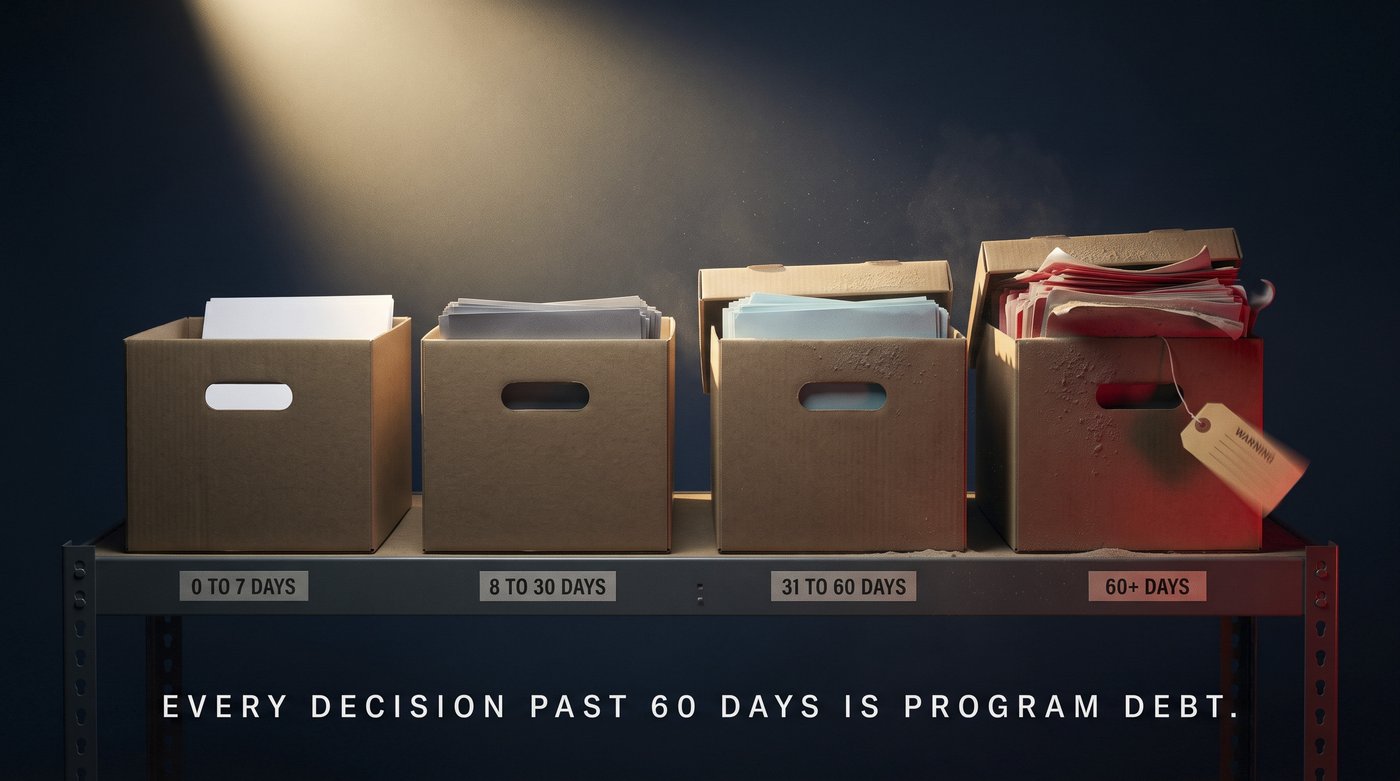
Aging of open decisions
- 0 to 7 days
- 8 to 30 days
- 31 to 60 days
- Past 60 days
Past 60 days, an open decision is carried as program debt and accrues interest every day.
From the field: the decision shelf
On one program, the gauge that mattered most was a plain count of decisions sitting unmade past 60 days. Naming an owner and a date for each one moved that number faster than any technical fix did.
PolicyPut decision velocity on the steering committee's metrics, right next to task completion. An aging decision backlog predicts an adoption failure months before the go-live does.
Note 9
Every vendor's AI layer sits on the governed data, or on nothing
Every major ERP vendor now ships an AI layer that sits directly on top of the governed data foundation. Workday positions Prism explicitly as the governed data foundation feeding Workday Illuminate agents. Oracle's answer is AI Agent Studio for Fusion Applications, a no-cost development platform for building and orchestrating agents. SAP's Joule is moving the same direction inside SAP Analytics Cloud.
The guidance that holds up across all three ecosystems is the same: start with one or two high-value use cases, prove the return, and only then expand.
- Contingent liability: Flex Credits
- Workday licensing moved at the same time to a consumption-based Flex Credits model. As of a May 2026 partner update, Workday hadn't published a public rate card for that cost. That's a real forecasting risk, and some partners already call it FinOps for AI.
PolicyBefore buying AI credits, agents or licenses of any kind, pick the single highest-value use case you can prove in 90 days. Everything else waits.
ERP analytics
Outlook: from dashboards to agents in 2027
The honest starting point for 2027 is Gartner's own warning about agentic AI cancellations, plus a sharper one aimed at analytics projects that skip the semantic layer. The near-term failure rate doesn't change the direction, though. Gartner also expects agents to be making a share of day-to-day work decisions by 2028.
Salesforce's Tableau introduced an Agentic Analytics Platform in May 2026, built around the idea that the truth should come to the user instead of the user going to a dashboard. The trust gap is real and measured: more than half of U.S. desk workers now describe themselves as AI skeptics, citing generic outputs and repeated hallucination headlines.
Outlook
Forward-looking statements
Gartner predictions
| Prediction | Share | By |
|---|---|---|
| Agentic AI projects canceled, due to escalating costs, unclear business value or inadequate risk controls | over 40% | end of 2027 |
| Agentic analytics projects that fail when they rely solely on protocol-level connections without a consistent semantic layer | 60% | 2028 |
| Day-to-day work decisions made autonomously through agentic AI | at least 15% | 2028 |
| Enterprise software applications that include agentic AI | 33% | 2028 |
PolicyBuild the semantic layer now. It's the only piece of the stack that survives the move from dashboards to agents intact, and it's the piece most programs still treat as optional.
ERP analytics
Most programs stay a report factory because governance goes to tooling
Opinion
Most programs never get past being a report factory. They spend their governance budget on the tool and their political capital on the go-live, and they never get around to naming who owns the truth.
The programs that work do the boring thing first. They grade the data, name an owner, kill more reports than they build, and only then let an agent anywhere near the result.
David Apollon9Nation Consulting
Sources. External figures synthesize public research and documentation from Gartner, BARC, Prosci, IDC, McKinsey, Diginomica and ComputerWeekly, plus Workday, Oracle and SAP product and AI documentation. Field examples are drawn from real, fully anonymized enterprise programs. This article is general guidance, not legal or financial advice.
Score your analytics stack across nine areas.
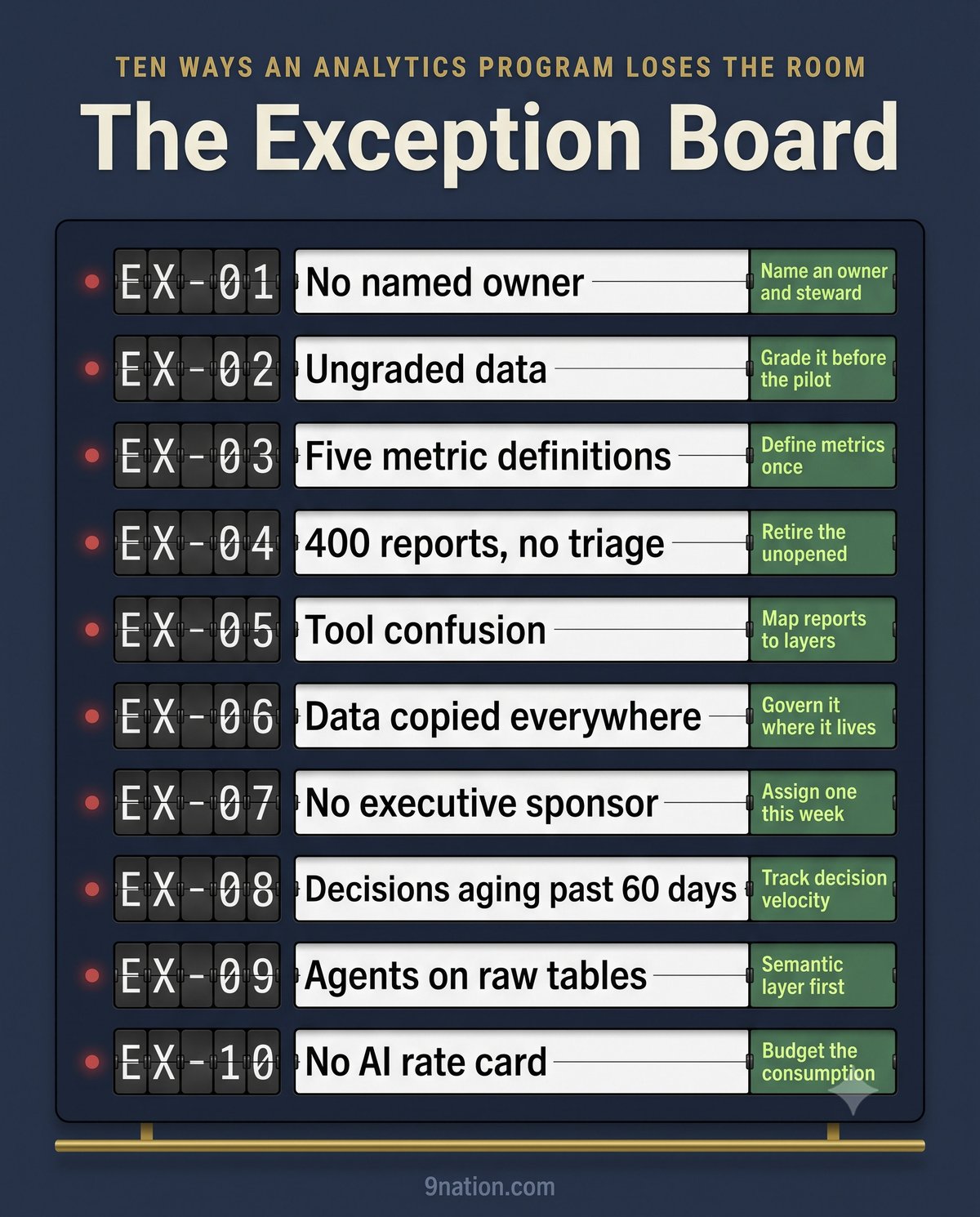
A pre-implementation readiness checklist across nine areas, plus an area-by-area quick reference: the common pitfall, the better move, and why it matters. It also carries the full register of ten ways an analytics program loses the room, with the fix for each. Keep it beside your program plan.
Put independent eyes on your analytics roadmap.
If executives are already asking why two reports disagree, a candid review of the governance and semantic layer before you scale AI on top of it is the cheapest insurance you'll buy.