
Field guide · Workday Adaptive Planning
Adaptive Planning fails at the first close, not at go-live
Eight decisions decide the outcome. Most get made before anyone opens the tool.
A competent partner stands up a working budget model in a quarter. That's the safe part.
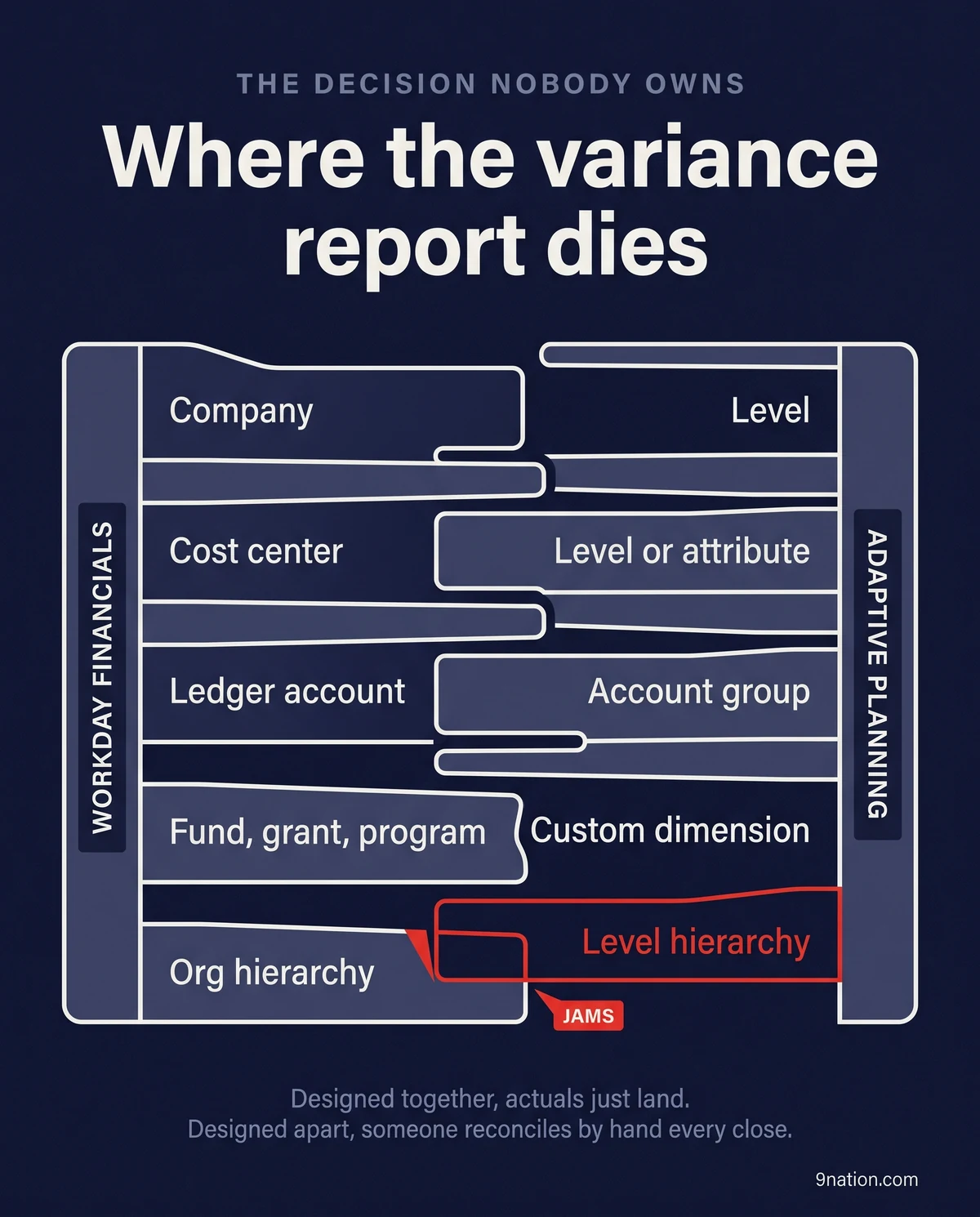
Plan structure and actuals structure don't line up, and the variance report turns into a two-day reconciliation.
Most of the effort goes into mapping worktags, cost centers, companies and ledger accounts to Adaptive dimensions. The modeling is the smaller job.
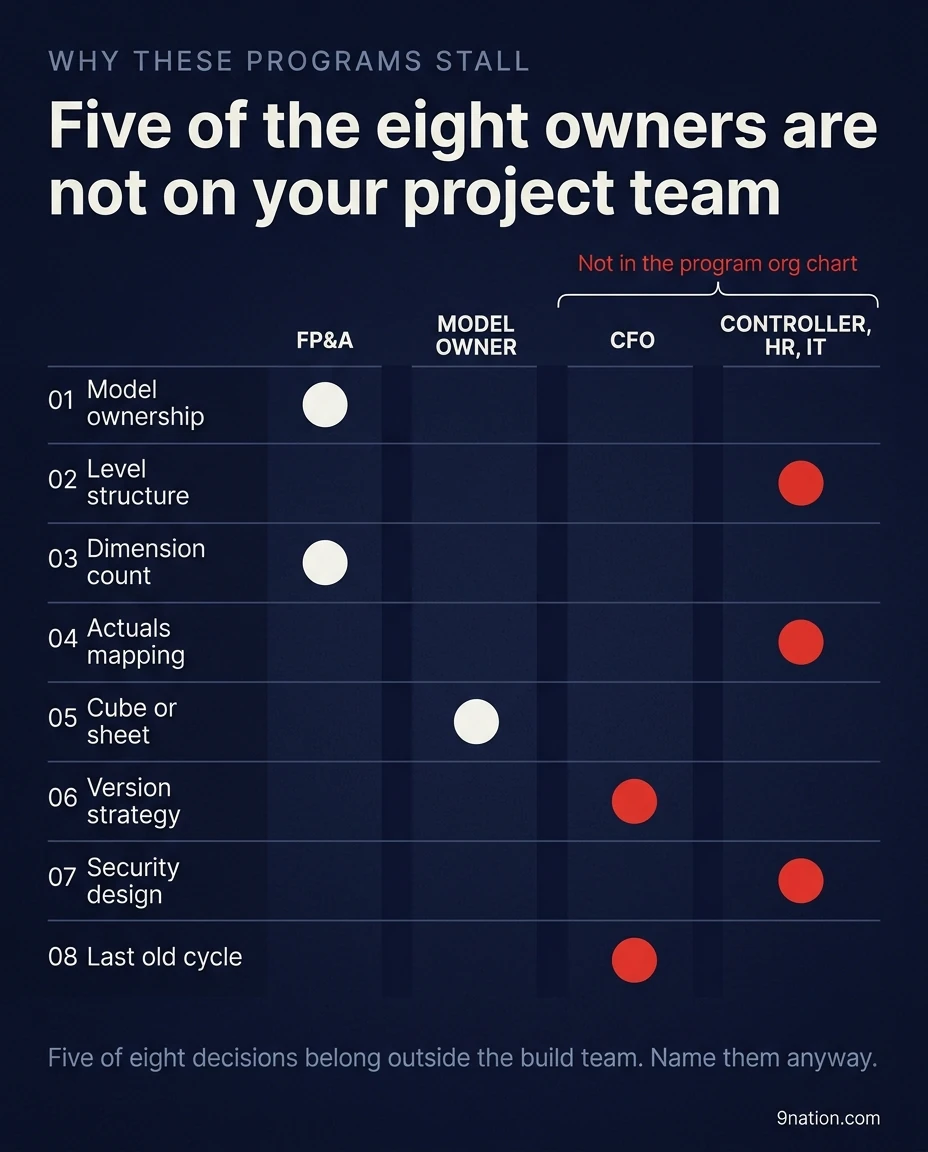
Five of the eight decisions belong to people who don't think they're on the project: the CFO, the controller, HR and IT security.
Plan 7 months. Workday's published average of 4.5 doesn't survive contact with a real chart of accounts.
Get the mapping and the ownership right. The rest is configuration.
Start with the real timeline
Workday puts average deployment at 4.5 months. I haven't seen one land there.
Partner incompetence doesn't explain the gap between the brochure and the field. Two things do: the mapping work nobody scopes, and one full planning cycle in parallel before the old process can be retired. Neither is optional, and neither is in the estimator.
The software will do what it says. Whether you get the cycle time back is decided in design.
The eight decisions
These are decisions to make, and each one has an owner who doesn't work for your implementation partner.
Owning it means deciding what the model does, approving a change and answering for the number in front of the CFO. Administering it is a different job. Name a person and a backup.
The model becomes an IT ticket queue. Mid-cycle changes wait on a sprint, and planners route around the system instead of through it.
Levels carry cost centers, departments, entities and regions. They drive sheets, reports, security and workflow at once, which is why a sloppy level design surfaces in four places.
Two things worth knowing. Adaptive supports ragged hierarchies, so branches don't all need the same depth. And level attributes handle most grouping needs without adding a dimension.
Actuals need translating on every load. The mismatch never gets fixed. It gets absorbed by a person doing it by hand.
Practitioner guidance puts the workable account range at 500 to 2,000, with calculation performance degrading past about 3,000. Check whether an attribute, an account structure or a report filter would do the job first.
Sheets get slow. Slow sheets send planners back to Excel, and adoption is the one thing configuration can't fix afterward.
Two patterns are normal: the native Workday to Workday connection when both products sit on one tenant, or an EIB load when you need transformation control or actuals from more than one ledger.
Neither is zero configuration. Somebody decides which worktags, cost centers, companies and ledger accounts map to which Adaptive dimensions. That mapping is most of the real work.
It also depends on a stable chart of accounts. An Adaptive rollout running next to an unfinished COA redesign will map twice. And the refresh belongs on the close calendar, because actuals loaded before the close is final show numbers that will change.
This is the one that shows up at the first close. The Mapping sheet shows where.
Cubes handle high-volume, multi-dimensional actuals. Sheets suit driver logic at a summary level. Most mature models are hybrid, which is fine when it was chosen.
Retrofitting a cube after several cycles of loading into sheets is a rebuild, and it takes the reports with it.
Actuals, budget, working forecast, prior forecast, long range, scenarios. The ceiling is 200 versions. Performance and human comprehension both live near 15 to 20 active. Virtual versions keep reporting views stable while the plan versions underneath them change.
Two people bring different forecasts to the same meeting. After that happens once, you're repairing trust first and implementing a platform second.
Actuals carry different sensitivity than plan data. Access should follow who enters, reviews and consolidates, because those three people are often in three different places on the org chart.
I watched one over-broad role on a compensation object stop an entire end-to-end test cycle for a week. Every script that touched pay had to pause. The build was fine. The design decision wasn't.
A week of testing, at the point in a program where a week is most expensive.
Pick the date the spreadsheet process stops. Run one full cycle in parallel, prove the new one, and retire the old one on the announced date. It needs to be a date on the finance calendar. An intention won't hold.
Both processes run indefinitely and the spreadsheets win. They're already trusted, and nobody needs permission to change one.
Three of the eight sit inside the build team. The other five sit with people who were never given a seat on it.
Model constraints come from Workday documentation and published practitioner guidance, listed on the Sources sheet.
Where the variance report dies
Two structures have to face each other. Designed together, actuals land and variance reporting is a version-and-period selection. Designed apart, something translates between them every month, and that something is a person with a spreadsheet.
What's still recoverable, and when
Decisions harden as the program moves, and each one stops being cheap at a different point. Cheap to change ends right after design. Anything still open after that is being settled by whoever builds first.
Whatever was assumed about mapping is now visible to Finance. The only cheap moves left are naming an owner and setting the retirement date.
Score your own program
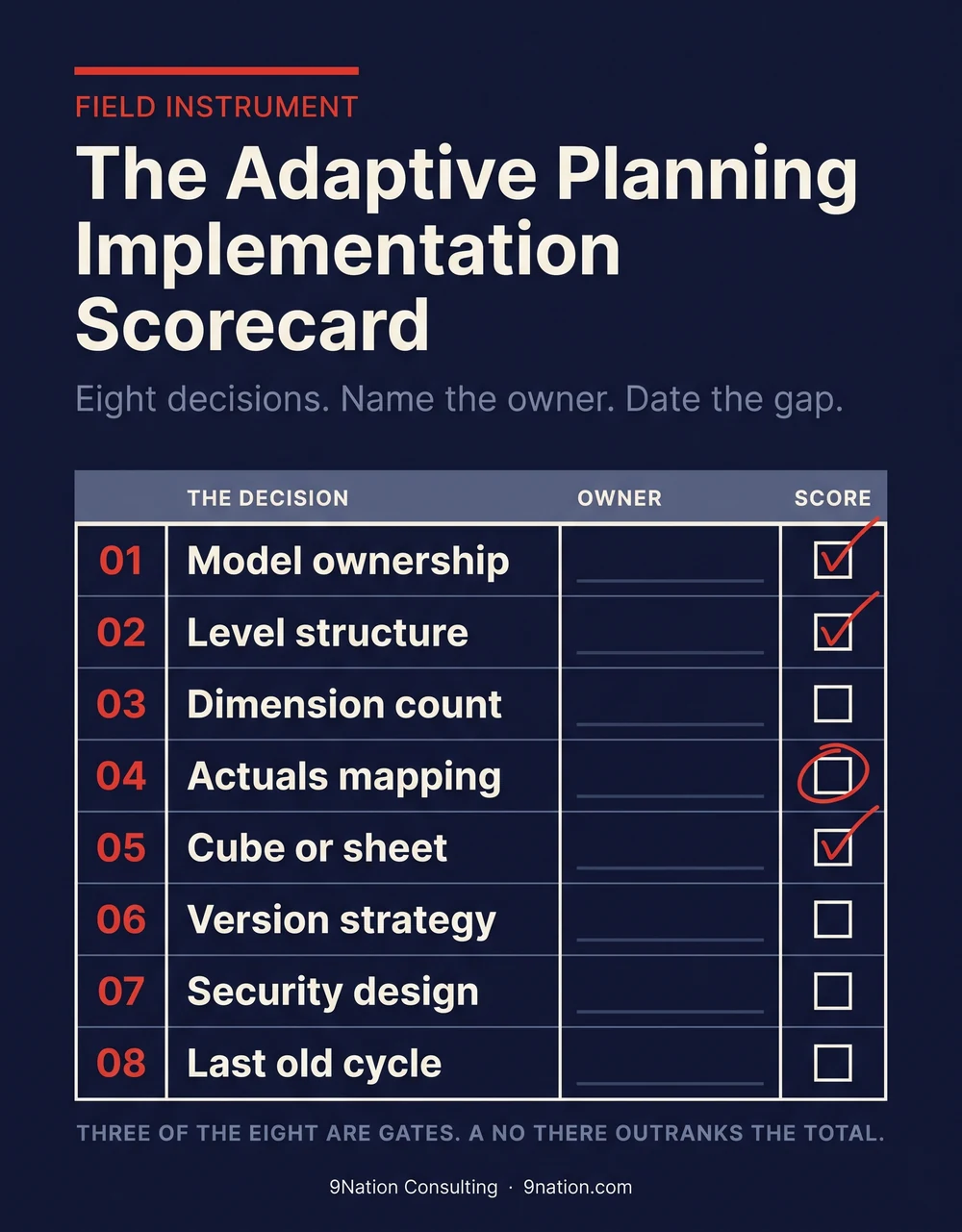
Eight questions. Decisions 1, 2 and 4 are gates: anything short of a Yes on one of them outranks the total.
Answer all eight
You have 0 of 8. The gaps are the interesting part, so answer No where the honest answer is No.
Nothing is sent anywhere. This runs in your browser.
Practices that hold
Most published advice for this platform is about attitude. These are the ones I'd hold a program to.
Departments make poor phases, because no single department's plan is a complete cycle. Each phase should end with something Finance can run.
Build for those and nothing else in phase one. A model that answers five questions well gets used. One that could answer forty gets abandoned.
Someone entering numbers next quarter, full time, with authority to say no planner will do that.
Three mock loads minimum. Under 2% error on the final one. Control totals reconciled to the dollar by Finance.
It's the step everyone skips. A feed that loads clean and still yields an unreadable variance report has passed the wrong test.
One cycle, both ways, differences explained. Parallel running exists to prove the new process. Don't let it turn into a lifestyle.
Two Workday releases a year, each with roughly a five-week preview. Someone owns regression-testing the model against both.
Stale versions, unused dimension values, test accounts. Retire a level with version availability, never deletion, or you lose history.
Workday announced Adaptive Decision Intelligence in May 2026, and the Illuminate planning agents are landing through the year. They're useful, and they raise the stakes on everything above. An agent answering questions against a badly mapped model produces confident wrong answers faster than a person could. Governance first.
Seven lessons, and what each cost
Every one was preventable at design for less than it cost to fix.
Every tab became a sheet. The approval chain stayed as it was. Scout24 went in with a budget cycle spread across 90+ Excel files, and rebuilding that faithfully is the most common way to change nothing.
Account groupings didn't match and cost center hierarchies diverged. By the third cycle the variance report was being rebuilt in Excel every month, live and irrelevant at the same time.
Cause: a level structure designed in isolation from the Financials hierarchy.
On a program this year, finance and procurement loads kept failing. No single person owned validation rules across the modules, so every team assumed another had it.
On one program, 400 "critical" legacy reports collapsed to 90 against the actual run logs. Nobody asked for the other 310 again.
At one client, 80 small customizations added three weeks of regression to every release. Two releases a year. In Adaptive the equivalent is a dimension added for one request and account links chained three deep.
One role exposed compensation data wider than intended. Every test script touching pay had to wait while it was redesigned.
Parallel running was meant to last one cycle. Nobody set the date, so it lasted four. The new tool became the place you entered numbers a second time.
The 90-day test
Ninety days after go-live, look for five things you can observe. Skip the adoption percentages.
Actuals landed on the close calendar without anyone asking, and they tie to the general ledger.
The variance report came from selecting a version and a period. Nothing was exported.
A planner outside Finance entered their own numbers without calling FP&A.
Someone asked a scenario question in a meeting and got the answer in that meeting.
The old spreadsheet process has an end date, and it has already passed.
It worked, and the fifth is fixable.
The model gets quietly abandoned inside a year. The time to intervene is while the partner's design decisions are still recent enough to trace.
Get the scorecard
The same eight decisions on two printable pages, with an owner column and a due-by column. Print it and argue over it with the people whose names go in the middle. That argument is the deliverable.
Sources and attribution
The 7-month average, 16 weeks for financial planning only, 8 months with workforce or consolidation added, the conversion gate thresholds, 400 reports to 90, the 80 customizations, the security role and the validation ownership fix. I haven't personally run an Adaptive Planning implementation. The Adaptive-specific failure patterns come from the sources below, and I don't claim them as mine.
Scout24, reported by Workday.
Workday Illuminate agents and the May 2026 Adaptive Decision Intelligence release.
Put independent eyes on your program.
If you're betting tens of millions on an ERP program, a candid second opinion is the cheapest insurance you'll buy.