
Client-side PMO for enterprise programs
Your systems implementer is accountable for their scope. Nobody is accountable for your whole program unless you make somebody accountable. I am the owner on your side of that line.
Large technology programs rarely fail on the software. McKinsey and the University of Oxford found large IT projects run 45% over budget while delivering 56% less value than predicted. BCG found only 30% of transformations hit their target value, and said plainly that the people dimension is usually the determining factor. Those are management gaps, and management was never in the implementer's scope.
I run the client side. Independent, with no stake in how many hours the program burns and no contract to protect except yours. The work is to hold one plan, drive the risks, keep the workstreams integrated, and put a status in front of your leadership that is worth acting on.
The shift I create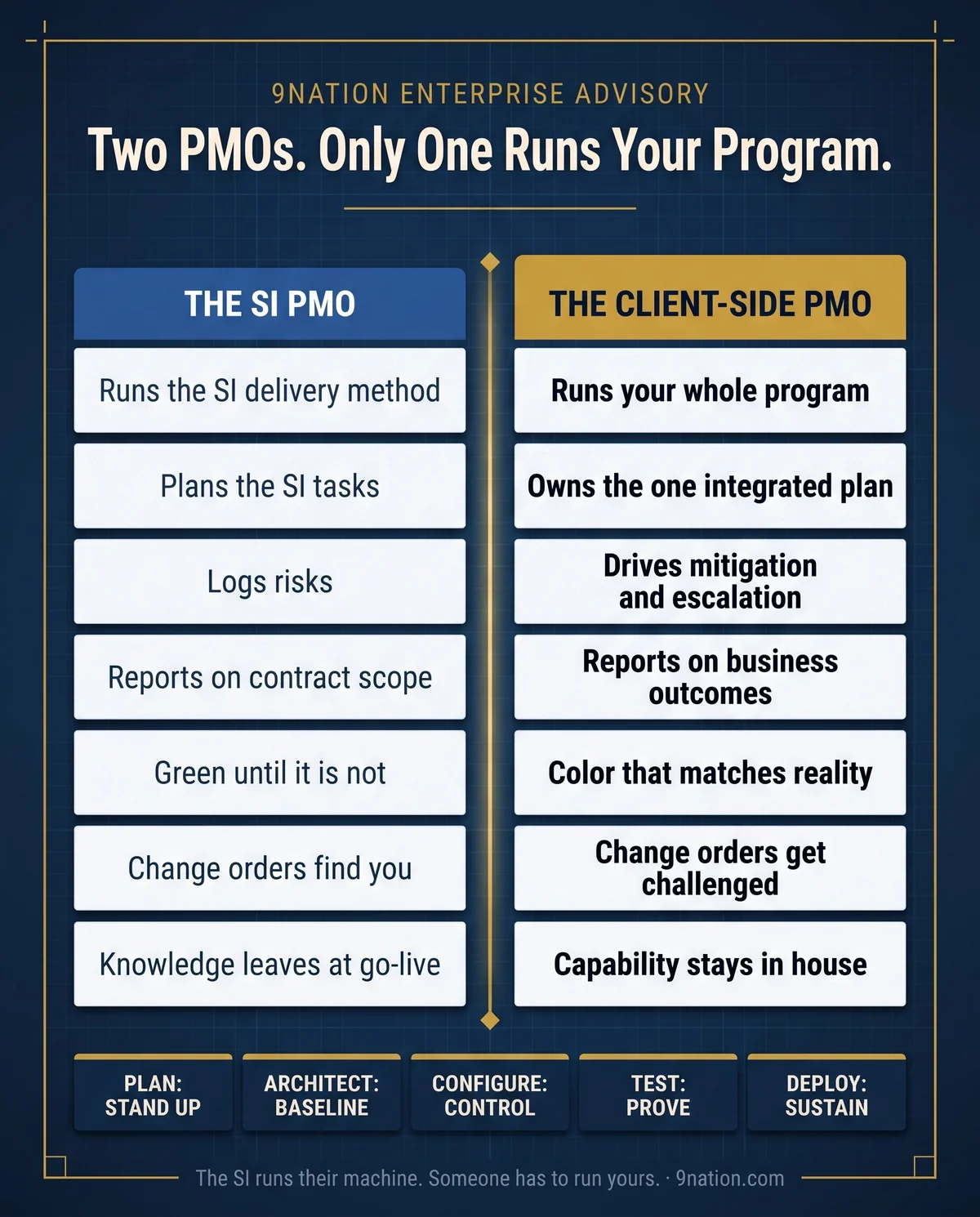
Five accountabilities, owned end to end.
Each one is the point where a specific failure mode gets caught, and each is routinely assumed to belong to somebody else.
Delivery execution
Day-to-day delivery across every workstream. Not monitoring the milestones. Meeting them.
The integrated plan
One plan holding both sides at working detail, jointly baselined and under change control.
RAID ownership
Named owners, dated next actions, pre-agreed escalation triggers. A system, not a log.
Workstream alignment
Functional, technical, data, testing, change, and security on one weekly drumbeat.
Honest status
Written RAG criteria, movement not position, and a first red that is met with support.
Decision velocity
A tracked decision backlog with owners and dates. Programs stall on decisions, not effort.
Estimate challenge
Somebody on your side, resourced well enough to test what the implementer proposes.
Readiness & stage gates
Written criteria rather than opinion, and long-lead items started two stages early.
Benefits ownership
Named benefits owners in the business, still named 12 months after go-live.
Capability retention
The reasoning behind decisions stays with you when the consultants roll off.
The full field guide, and a toolkit for your first 90 days.
The client-side PMO guide
All five accountabilities in depth, the SI PMO versus client-side comparison, and the one lever that matters most in each area.
Read the guideThe client-side PMO toolkit
A first 30, 60, and 90 day stand-up checklist, plus a pitfall-by-pitfall quick reference. Built to bring straight into your first week.
Download the toolkit (PDF)Twelve red flags
The client-side warning signs that look normal in a status meeting, with the fix for each, inside the guide.
See the red flags →Put an experienced owner on your side.
If you are about to commit to a major ERP, CRM, or transformation program, the client-side PMO is the role that decides whether you get what you paid for.