
Workday's AI bet, second of three
Illuminate and the Agent System of Record: how Workday puts the pieces to work
Six acquisitions are raw material. The interesting question is the assembly: how the pieces fit, which agents are real in 2026, and which ones you should let someone else debug first.
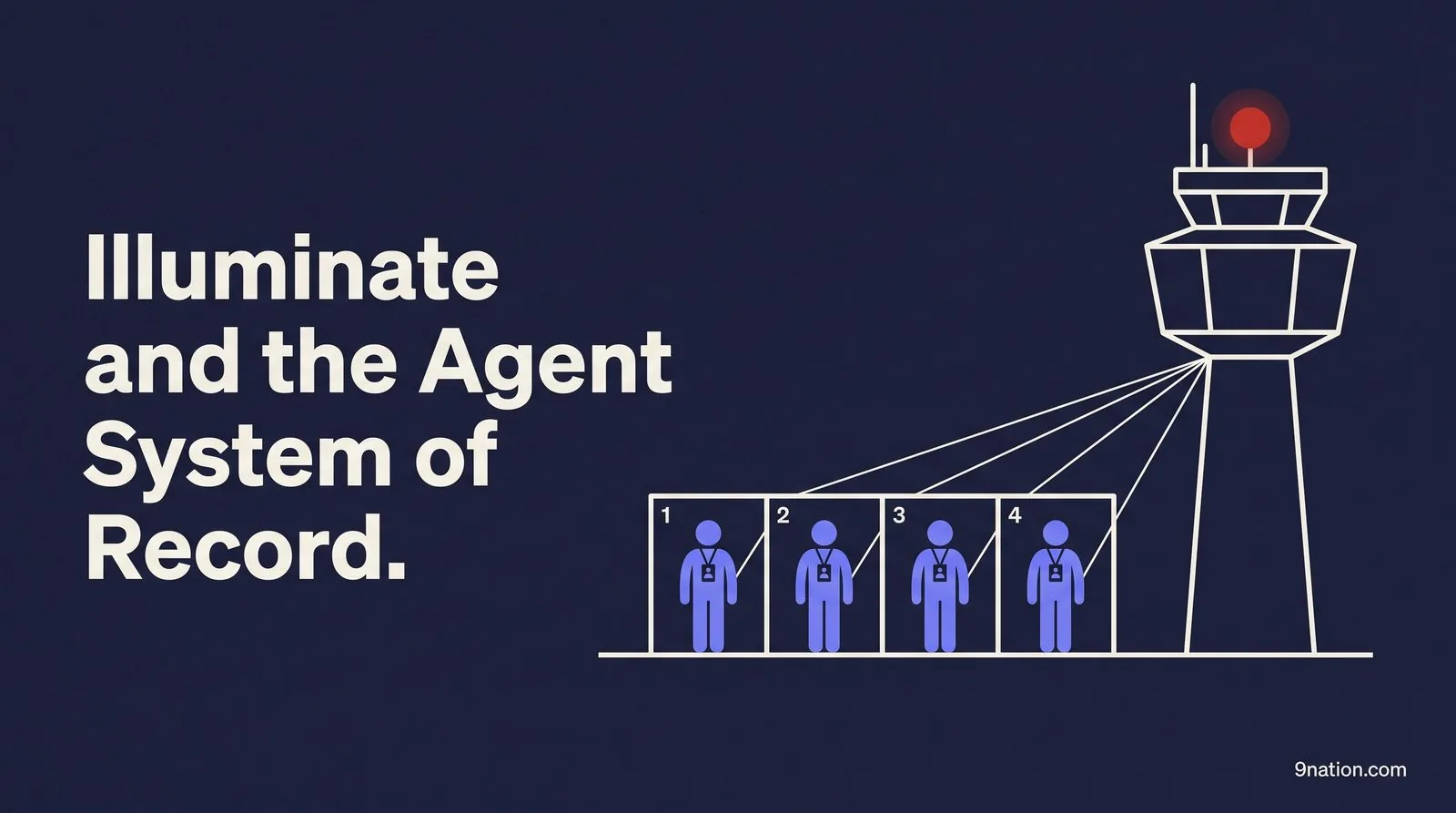
The last article mapped what Workday bought. This one is about what Workday does with it, and what you should do about that if you run the platform.
I've led more than 20 Workday programs. My read is that the architecture is genuinely smart in one place and oversold in another. For a buyer, it's mostly a sequencing decision.
The architecture
Strip the branding and there are five layers
Illuminate is the umbrella, the name Workday puts on its AI platform. Four working layers sit under it, and there's a sixth piece that hardly anyone names.
Illuminate
It's a brand. There's nothing called Illuminate that you can buy, so don't let the name stand in for a question about what the thing can do.
Role-based agents
Software workers aimed at specific jobs in HR, finance and industry workflows.
This is where the pilots live. Sequence them. Don't switch them all on at once.
Sana, the front door
The acquired knowledge layer. A person asks in plain language and starts an action.
It changes the entry point to your systems, which changes your support model.
Build, the workshop
Flowise-derived tooling for making your own agents.
Roadmapped for the first half of 2026. For now that's a promise. It isn't in your tenant yet.
ASOR, the Agent System of Record
Manages every agent once it exists.
The control layer. Generally available since February 2026.
The sixth piece
Agent Gateway
Workday's plumbing for agents to talk to other agents and other systems, on open standards.
Where the real engineering is. Early adopters got it at the end of 2025, and the partner network has grown past 65.
The Gateway is the unglamorous part. It decides whether any of this works at scale, and it's further along than the marketing implies. Ask about it before the agent demo starts.
The control layer
ASOR is the genuinely new idea
Most of what vendors call AI innovation is a copilot with a new name. The Agent System of Record is a real idea, and Workday deserves credit for it.
The premise: if agents are going to act inside your business, they have to be managed like employees. Workday made ASOR generally available in February 2026, and every agent in it gets four things.
Agent record
Agent System of Record
- Identity
- One per agent, the way an employee gets one.
- Role and scope
- A defined job, and a limit on what it can see and do.
- Audit trail
- A record of what it did. It's the only thing that survives a dispute.
- Owner
- A named person who can switch it off. When an agent is confidently wrong, that's the control that matters.
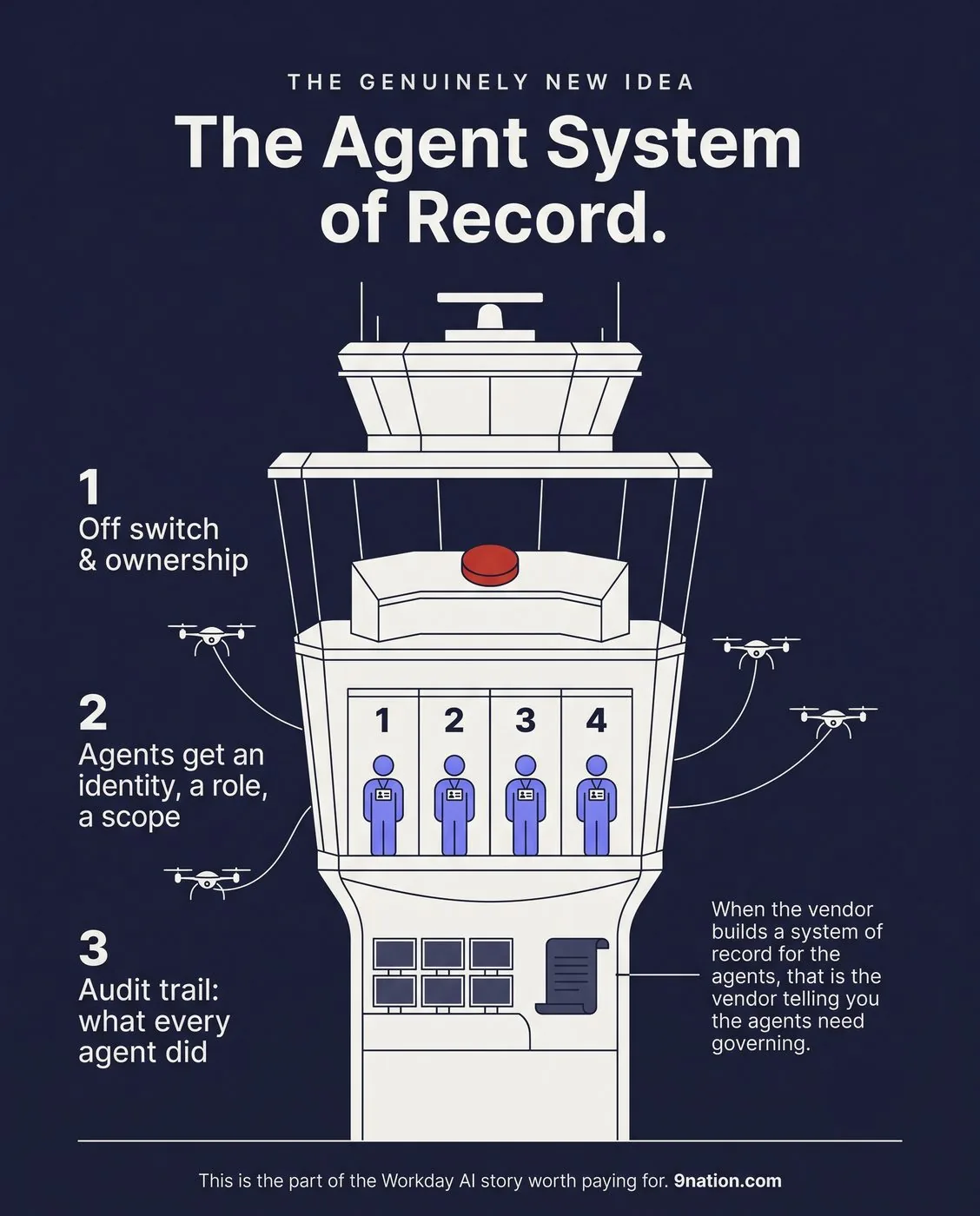
Think about what the vendor is admitting by building it. A feature is something you toggle on. Agents get onboarded and supervised, and when they misbehave they get disciplined or terminated, like anyone else on staff. A platform that gives you a system of record for agents is telling you, plainly, that they're a workforce you have to govern.
That's the part of the Workday story I'd pay for, because it's the control layer that makes the exciting parts safe to run.
Shipping and roadmap
The agents that are actually real in 2026
Here's where you separate what's shipping from what's on a roadmap.
12
of Workday's own agents in general availability in the March 2026 release
400+
customers in the early-access program before it
65+
partners on the Agent Gateway network
Shipping now
Workday put twelve of its own agents into general availability in its first 2026 release, in March, after an early-access program with more than 400 customers.
- A recruiting agent
- Finance and expense agents
- Industry-specific agents
They're role-based and they're in tenants. Most are built to recommend and assist, with a human in the loop.
Further back
- Build, the Flowise-based tooling
- The Pipedream wiring
Both came out of the 2025 shopping spree. They're dated for 2026, but they're newer and less proven in production.
- End of 2025Agent Gateway reaches early adopters
- February 2026ASOR generally available
- March 2026Twelve agents generally available
- First half of 2026Build, roadmapped
- 2026Pipedream wiring, dated
When a roadmap slide shows all of it on one confident timeline, remember that a shipped agent with 400 customers behind it and a builder still being integrated aren't the same maturity, even when they share a slide.
Pilot this, park that
If you run Workday, it's arriving whether you adopt it or not
Whether to adopt Workday AI was never really your call. If you run Workday, it's coming into your tenant. Your decision is which agents to pilot now and which ones to let other companies debug on their own budget.
Pilot
The ones that recommend, where a wrong answer is cheap and gets caught.
- Knowledge search through Sana. The worst case is a bad answer that a person reads and throws away.
- Recruiting screening. A human still makes the actual call.
- Expense and anomaly flagging. The agent points and a person decides.
High volume, low blast radius, a human at the gate. You get real learning and real productivity with a small downside.
Park
The ones that act unattended on things you can't undo.
Anything that posts to the ledger, runs payroll or moves money without a person in the loop. It belongs in someone else's pilot first.
The newest roadmap pieces, until they've shipped and settled. Build and the deepest cross-system automation are the least proven parts of the platform. There's no prize for being the first customer to run an unfinished agent builder against production.
Workday's own returning CEO drew this line for you when he said you can't have probabilistic outcomes in running a payroll. When the vendor's chief executive tells you where the technology shouldn't go yet, believe him, and let the early adopters find the edges on the irreversible stuff.
Mid-flight
What this means for a program mid-flight
If you're in the middle of an implementation right now, don't let AI derail a program that's already working. Agents change your future-state design, your security model and your testing approach. Bolt them onto a program that's behind and you'll miss a go-live date for a feature you didn't need on day one.
Do two things instead.
Reserve the governance seat now.
Name the person who'll own agent behavior, access and cost, so the role exists before the agents do.
Put an agent pilot on the roadmap for after stabilization.
Keep it out of cutover.
- Get live
- Get stable
- Then pilot one recommend-only agent, with a human gate and a cost cap
That order gets you the benefit without betting the go-live on it.
The Workday AI platform is real, and with ASOR it's ahead of the pack on governance. The mistake is treating the whole thing as one decision made under a roadmap slide. It's a set of small pilots in sequence, and the order is yours to control.
This week
Name the two agents
Pilot firstrecommend-only, human-gated
Parkeduntil someone else has run it in production
Write both down. Then ask your account team to show you the ASOR controls in writing, before you enable anything: identity, audit trail and the off switch.
Sources
Workday, Agent System of Record generally available Feb 18, 2026; agents "governed like employees"; Agent Gateway (MCP, A2A, OpenTelemetry) early adopter end 2025; 65+ partners. newsroom.workday.com; analysis: Josh Bersin, Apr 2026.
Workday, 12 organically built agents entering GA in the R1 2026 release (March 2026); 400+ early-access customers. Workday FY26 earnings commentary and Workday Rising materials.
Workday, Sana positioned as the "front door for work," Sana from Workday GA Mar 17, 2026, newsroom.workday.com. Aneel Bhusri on probabilistic outcomes in payroll, Workday FY26 Q4 earnings call, Feb 2026. Build (Flowise-derived) and Pipedream integration on the 2026 roadmap, Flowise, Pipedream.
Sequence the pilots. Keep the go-live.
An independent read on which agents earn a pilot in your tenant, and which ones wait, before the roadmap slide decides for you.