← All insights Workday ยท Implementation Playbook

The Workday Lessons You Only Learn the Hard Way

Workday is incredible software. An undisciplined deployment is the fastest way to blow a seven-figure budget. Here are the nine unforced errors I've watched derail brilliant projects, and how to fix them before your parallel run hits a wall.

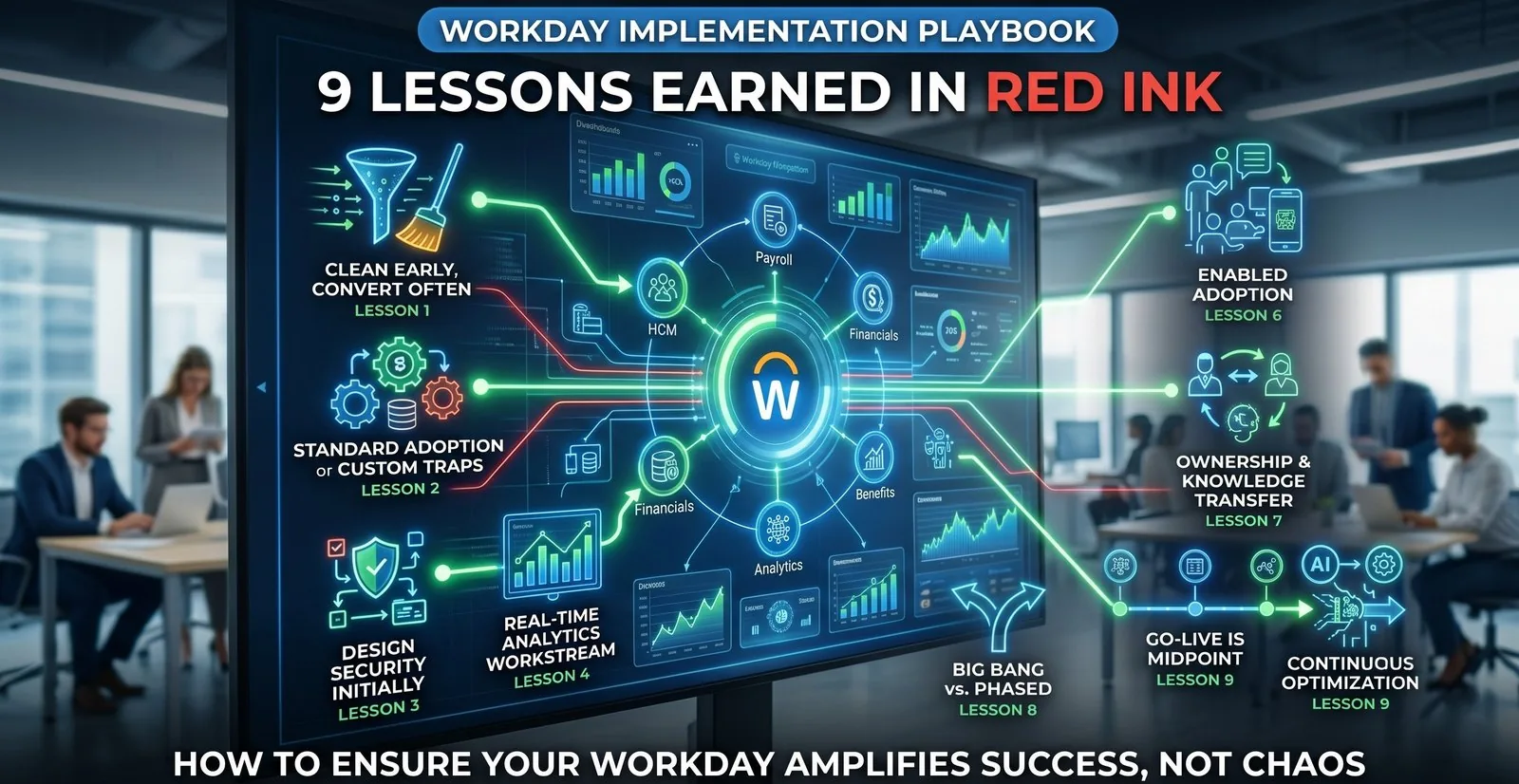
Workday Implementation Playbook, 9 lessons earned in red ink
The one-page version

This article has a companion poster: The Complete Workday Guide, what Workday is, how a task flows through it, and the vocabulary, on one page. Free, no form.

Workday is incredible software. However, an undisciplined deployment is the fastest way to blow a 7-figure budget and stall a corporate roadmap. After guiding years of ERP rollouts, I've seen the same 9 unforced errors derail otherwise brilliant projects. Here is the field-tested playbook on how to spot them, and fix them, before your parallel run hits a wall.

I'll say the obvious part first: Workday is one of the strongest platforms in the enterprise. But great software amplifies whatever you bring to it, discipline or chaos, ownership or abdication. After many years in ERP and a long run inside Workday deployments, these are the lessons that earned permanent space in my project charter. Each one cost someone real money, time and critical resources to learn.

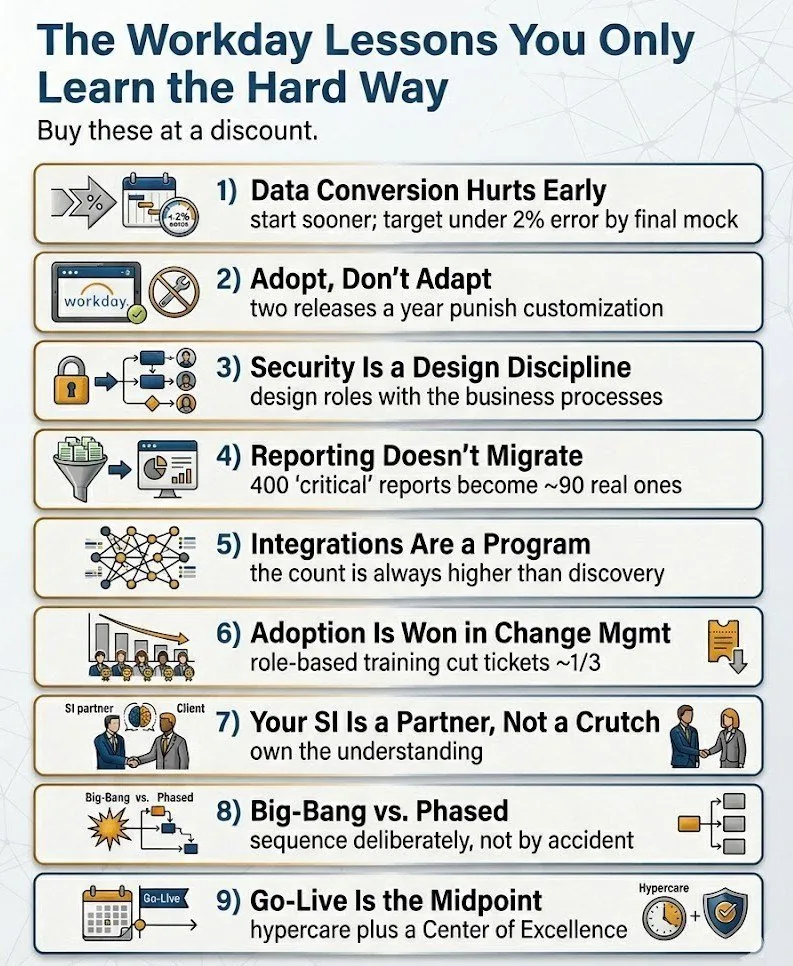
The nine Workday lessons at a glance, data, customization, security, reporting, integrations, adoption, knowledge transfer, sequencing, hypercare
The nine lessons, at a glance.
None of these failures are ever technical. They are failures of ownership, sequencing, and honesty about the state of the work.
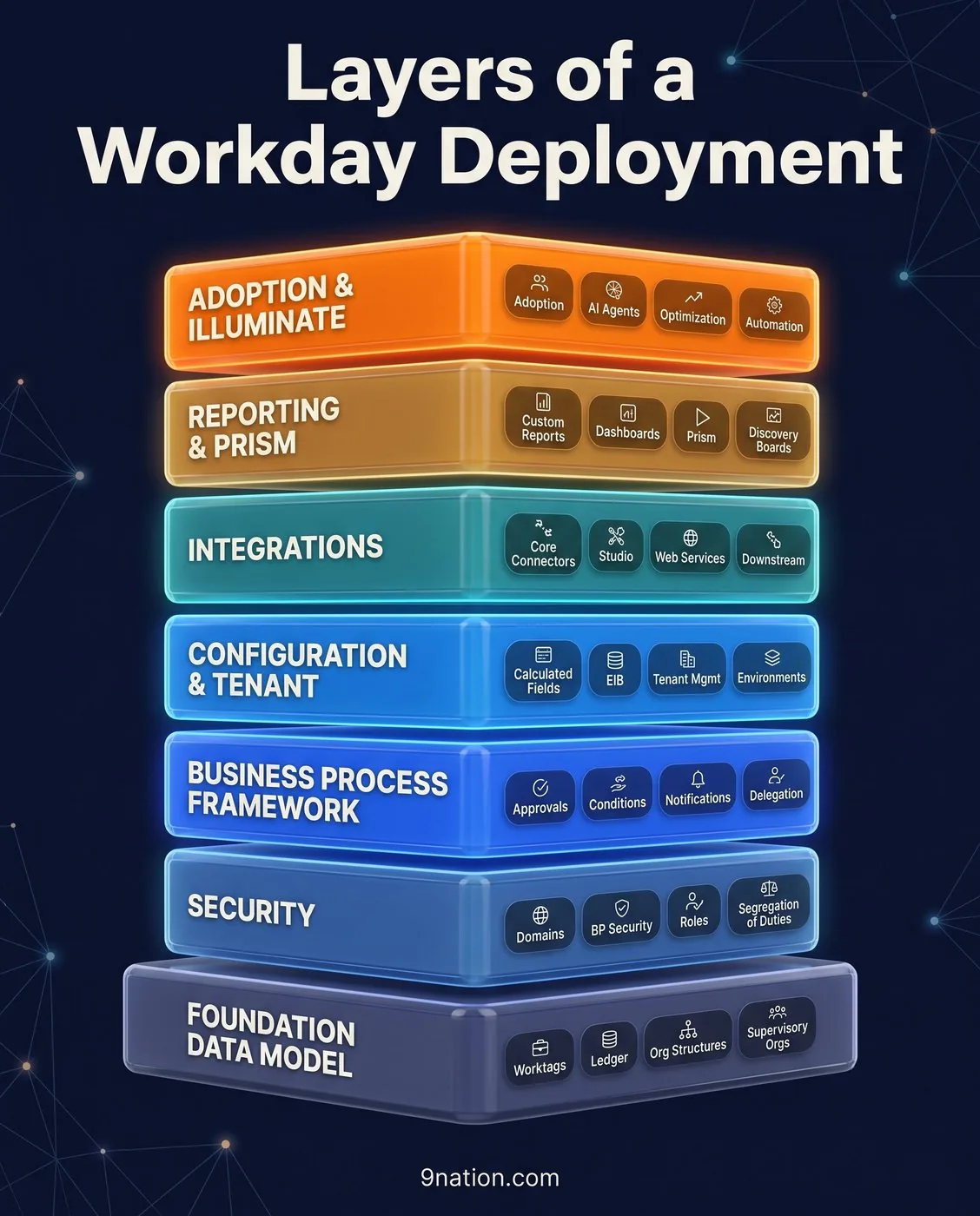
Layers of a Workday Deployment infographic: seven layers from the Foundation Data Model up to Adoption and Illuminate
A Workday tenant is a stack. Everything at the top, Illuminate included, inherits from the Foundation Data Model and the data beneath it.

1 Data conversion will hurt you, earlier and deeper than you planned.

Start conversion far earlier than feels reasonable. Treat it as a project inside the project, with its own dedicated owner and plan. Legacy data is always messier than discovery suggests.

Hidden Risk
On a recent program, we found 10% of "active" worker records were duplicates or carried termination dates that flatly contradicted payroll history.
Cost
Incorrect worker or pay data creates genuine compliance and payroll-tax exposure: wrong filings, wrong withholdings, and real penalties.
Missing Link
You need a single, named data owner on the business side, not just a technical conversion lead. Technical teams can move data; only the business can vouch for it.
Mandatory Rules
  • Clean Early, Reconcile Obsessively: Run at least three mock conversions. Refuse to call data "go-live ready" until the final mock loads under 2% and Finance has reconciled control totals to the dollar.
  • Empower the Business: When ownership is missing, conversion drifts into an endless loop of "that doesn't look right" with no one empowered to resolve it. Someone must be able to authoritatively answer, "Is this record correct?" Plan on your business being a part of the data process, ALWAYS.
2 Adopt the platform. Don't bend it.

Workday ships two major feature releases a year, each with roughly a 5-week preview window to regression-test before it lands. That cadence is a gift, unless you've customized your way into a corner.

Hidden Risk
Every bespoke condition rule, clever integration, or faithfully recreated legacy quirk becomes something you must retest twice a year, indefinitely.
Real Cost
At one client, roughly 80 "small" customizations added 3 weeks of regression effort to each release cycle. That is 6 weeks a year of a team's life spent maintaining decisions nobody remembered making.
Strategy
Reserve true customization (such as Workday Extend or heavy custom integrations) for the rare places it creates genuine, competitive differentiation. Everywhere else, adopt the standard, let the platform carry the maintenance burden, and accept that it might sting a little up front.

3 Security is a design discipline, not a go-live task.

Workday's security infrastructure, including domain policies, business-process policies, and the complex ecosystem of role-based, user-based, and intersection groups, is incredibly powerful. However, it is completely different from legacy frameworks. Treat it as an afterthought, and you will pay for it during testing.

Flashpoint
I once watched an End-to-End (E2E) testing cycle stall for a full week because a single role-based security group inadvertently exposed sensitive compensation data far wider than intended. Every test script involving pay had to pause.
Downstream Ripple
Security touches everything. It determines what appears in an executive report, who can launch a business process, and what an automated integration is permitted to read. A weak security design quietly undermines the entire build.
Strategy
Design security roles alongside your business processes, never after them. Test them just as rigorously as any other configuration from day one.

4 Everyone underestimates reporting.

Sankey diagram showing 400 legacy reports reduced to 90 rebuilt reports
A real program number: 400 legacy reports walked in, 90 walked out.

There is a quiet, near-universal assumption that your legacy reports will simply "come across." They will not. In the new system, reports must be completely rebuilt from scratch using custom reports, calculated fields, and Prism Analytics for heavier data blending.

Reality Check
A report is no longer just a "report." It is a distinct design and build effort.
Bloat Factor
Start with an honest inventory. At one client, roughly 400 "absolutely critical" legacy reports collapsed to just 90 that anyone used once we audited the system run logs.
Strategy
Give reporting and analytics its own dedicated workstream, its own requirements, and its own testing cycle. The week after go-live, executives won't ask if the workflows route correctly. They will ask where their numbers are. "We're still rebuilding that report" is not an answer you want to give the CFO.

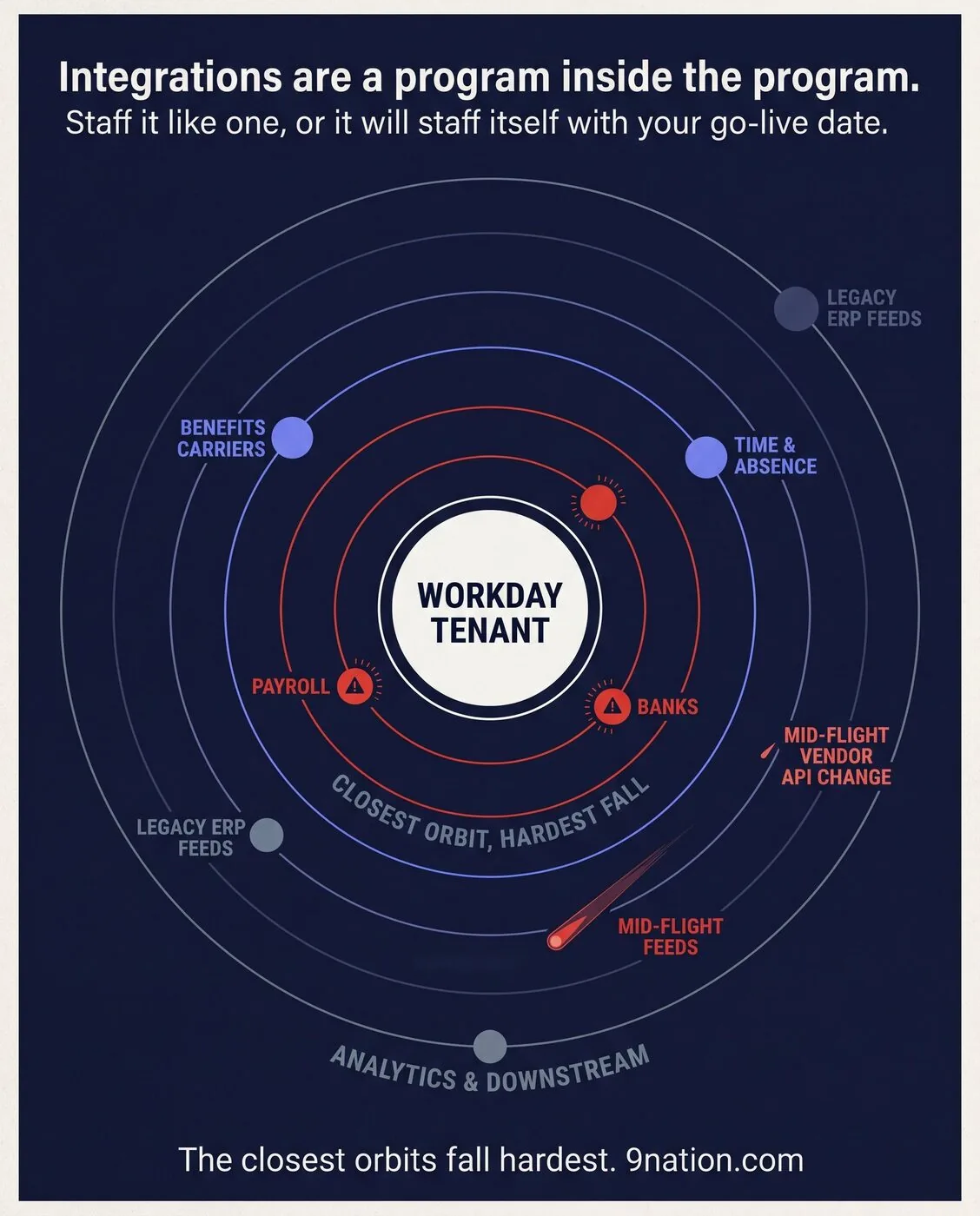
5 Integrations are a program inside the program.

Orbit diagram of integrations circling a Workday tenant, closest orbits carrying the highest risk
The integration orbits. The closest ones fall hardest.

Almost every organization underestimates both the sheer volume and complexity of integrations. The clean "one system" narrative quietly hides dozens of handshakes to benefits carriers, banks, time clocks, tax engines, and downstream applications.

Hidden Scope
On one program, initial discovery listed 50 integrations. The real number was closer to 90 once we mapped the real footprint across EIBs, Core Connectors, Workday Studio, and PECI for payroll.
Vulnerability
Every single integration requires a custom build, testing, error handling, and a fallback plan for the night it inevitably fails at 1:00 AM.
Strategy
Inventory your ecosystem early, name a single business owner for each handshake, and test them with production-like volumes rather than a few sample records. Don't forget production monitoring and alerting. You want to find out an integration failed from your own dashboard, not from an angry vendor or a missed bank file.

6 Adoption is won in change management, not configuration.

A beautifully configured tenant that is poorly adopted is just a failed project wearing a success costume. Different audiences, including employees, managers, HR, and finance analysts, require vastly different training depths, formats, and timing.

Pitfall
Generic webinars delivered 3 months before launch accomplish almost nothing. This failure point scales dramatically in high-headcount or complex industries like Higher Education with students and faculty, or Healthcare with physicians and clinical staff.
Payoff
Programs that succeed utilize role-based, hands-on enablement and targeted in-app guidance. One client that pushed aggressive manager self-service training before go-live cut HR's transactional ticket volume by roughly half in the first quarter.
Strategy
Treat adoption communication as a sustained marketing campaign, not a one-time launch announcement. Adoption isn't a "soft" metric. It's the hard difference between a system people use and an expensive platform they route around.

7 Your SI is a partner, not a substitute for understanding.

A good System Integrator (SI) is worth every dollar, but you must always remember that they will eventually roll off.

Exposure
The most painful post-go-live situations share one root cause. The client outsourced the fundamental understanding of the system alongside the build, completely skipping legitimate knowledge transfer.
Crisis
When a critical business process breaks in production months later, no internal team member can explain why it was configured that way in the first place.
Strategy
Insist on active knowledge transfer starting in Week 1, not as a rushed closeout task. For every major functional pillar, develop an internal client owner who can explain the configuration unaided. When the SI hours taper off, your team owns the platform and the next decade of feature releases.

8 Decide big-bang vs. phased deliberately, never by accident.

Standing up HCM, payroll, benefits, and financials in a single, massive cutover is highly seductive. It promises one change narrative, one major celebration, and one project timeline to close out.

Core Trade-off
A "big-bang" approach multiplies the blast radius because a single workflow or integration failure can ripple across every corporate function on Day 1.
Alternative
Phasing your rollout shrinks that immediate blast radius. However, it introduces temporary, throwaway integrations and drags the organization's change fatigue out over a longer period.
Strategy
There is no universally right deployment sequence. The wrong way to decide is by accident, because the timeline looked clean on a slide. Make sequencing a risk-weighted, deliberate choice at the start, with the trade-offs explicitly signed off by the executives who will own the consequences.

9 Go-live is the midpoint, not the finish line.

The corporate calendar often treats go-live as the end of the journey. In reality, it is caught right at the halfway mark. Hypercare, stabilization, and your first true optimization cycle are where your massive financial investment starts paying back.

Evolution Risk
Workday evolves twice a year, most recently introducing a rapidly expanding set of Illuminate AI agents across HR and Finance. Because of this, maintaining system health is a permanent organizational capability, not a temporary project state.
Differentiator
The organizations that maximize their ROI stand up a dedicated Workday Center of Excellence (CoE) before go-live.
Strategy
Build the internal muscle to govern, regression-test, and continuously optimize before Day 1 of production. Everyone else ends up building that muscle in a panic during their first mandatory feature release, usually while something critical is on fire.

A pre-mortem I run before every kickoff

This is a basic pre-mortem I run before every kickoff.

  • Data. Who owns conversion, and what's our error-rate target by mock load? Can we start cleanup activities now?
  • Customization. What standard are we tempted to break, and is it worth all the regression testing twice a year?
  • Security. Are roles being designed with the business processes, or bolted on later?
  • Reporting. What's the real list of reports people use, verified against run logs?
  • Integrations. Have we inventoried every handshake and named an owner for each?
  • Adoption. What adoption metric and critical KPIs will we watch in the first 30 to 60 days?
  • Sequencing. Is big-bang vs. phased a deliberate, signed-off decision?

I've packaged this exact framework into a downloadable Workday Deployment Readiness Checklist, a pre-formatted template you can bring straight into your next steering committee. Get the free checklist here, or message me on LinkedIn and I'll send it over.

None of the nine failures were technical

If there is a thread running through all nine, it's this: none of these failures are technical. They're failures of ownership, sequencing, and honesty about the state of the work. Great technology will faithfully amplify whatever discipline, or lack of it, you bring. Go in clear-eyed on these lessons and you'll spend your energy on the work that matters, instead of the fires you could have prevented in a workshop 6 months earlier.

Practitioners, what's the one lesson that earned permanent space in your charter? The best ones in this field are the lessons we share before someone else has to learn them the hard way, and I'd like to add yours to my list.

Complimentary 30-minute deployment review

Spotting these red flags in your own charter?

If you're staring down a kickoff, or mid-build and realizing your integration map or data migration is tracking toward a 2 a.m. crisis, let's look at your timeline, sequencing, and resource plan before production does it for you.

Field notes

Get the next lesson in your inbox.

One hard-won program lesson at a time. No cadence promises, no spam.