
Workday's AI bet, 3 of 3
Flex Credits: read the meter before you sign
Workday bills its AI agents against an annual credit allotment, and one pilot can spend the year in six weeks. What to get in writing before you switch an agent on.
Terms on the left page, my commentary on the right, matched by clause number.
Part one
The standard terms
Paraphrased from the published mechanics as of mid-2026, not Workday's contract text.
For 20 years enterprise software billed you like rent. Workday's AI pricing bills you like a meter, and I think that's the change buyers are most likely to miss this year.
Flex Credits are consumption pricing. You get an annual allotment of credits and the agents spend them as they work, so the more the agents do, the more you spend. No vendor or integrator is going to write the buyer's side of this, so I will.
1.1Unit of charge
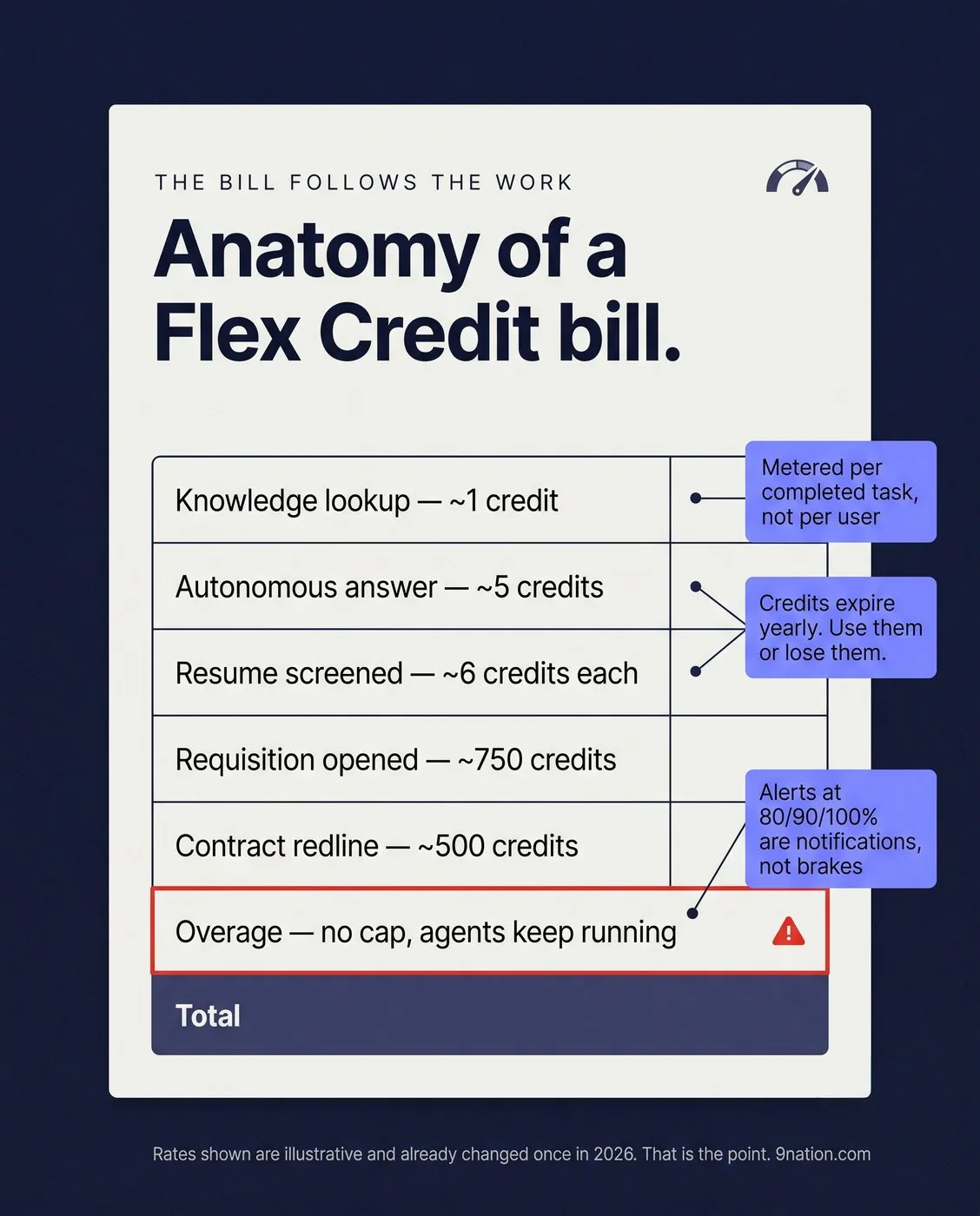
The Customer receives an annual allotment of Flex Credits. Agents spend credits as they work. Every meaningful action an agent takes costs credits, and the meter counts completed tasks, not users or logins.
On 1.1
Rent was a per-employee price and a renewal date. Headcount changes slowly, so the bill changed slowly, and it was a number you put in a budget and forgot. It lived in procurement.
A meter ends up in a different meeting. The bill tracks activity, and activity spikes for reasons that have nothing to do with headcount: a busy hiring quarter, a new workflow someone switched on, an integration looping harder than expected. That puts it in the CFO's monthly variance review.
1.2Credit schedule
Credits are drawn per completed task at the published rates. Rates may be revised.
| Action | Credits |
|---|---|
| Self-service knowledge lookup | about 1 |
| The same feature acting autonomously | about 5 |
| Resume screened | about 6 per resume |
| Contract redlining pass | about 500 |
| Open a requisition workflow | about 750 |
| API-driven activity | about 60 per 10,000 calls |
On 1.2
What each action costs
Published rates as of mid-2026 run from a single credit for a simple retrieval up to hundreds of credits for a heavier action. The schedule opposite pulls a few points off the rate card to show the spread.
Treat every figure in it as illustrative. Workday already revised the card once, in May 2026, and a meter whose rates move under you is a budgeting problem before you've spent a single credit.
The next three clauses matter more than any single rate.
1.3Term of credits
Unused credits expire after a year. There is no rollover.
On 1.3
Use them or lose them. That punishes the careful buyer who under-adopts, and it pressures you to spend the allotment whether or not you found real value.
1.4Consumption notices
The consumption dashboard warns at 80, 90 and 100% of the allotment. Consumption continues past 100%. Overage is reconciled later and sold as additional credits.
On 1.4
Those are notifications and nothing more. Cross 100% and the agents keep running, then Workday reconciles the overage later and sells you more credits. Nothing stops them unless you negotiated a stop.
Buyers are already cooling on variable bills
Buyer preference for consumption pricing fell from 52% to 38% in a year, according to Futurum's tracking, as the reality of variable bills set in. KPMG found only 26% of organizations have full, real-time visibility into what their AI systems cost to operate. Workday's own chief technology officer called the shift to consumption, in his words, in some cases disruptive to customers. That's an unusual thing for a vendor's CTO to say about his own pricing.
You'll also hear that most Workday customers hate Flex Credits. The version I can support is narrower and still bad enough: the shift to variable pricing is unpopular enough that a well-known analyst has publicly warned about budget black holes, buyer appetite for consumption models is falling, and most executives can't see their own AI spend clearly.
1.5Metered environments
Consumption meters in production, not test tenants. Optimization tooling is the exception and can consume credits in every environment.
On 1.5
Production only sounds safe, but optimization tooling bills in every environment. If you don't know which features bill outside production, you can burn credits in a sandbox you thought was free.
- 80% alertNotification
- 90% alertNotification
- 100% alertThe agents keep running
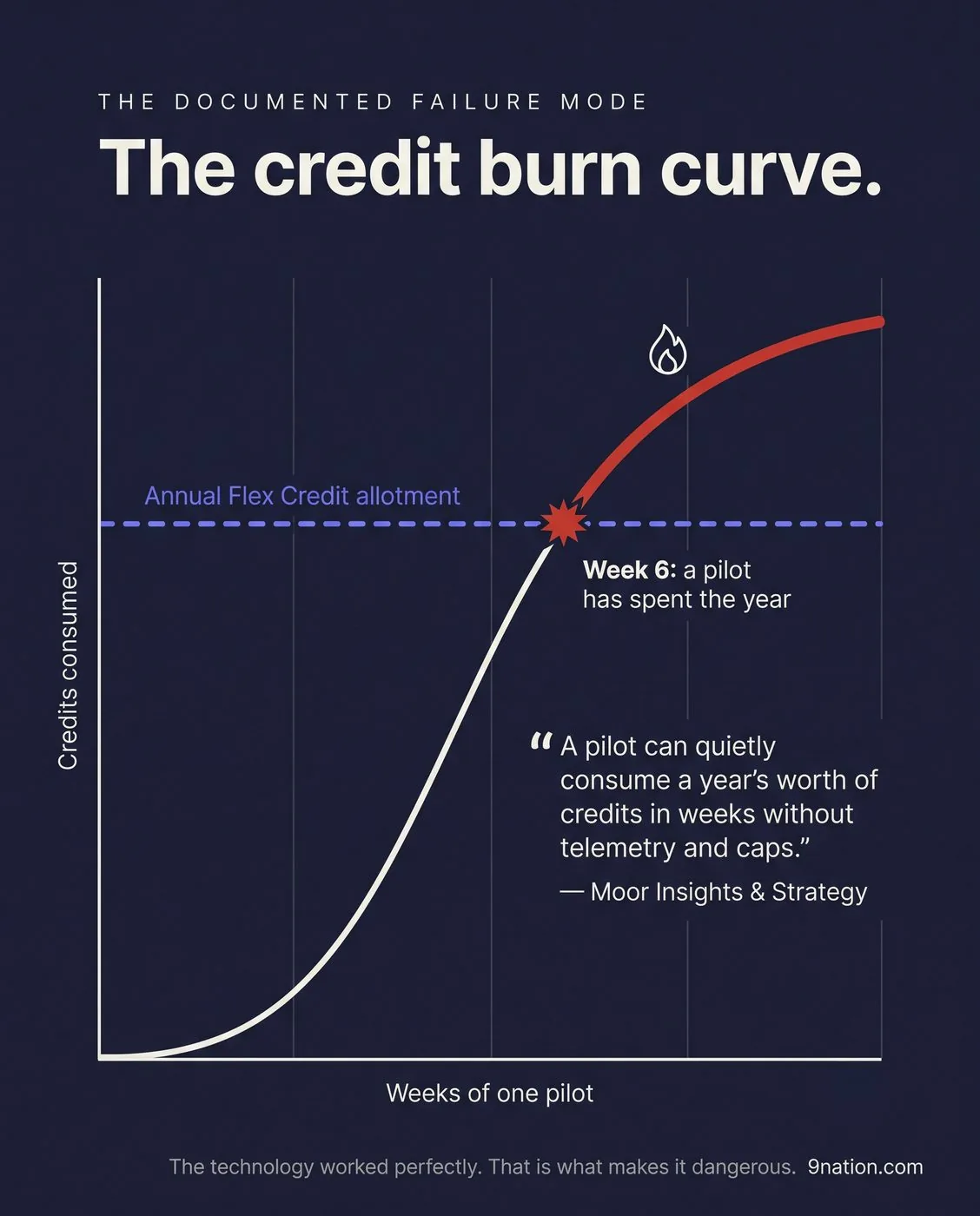
The alerts fire on schedule and nothing stops. The drain's shape is illustrative. Week six is the documented case: a pilot that spends the year's credits in a 6-week test.
On Exhibit A
How one pilot burns the year's credits in six weeks
This failure mode is documented. An analyst at Moor Insights put it directly this year: a pilot can quietly consume a year's worth of Flex Credits within weeks without strong telemetry and governance. A budget black hole, in her words.
You approve a pilot. Someone points an agent at a high-volume process: screening resumes, redlining contracts, answering employee questions at scale. Each action is a few credits or a few hundred, and the volume is large. There's no hard cap, because the default is alerts. The dashboard turns yellow, then red, and the agent keeps working because nobody wired the red line to an off switch. By the time the overage conversation happens you've spent the annual allotment on a 6-week test, and you're buying more credits to keep the lights on. The technology did exactly what it was built to do the whole time.
So the year's credits can be gone in six weeks, with every alert fired and nothing stopped.
Part two
The buyer's rider
AI consumption terms to write into the deal before signature.
Six terms to write into the deal before you sign
Get these in while you still have room to negotiate. I'd treat all six as non-negotiable.
R1Telemetry
Real-time consumption visibility, per agent and per workflow, exportable to your own tools.
On R1
If you can't see the meter in real time, you can't govern it.
R2Hard caps
An enforceable ceiling that actually stops agents at a number you set.
On R2
Another alert doesn't count. Clause 1.4 already gives you alerts.
R3Rollover or right-sizing
Rollover of unused credits, or the right to resize the allotment down at renewal.
On R3
Don't pay a use-it-or-lose-it penalty for adopting responsibly.
R4Pilot fences
A sandboxed credit budget for every pilot, with a hard stop, so a test can never drain your production allotment.
On R4
This is the single term that prevents the six-week scenario in Exhibit A.
R5Rate protection
Price locks on the rate card, notice periods before rates change, and a cap on year-over-year rate movement.
On R5
The card already moved once. Assume it moves again.
R6Exit ramps
The right to revert to predictable pricing, defined off-boarding, and no punitive true-up on the way out.
Before you enable a single agent
- R2A hard cap that stops agents at a number you set.
- R4A sandboxed credit budget for every pilot, with its own hard stop.
Get both in writing.
Run the credits the way you run a budget
Name an owner for AI consumption, the same way you name a business owner for data. Set a monthly credit budget per agent and per workflow instead of one pool for the whole company. Review consumption weekly during any pilot and monthly in steady state. Wire the hard cap to a real stop. And before any new agent goes live, require a written business case with an expected credits-per-outcome. None of this is exotic. You already do all of it for spend that shows up on an invoice.
The Workday AI platform is capable, but the pricing model moves a new kind of risk onto the buyer. A buyer who signs the standard terms and turns on agents without caps has accepted that risk without pricing it. Read the meter before you sign. The first overage invoice is a bad time to start.
Do this week: before you enable a single agent, get the two terms opposite in writing. If your account team won't put brakes on the meter, that tells you how the meter is designed to run.
Sources
CIO.com, Workday Flex Credits coverage, Jul 3, 2026 (no rollover / annual expiry; alerts at 80/90/100% are not a hard cap; overage reconciled and sold; rate-card points; analyst quotes), cio.com. Melody Brue, Moor Insights & Strategy, on pilots consuming a year of credits in weeks ("budget black hole"), 2026, quoted via CIO.com. Gabe Monroy, Workday CTO, describing the consumption shift as "in some cases disruptive to our customers," 2026, via CIO.com.
Futurum Group, buyer preference for consumption pricing declining from 52% to 38% (2024 to 2025). KPMG Global AI Pulse Q2 2026 (26% of organizations report full real-time visibility into AI operating costs).
Workday Flex Credits FAQ and rate-card revision, May 30, 2026 (Document Storage and Integration Events metering removed; API overage-free through Jan 31, 2027; production-only billing with optimization tooling as the cross-environment exception). Rate-card credit values in this article are illustrative for that reason.
Get the guardrails into the deal before you sign it.
The AI-in-ERP Contract Rider covers the twelve clauses, including the caps and pilot fences from this article. Free on the Toolkit page.