
AI and ERP: a field read, 1 of 3
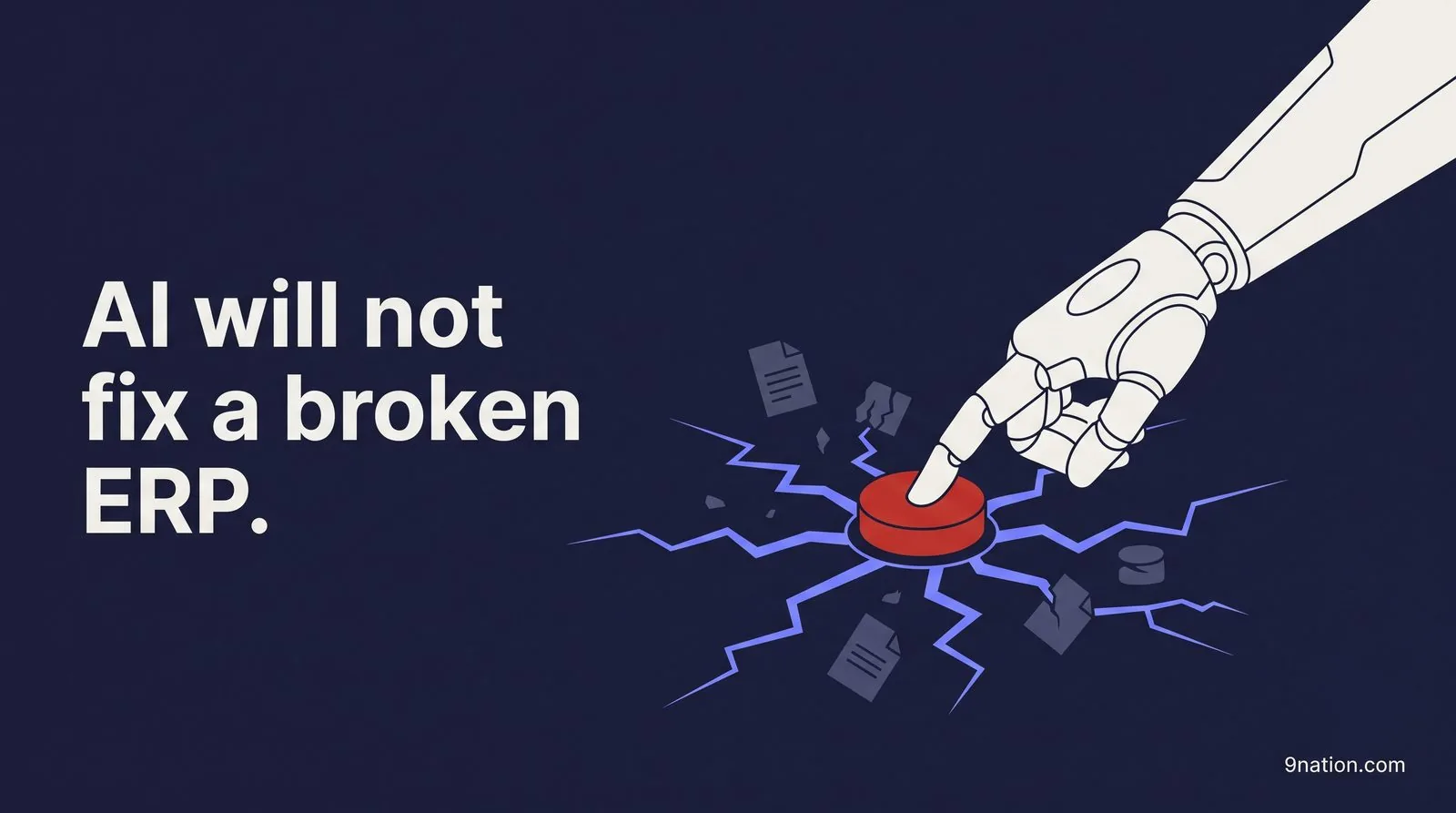
AI will not fix a broken ERP
An agent doesn't run on the demo tenant. It runs on your data, and in most ERP estates that data is barely clean enough for a person to trust, let alone a machine that acts on it without asking first.
Every buyer I talk to this year is hearing the same pitch: agents that reconcile your accounts, chase your approvals, answer your employees and close your books while you sleep. The demo is clean and the slide says autonomous. The count on the slide keeps climbing too, hundreds of agents and thousands of skills, live now.
What the pitch leaves out is the kind of record you'll find a few layers down. That's what an agent actually runs on, and most of the estates I walk into are full of them.
The vendors are right that the technology works. What they stay quiet about is the precondition. An agent that acts needs master data clean enough to trust, workflows disciplined enough to follow and approval logic explicit enough to encode. Most estates don't have all three yet, and missing any one is enough for the pilot to produce confident nonsense.
An agent is a worker who never questions the record
Give a new analyst a report full of duplicate vendors and stale cost centers, and within a week they'll ask why the numbers look wrong. They flag it, walk down the hall and hold the payment until somebody confirms. Every one of those habits is a control you've been getting for free.
An agent does none of that. It reads the field, believes the field and acts. Point it at a supplier master with duplicate records and it will happily pay the same invoice against two vendor IDs. It's fast, consistent and completely confident, which on bad data makes it an error machine with a nicer interface.
On a recent program, 10% of active worker records were wrong
Point an agent at worker data where termination dates contradict payroll history and it will process a change for someone who left in March.
I'm not speaking in theory. Every record in that 10% was either a duplicate or carried a termination date that contradicted payroll history. That's payroll tax and compliance exposure, and it was sitting inside a system everyone described as clean.
The bracket on the core covers both kinds of bad record in that 10%: the duplicates in the layer above and the termination dates in this one.
The wider research says the same thing in bigger letters. Gartner found that 63% of organizations either lack AI-ready data management practices or aren't sure they have them, and it has gone on record that through 2026 a large share of AI projects will be abandoned because the data underneath wasn't ready. MIT's 2025 field study of enterprise AI put a harder edge on it: about 95% of generative AI pilots delivered no measurable return to the P&L. Where they fell short, it was usually the inputs, rarely the technology.
Ready means four answers, each with a name and a date
A data quality dashboard showing green doesn't prove much. Someone should be able to answer each of these by name, with a date.
- Who owns each master?
Name the person accountable for it. On most programs nobody owns worker, supplier or customer data end to end, so when the loads fail there's nobody to call.
OwnerBy - How dirty is it?
Run the duplicate check and the completeness check, and put a real percentage on vendors and workers before anyone promises an agent will "handle" it.
OwnerBy - Do the workflows run the same way twice?
If the process lives in three people's heads and changes by region, there's nothing consistent to automate. Check whether the documented path matches the logs.
OwnerBy - Is the approval logic written down?
An agent needs to know when it may act alone and when it must stop and ask. If you can't write the exception rule without saying "it depends," the agent either does too much or nothing useful.
OwnerBy
At the bottom, the data discovery called ready
On another program we found error rates north of 20% in legacy data that discovery had signed off as ready. Then there's the classic: 400 "critical" legacy reports collapsed to 90 once we checked them against the actual run logs, and nobody ever asked for the other 310 again. Each of those reports was a surface an agent could read and act on. Most were clutter, and some were wrong.
The demo only shows the top layer. In production the agent reads and acts on all five.
The 90 days before you spend a dollar on agents
Before the agent conversation, run a short, unglamorous cleanup. It's the cheapest insurance in the program.
030First 30 daysName an owner for every master data domain and give each one a single measured error rate. No owner, no agent. It costs nothing but a decision, and it's the decision most programs skip.
3060Days 30 to 60Rationalize before you migrate. Kill the reports nobody runs, dedupe the vendors and workers, and reconcile the control totals to the dollar. On the programs that go well, finance signs off on data that clears under a 2% error rate on the final mock, and we run at least three mocks to get there. That's the bar an agent should inherit.
6090Days 60 to 90Write the approval logic down. For each process you'd hand an agent, state the threshold where it acts alone, the threshold where it routes to a human, and the human who owns the exception. If you can't write that rule, you aren't ready to automate that process, and no vendor can write it for you.
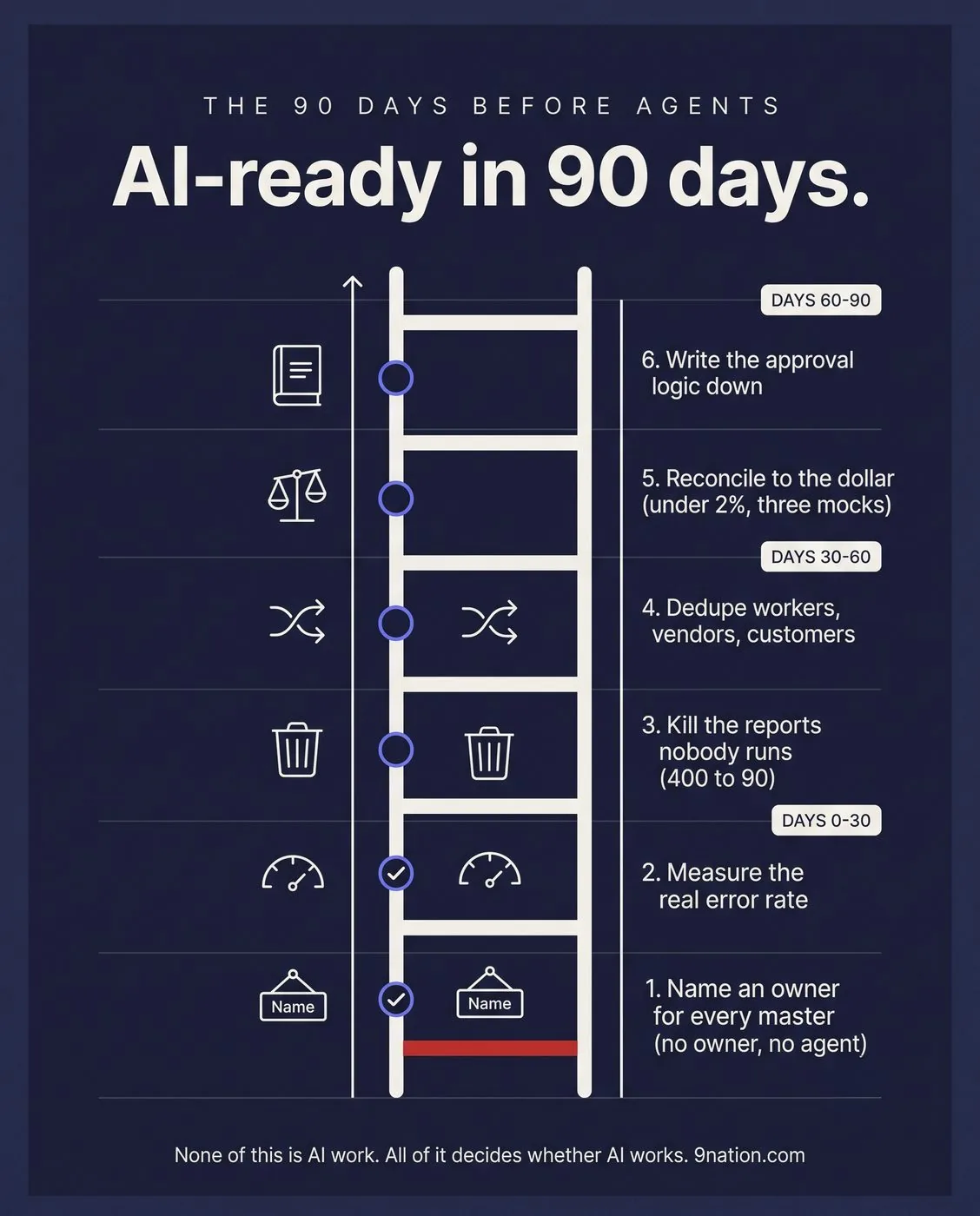
None of this is AI work, but it decides whether AI does anything in month two besides embarrass you.
The cleanup is your job, and no vendor can take it
The platform ships the agent and the SI configures it, but neither one owns your master data, your process discipline or your controls. Those were your problem before AI. They're more expensive now, because a person who inherits bad data slows down and a machine that inherits bad data speeds up.
Agents will change ERP work, and I'm not in the camp that calls this hype. I'm in the camp that says the value lands only on estates that did the boring part first. Right now that's a small club.
Sources
Gartner, "Lack of AI-Ready Data Puts AI Projects at Risk," Feb 26, 2025 (63% lack or are unsure of AI-ready data practices; prediction that 60% of AI projects will be abandoned through 2026 without AI-ready data). gartner.com
MIT NANDA, "The State of AI in Business 2025" (about 95% of enterprise generative AI pilots showed no measurable P&L return; 300+ deployments studied). Report PDF; corroboration: Fortune, Aug 18, 2025.
Field numbers (10% duplicate or contradictory worker records, 20%+ legacy error rates, 400 reports to 90, under 2% final-mock error over at least three mocks) are from 9Nation program experience and the published Workday Lessons Learned material. Clients anonymized to program level. The record specimens are illustrative; each problem is one this article describes.
Find your real error rate before the vendor demos against it.
A short, independent data-readiness read is the cheapest insurance an AI roadmap can buy. Client side, no platform to sell.