
AI and ERP: a field read2 of 3
9Nation Consulting presents
The agent demo vs. the cutover weekend
A field read in two acts
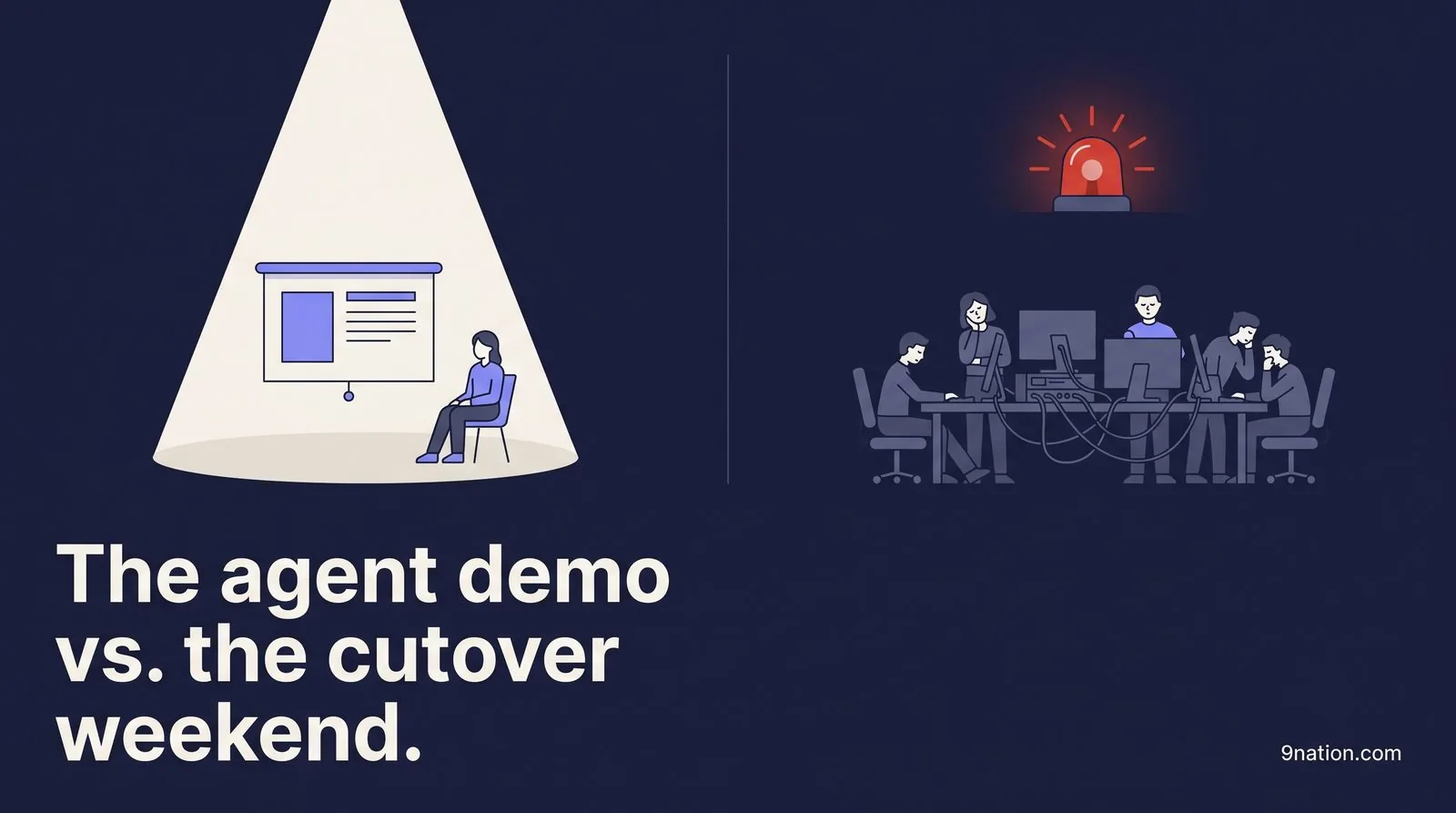
The demo is always a Tuesday. The cutover is always a weekend. And the weekend doesn't care how many agents were on the slide.
The setting
- Act One
- A Tuesday. The demo, on a clean tenant.
- Act Two
- A weekend. The cutover, on your data.
Scenes
- The demo the count, the role, the reliability numbers
- Intermission three questions
- Opening night what still breaks
- Before the run a pilot with a real answer
Cast, in order of appearance
- The agent
- reads an invoice, matches it to a PO and posts it
- The clean tenant
- the demo data
- The room
- nods
- The slide
- carries the count
- The vendor
- has every reason to flatter the category
- You
- the buyer, with three questions
- The human in the loop
- confirms every consequential action
- Your messiest master
- never shown on a Tuesday
- The meter
- runs where you can't see it
Act One
The demo
A Tuesday
A clean tenant. The prompt is rehearsed. The agent reads an invoice, matches it to a PO and posts it while the room nods. The count on the slide is enormous.
Scene one
The count is a marketing artifact
Start with the numbers, because they're doing more persuading than informing. Oracle points to more than 600 agents in Fusion. SAP pointed to 2,500 Joule skills in April, then stood on stage in May and reframed the story around 50 assistants and 200 agents. Gartner says 40% of enterprise apps will carry task-specific agents by the end of this year, up from under 5% in 2025.
2,500 Joule skills
Reframed on stage two months later as 50 assistants and 200 agents.
600+ Fusion agents
Agents and assistants mixed across Fusion and the industry applications. 22 genuinely agentic applications when Oracle named them in March, which is 2% of the headline.
Thousands of vendors claiming agentic AI
Gartner calls the pattern agent washing: assistants, bots and RPA relabeled as agents. Around 130 judged to be building the real thing.
When SAP's own headline moves from 2,500 skills to 200 agents inside 2 months, the count has stopped measuring capability. It's measuring the current shape of the pitch. Oracle's genuinely agentic tier, the pieces that reason and act instead of retrieving and summarizing, is a real and interesting number. It's also a sliver of the 600.
So the first job is translation.
The slideHundreds of agents, live now.
YouHow many act without a human? On our kind of data? In production, or in early access?
Scene two
What "agent" means in each vendor's mouth
The word carries three different meanings depending on who's selling.
Who's who in the role of the agent
A copilot. It drafts, suggests and summarizes, and a person accepts or rejects. Useful and low risk. It isn't autonomous in any sense that changes your controls.
A workflow with a language model bolted on. It follows a fixed path and calls the model at a step or two. It's reliable because the path is hard-coded, and barely more intelligent than the automation you already run.
The real thing. The agent decides what to do next and acts on systems that move money or records. That's the version worth the excitement and the caution. It's also the smallest category on offer, and the one vendors are quietest about on pricing and reliability.
None of these is bad. Confusing which one you're buying is what gets programs in trouble.
Scene three
The reliability number the vendors don't lead with
Salesforce, an agent vendor with every reason to flatter the category, runs a benchmark on its own technology and publishes the results.
- Single-step tasksabout 58%
- Multi-step tasks, the kind a real process isabout 35%
- Built-in awareness of what data should stay confidentialnear zero
Read that as a buyer. A capability that completes a realistic multi-step task one time in three is a genuine assistant and a dangerous unattended worker. That gap is why, in the field, every consequential agent action still routes back to a human for confirmation. The autonomy is real in the demo and conditional in production.
McKinsey's 2025 survey lands in the same place: 39% of companies reported any enterprise-level earnings impact from AI, and most of that was under 5%. The technology is working. The unattended, bet-the-close version mostly isn't here yet.
Intermission
Three questions that expose roadmap-ware
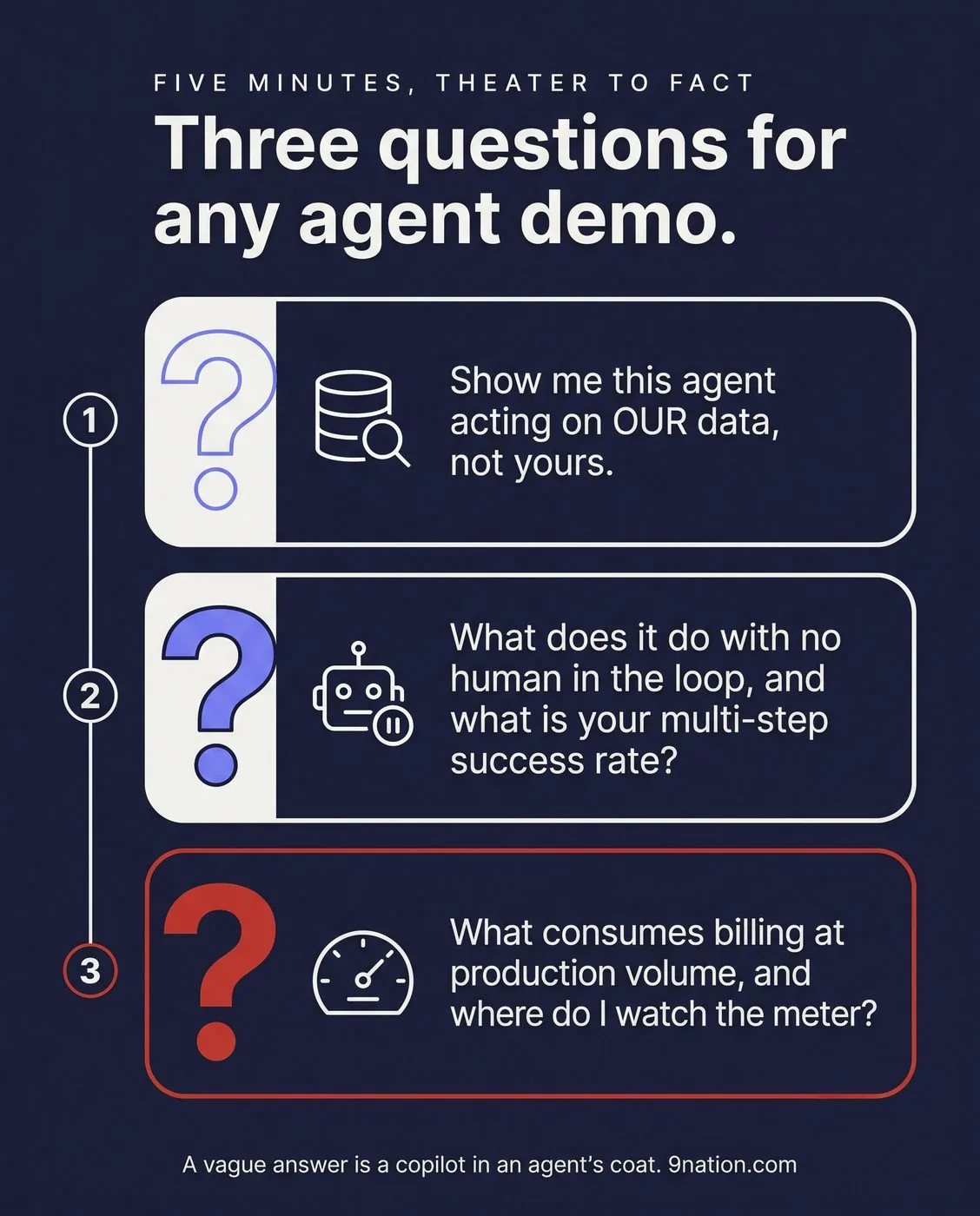
Bring these to any agentic demo. They take the conversation from theater to fact in about 5 minutes.
You, firstShow me this agent acting on our data.
Ask them to run it on a copy of your messiest master instead of the clean tenant. If the answer is "in a later phase," you're looking at roadmap.
You, secondWhat does it do with no human in the loop, and what's your published success rate on multi-step tasks?
A confident vendor has a number. A vague one is selling a copilot wearing an agent's coat.
You, thirdWhat consumes billing when this runs at production volume, and where do I watch the meter?
If the person in the room can't answer, the meter is running somewhere you can't see. That's the subject of a later article in this series.
Act Two
Opening night
A weekend, with no script
The cutover weekend. It tests your data, your sequencing and your governance.
Data conversion
Runs past its window
One benefits conversion nearly pushed go-live and blocked the first payroll run.
Security
Stalls testing for a week
One role exposed compensation data far wider than intended.
Integrations
50 in discovery, closer to 90 for real
Banks, carriers, tax engines and downstream apps.
Agents or no agents, the weekend runs on the same data.
The demo never shows this part, since none of it got better with AI.
Scene one
Data conversion still runs past its window
On a statewide program this year, one benefits conversion ran so far past its slot it nearly pushed go-live and blocked the first payroll run. One workstream put the whole date at risk. No agent on the slide touches that.
Scene two
Security still stalls testing
I once watched an end-to-end cycle stop for a full week because one security role exposed compensation data far wider than intended. Every test script that touched pay had to pause. The build was fine. The design decision wasn't.
Scene three
Integrations are still a program inside the program
Discovery lists 50. The real number lands closer to 90 once you map every handshake to banks, carriers, tax engines and downstream apps. Agents add integration surface. They don't remove it.
Before the run
How to run a pilot that produces a real answer
A pilot is a success when it answers a question you wrote down first. An agent doing something impressive once tells you nothing. Before it starts, write down five things.
- The transaction
- The data it runs on
- The success threshold, as a number
- The human who owns the exceptions
- The credit budget, with a hard stop
Then let it run on real volume. A pilot with those five things produces a decision. A pilot without them produces a testimonial, and you can't deploy a testimonial.
Sources
Oracle, "Oracle Introduces Fusion Agentic Applications," Mar 24, 2026 (22 new agentic applications), oracle.com; Oracle Fusion Insider, AI World, Oct 15, 2025 (600+ agents and assistants), blogs.oracle.com.
SAP News, "SAP Business AI Release Highlights Q1 2026," Apr 2026 (2,500+ Joule Skills), news.sap.com; SAP Sapphire, "SAP Unveils the Autonomous Enterprise," May 12, 2026 (50+ Assistants, 200+ agents), news.sap.com.
Gartner, task-specific agents in 40% of enterprise apps by 2026 (Aug 26, 2025), gartner.com; over 40% of agentic AI projects canceled by end-2027, agent washing, ~130 real vendors (Jun 25, 2025), gartner.com.
Salesforce AI Research, CRMArena-Pro, arXiv:2505.18878, May 2025 (~58% single-turn, ~35% multi-turn agent success; near-zero confidentiality awareness), arxiv.org. McKinsey, "The State of AI in 2025," Nov 2025 (39% report any enterprise-level EBIT impact), mckinsey.com.
Field anecdotes from 9Nation program experience. Clients anonymized; the statewide program is a statewide public-sector Workday program.
Bring an independent voice to your next agent demo.
25 years of cutover weekends buys a sharper set of questions than any roadmap slide expects. Client side, no platform to sell.