
AI and ERP: a field read, 3 of 3
What AI changes about running an ERP program
Agents take real work off the program and add different work back. The teams that win see the new work coming and staff it.
Hand over
Busywork
Handed over
Decision velocity
Watched weekly
Test
Scenario library
Built
Failure rate
Defined
Declined cases
Monitored
Model updates
Re-test set
Supervise
Managers
Know when to stop it
Govern
Agent behavior
Owned
Contract
Telemetry and caps
In the deal
This week
Agent owner
Named
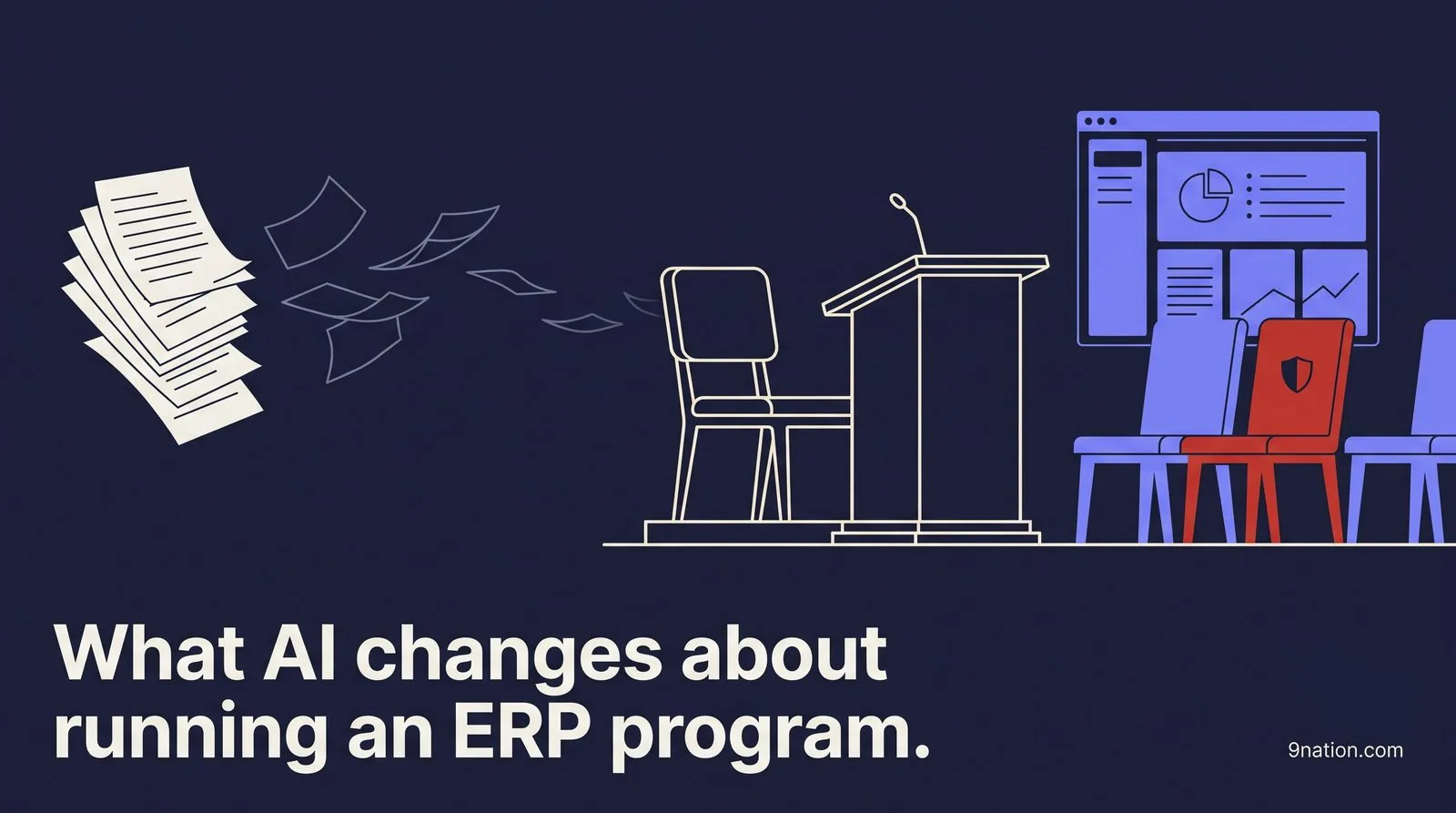
Most of the AI-in-ERP writing is about the software. This one's about the program, the thing I actually run: the plan, the testing, the change management, the governance, the contract and the shape of the team. Agents change all six, and almost nobody is writing about that from the client-side seat.
The teams that get caught out treat the agent as a feature, then find out in testing that they bought a new class of thing to manage.
Hand over
Switches 1 and 2
What agents take off the plate
- Status compilationAgent
- Report generationAgent
- First-pass test data setupAgent
- Meeting notes and action logAgent
- Closing decisionsYou
Good riddance to the busywork, which is the first thing to go. Status compilation, the weekly ritual of chasing eight leads for eight slides, is work an agent does well because it's reading structured data and summarizing it. Report generation, first-pass test data setup, meeting notes and action logging are assistant tasks too. Handing them over is the easy, safe win.
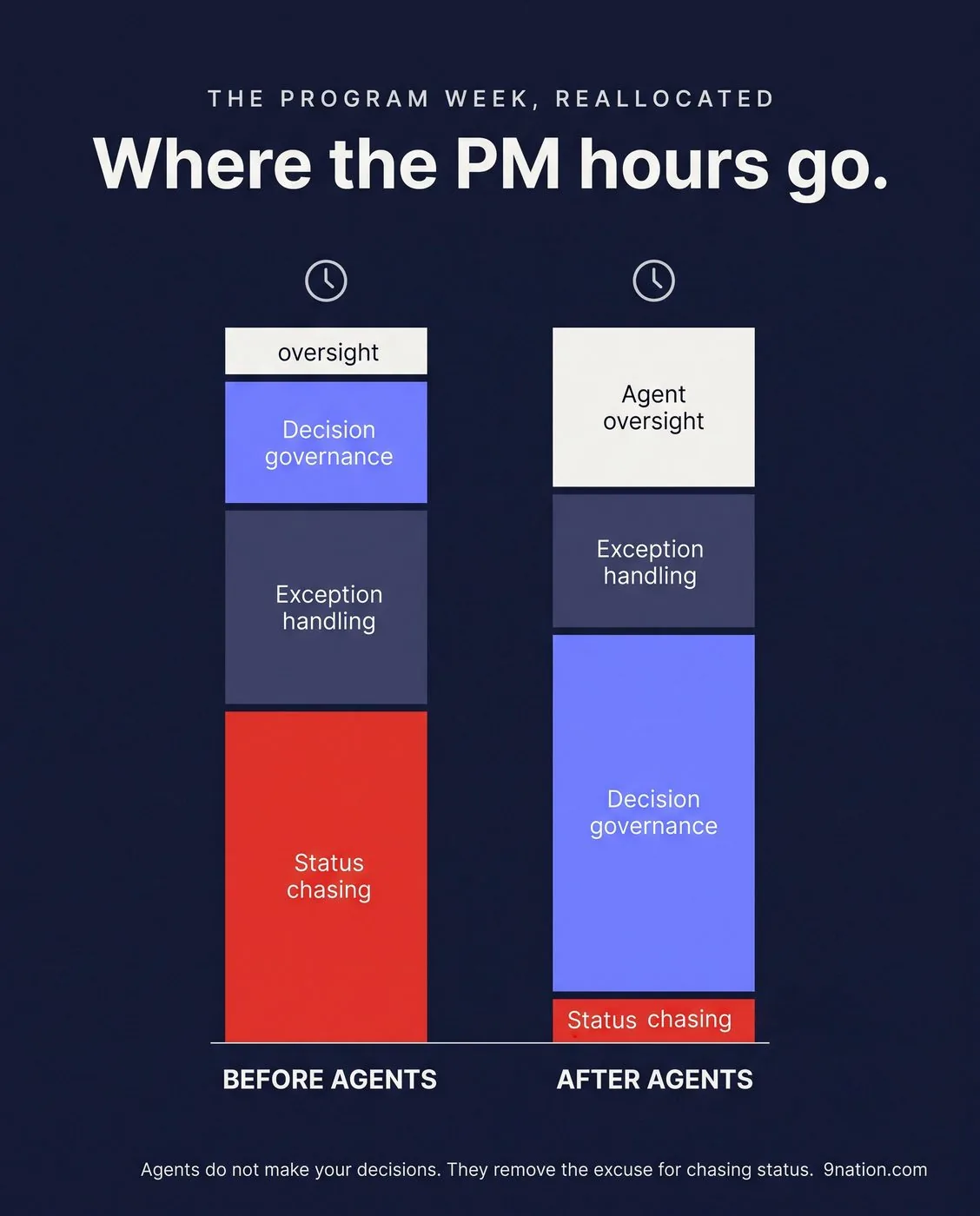
Once the agent compiles the status, the program manager loses the last excuse for spending the week on it. Nobody puts that on the slide. What's left is the job that always mattered more: closing decisions.
Decision velocity, the number of real decisions a program resolves per week, is the metric I watch above all others. Unmade decisions stall programs. Configuration doesn't. An agent won't make a single decision for you, though it will strip out the noise that let you pretend chasing status was the work.
Test
Switches 3 to 6
Testing changes shape
A report is deterministic. Same input, same output, every run. You test it once against an expected value and it stays tested.
An agent is probabilistic. The same input can produce a different action, because the model weighs context and picks. Workday's returning CEO put it plainly on the February earnings call, and that one sentence is the whole testing problem.
You cannot have probabilistic outcomes in running a payroll.
A report
Every run lands on the expected value.
An agent
- One run of the same input
- The acceptable failure rate you define
- A declined case, routed to a person
- The spread after a model update you didn't schedule
Instead of checking whether a number matches, you're testing a distribution of behavior across edge cases, adversarial inputs and drift over time, as the model updates underneath you. That takes new artifacts.
- Scenarios the agent must handleLibrary built
- Acceptable failure rateDefined
- Cases the agent declinesMonitored
- Vendor model change you didn't scheduleRe-test
That's a larger test scope than report testing. Programs that budget agent testing as if it were report testing will find the gap in UAT, the most expensive place to find anything. The model also updates on the vendor's calendar, so every model change is a re-test you didn't plan for. The declined cases need a person watching them, because an agent that quietly does nothing is harder to spot than one that fails loudly.
Supervise
Switch 7
Change management for a half-human workforce
Change management used to mean getting people to adopt a system. Now it means getting people to supervise a coworker that's partly software.
- Manager who approves the agent's workKnows when to stop it
- Employee whose task the agent now doesNew job, honest answer
The manager has to know when to trust the agent and when to stop it. The employee needs a new definition of the job and an honest answer about what it means for them. That anxiety is real. A training deck won't touch it.
The readiness data says most companies aren't staffed for this. Deloitte's 2025 State of AI in the Enterprise study found only 21% of organizations have a mature governance model for agentic AI, while adoption runs well ahead of the guardrails. Change management is where that gap turns into program risk, because an unsupervised agent and an unsupported team fail in the same quarter.
21%
of organizations have a mature governance model for agentic AI
Deloitte, State of AI in the Enterprise, 2025
Govern
Switch 8
The governance seat every program now needs
This is the seat programs are missing. Someone has to own agent behavior the way a manager owns an employee.
- What the agent is allowed to doOwned
- What data it can seeOwned
- When it acts aloneOwned
- Who answers when it acts wrongOwned
- What it costs to runOwned
Access and security for agents isn't a go-live task, any more than it was for people. I've watched one unowned security decision stall an entire test cycle for a week.
The platform vendors are backing the seat by building for it. Workday's Agent System of Record went generally available in February, and its whole premise is that agents get managed like employees, with an identity, a role and an audit trail. When the vendor builds a system of record for the agents, that's the vendor telling you they need governing. A buyer who doesn't put a human in that seat has outsourced a control function to a slide.
Redraw
No switch
The 2027 program org chart
Draw your current program org chart. Now add and subtract.
- Status-reporting layerThinsThe compilation is automated.
- Testing teamGrowsIts skills change too, because someone has to design and monitor probabilistic test suites.
- Agent governance ownerNew seatNear the top, next to the PMO, and accountable for what the agents do, see and cost. The agents get seats of their own on the chart.
- Program managerBox changes colorLess status chasing, more decision governance, more exception handling on the calls agents escalate.
Picture a program week. The hours that used to go to compiling status, and to getting ready to talk about status, collapse toward zero. They stay on the calendar and move to closing decisions, governing agents and handling the exceptions the agents kick up. The total is about the same. The work inside it is worth more and harder to fake, which is exactly why some people will resist the change.
Contract
Switch 9
The contract changes too
One more thing moves, and it moves money: the contract. With consumption-priced agents, the bill follows the work the agents do. Those are contract terms nobody wrote before this year.
- Telemetry, caps and pilot fencesIn the deal
A program that doesn't write those into the deal will meet the meter the hard way. That's its own piece, the one that sounds most like the work I do, and it's next in the series.
This week
Switch 10
Add one box before you run a single agent pilot
- Agent off switchA person on your side
Put the box on your program org chart and name the human who owns agent behavior, access and cost. It can't be the platform or the integrator. It has to be someone on your side with the authority to switch an agent off. If you can't fill that box, you aren't ready to give an agent the keys.
Sources
Workday, Agent System of Record generally available Feb 18, 2026 (agents managed like employees, with identity and audit trail), newsroom.workday.com; analysis: Josh Bersin, "The Reinvention of Workday," Apr 2026, joshbersin.com.
Aneel Bhusri (Workday CEO), on probabilistic outcomes in running a payroll, Workday FY26 Q4 earnings call, Feb 2026 (reported via TIKR, Apr 28, 2026).
Deloitte, "State of AI in the Enterprise" 2025 (only 21% have a mature agentic AI governance model; adoption ahead of guardrails), deloitte.com. NIST AI Risk Management Framework 1.0 and Generative AI Profile (NIST-AI-600-1), nist.gov.
Field anecdotes and the decision velocity metric come from 9Nation program experience and the published Workday Lessons Learned material. Clients are anonymized to program level.
Fill the governance seat before the agents arrive.
If your program org chart has no box for agent behavior, access and cost, close that gap before the pilot starts.