
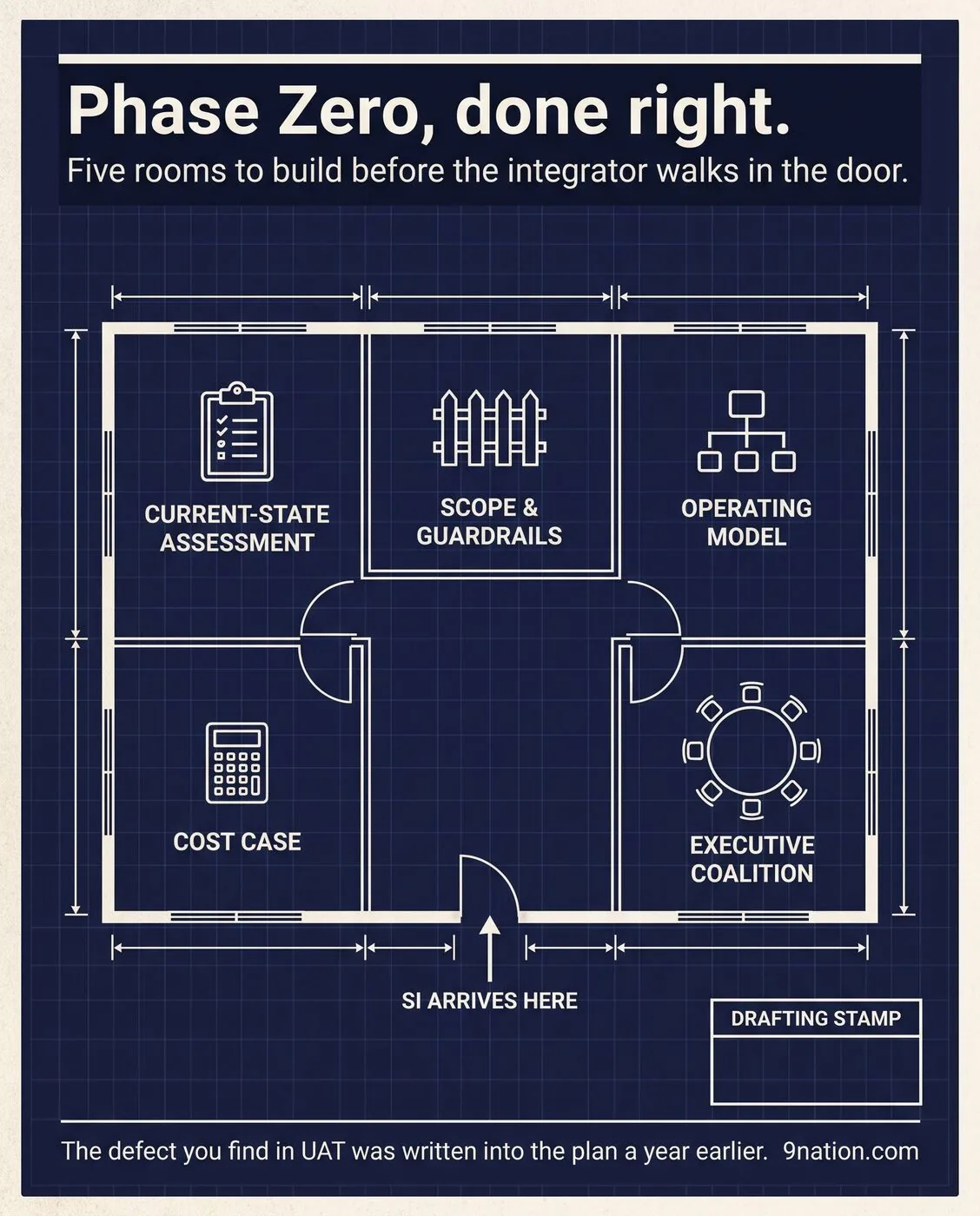
The short version. Before the integrator arrives, build five things: an honest assessment of where you stand today; written scope, with a standard-versus-customization posture you hold; an operating model with real decision rights and backfill for the people you put on the program; a cost estimate and business case you built yourself; and an executive coalition that actually agrees on what the program is for. All five are cheapest to settle now, while nothing is committed.1
By the time most ERP programs hold their kickoff, the outcome is already half decided. The scope was set in a hurry, the timeline came off a vendor slide, and the business case promises numbers nobody can trace back to a real operating decision. The build hasn't started, but the program is already carrying risk it doesn't know about.
Phase Zero is the work you do before any of that gets locked in: an honest assessment of where you stand, a business case you can defend, and the mobilization that turns a budget line into a program. Done right, it's the cheapest risk reduction you'll ever buy.
1 The calls you make here shape everything downstream
Cost, timeline, scope and the fights you'll have in year two all trace back to decisions made in this window. If you skip them, you end up improvising under pressure with tens of millions already committed.
Phase Zero is
not a procurement checkbox
not the week you spend writing an RFP
not a formality you rush to reach the "real" work
deciding what problem you're solving and what good looks like, and testing whether the organization can absorb the change.
2 Start from where the program really is
Where the program really is and where the steering deck says it is are usually further apart than anyone wants to admit, and the program pays for every inch of that gap later. A real assessment looks hard at four things.2
| Assess | What you're actually looking for | What it costs to skip |
|---|---|---|
| Process | How work gets done today, including the workarounds and the spreadsheets nobody mentions in a design workshop | Designing for the documented process, then discovering the real one in testing |
| Data quality | Whether your master data can survive a migration | Pouring bad data into an expensive new system and calling it transformation |
| Organizational readiness | Whether the people who have to adopt this are equipped and willing | Change management stays a line item nobody owns until go-live proves it |
| Technology | The environment, the integrations, the dependencies, and the legacy systems that were supposed to be gone 2 years ago | An integration count that doubles after the estimate was signed |
3 Write the scope down, or it grows one request at a time
Decide what's in and what's out before the program starts, and write it down. Scope left vague expands one reasonable-sounding request at a time, until the timeline and the budget no longer mean anything. Set your posture on standard versus customization early, too, and hold it.
Every time you bend the software to match how you work today, you pay for it in build, in testing and in every upgrade for the life of the system.3
4 Decide who decides before the first hard decision lands
Stand up the PMO and the governance you'll actually use, rather than a wiring diagram that looks impressive in a board pack and collapses the first time two executives disagree. That means clear decision rights, a real escalation path, and a cadence people respect.
Then be honest about resourcing. If you put your best people on the program, and you should, somebody has to do their day jobs. Backfill them, or the business suffers while the program runs.4
5 Build your own estimate, and a business case you can measure
Build your cost and timeline independently. The vendor is selling, and its estimate reflects that. You need a number you can stand behind in front of the board, with real contingency in it, rather than a figure engineered to clear an approval gate.
Hold the business case to the same standard. Promise benefits you can measure, because at benefits-realization time someone will hold you to them. Tie every claim to a real outcome: a process that gets faster, a cost that comes out, a risk that goes away. The inflated ROI that wins approval today is the number that comes back to embarrass you in 2 years.5
2yearsuntil the inflated ROI that won approval comes back to embarrass you
6 A signed budget doesn't mean your sponsors agree
A signature on a budget tells you the money is available. It tells you nothing about whether your sponsors agree on what this program is for.
Surface the disagreements now, while they're still cheap to resolve: the function that quietly thinks the scope is wrong, the executive who never wanted this platform, the two leaders with incompatible pictures of the target state. Those tensions don't go away because nobody named them. They resurface mid-build, when changing course costs ten times as much. A program without a real coalition behind it is starved of decisions and attention until, one day, everyone agrees it was always going to be hard.
10×what changing course costs when the tensions nobody named resurface mid-build
The time and money you put into Phase Zero is the highest-return spend in the program. It's also the easiest to cut, because nothing has visibly gone wrong yet. Cut it and the cost comes back later, with interest.
D.A.
9Nation ConsultingMemorandum: Phase Zero done rightWorking draft