
Global programs
Global Workday deployments: what changes at every border
A domestic Workday program is one system with one set of rules. A global one is 30 sets of rules wearing a single login. Here's where it breaks, region by region and domain by domain, and how a program lead keeps it from breaking at the worst possible moment.
One login, four crossings
- Native Workday payroll
- Payroll through a partner
- Crossings 1 to 4, left to right
- 1Payroll splits in two. The United States, Canada, the United Kingdom, France and Australia run native. Everyone else connects through partners.
- 2Councils and privacy. Works councils in Germany, the Netherlands, France and Austria. PIPL in China.
- 3Payroll on a clock. RTI in the UK, STP in Australia, eSocial in Brazil, and Mexico's own statutory stack.
- 4Books and invoices. Brazil, Mexico and India clear invoices live already. Belgium, Poland, France and Spain follow in 2026, Germany in January 2027.
Stylized, not to scale.
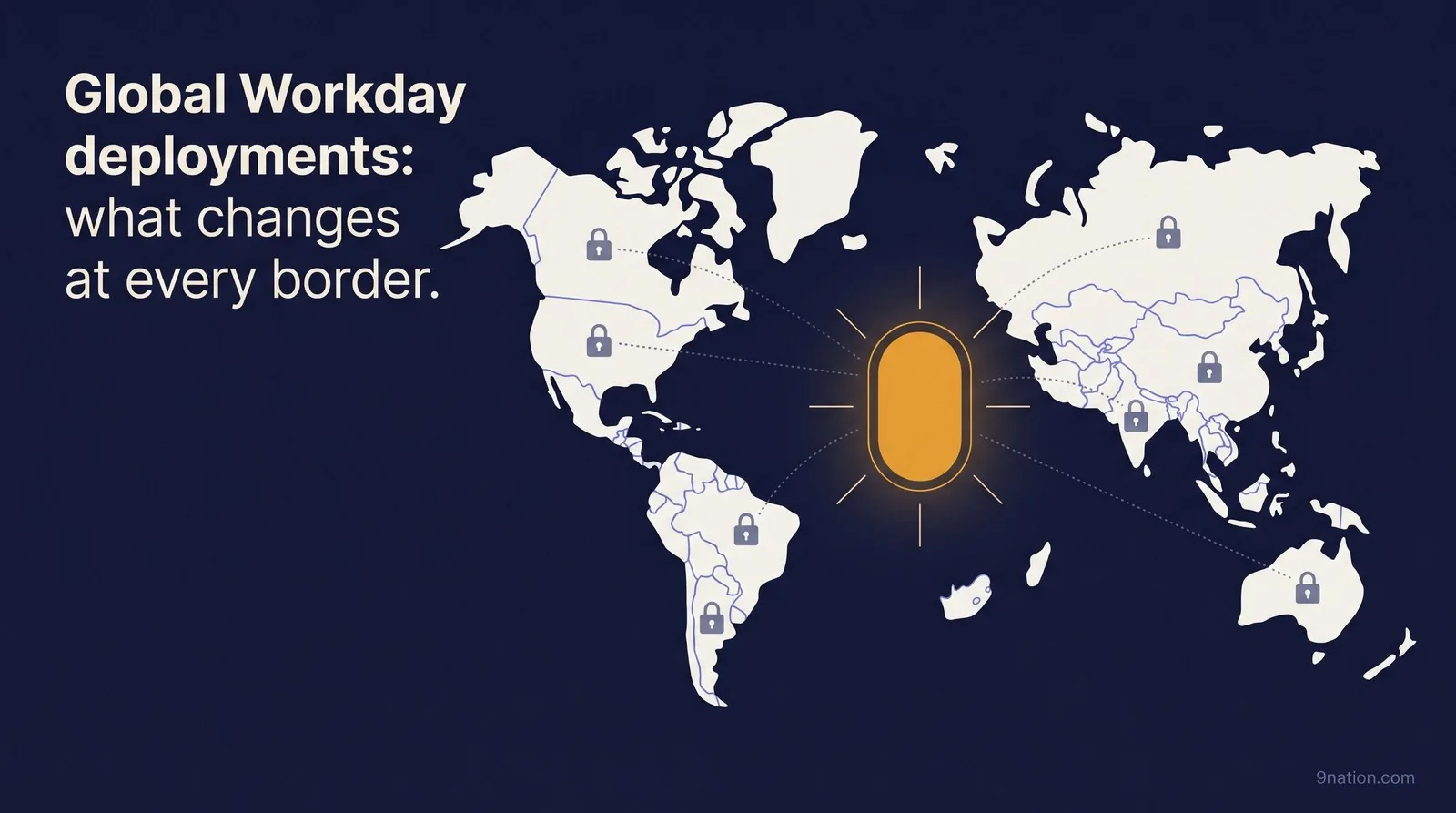
The sales story for a global Workday deployment is clean. One system, one source of truth, every country, every employee and every ledger in one place. I've sat in the room while that story was told, and most of it is true. The trouble is that the story ends at the slide, and the program starts the morning after. Someone in Germany asks whether the works council has approved the design. Someone in Brazil asks how eSocial events will be filed. Someone in finance asks which statutory chart of accounts the Italian entity closes on.
Ask which statutory chart of accounts each entity actually closes on. One system doesn't make that question go away. It moves it from a boundary between systems to a boundary inside one, where it's harder to see and easier to discover late.
That's what a global program actually looks like: one system wrapped around 30 local realities that don't care what your global template says. The program lead's job starts with refusing to pretend those realities away. Find them early, put them on the plan, and make sure none of them shows up as a surprise at cutover.
Most programs don't manage it. Panorama Consulting's 2026 research put the ERP failure rate at 68%, with budget overruns averaging 189% and timelines running about 25% long. Only 32% of programs hit the objectives they set out to achieve. The two largest drivers of failure were inadequate change management at 42% and poor data migration at 38%. Neither one is an exotic technical failure. They're program failures, and they get worse with every border you cross.
- Native United States, Canada
- Native United Kingdom, France
- Native Australia
Crossing 1 · Every country
The one-system promise has a multiplier hidden in it
A single tenant gets you one platform. You still configure every country in it. Each one you add brings its own localization: its own legal entities, pay elements, statutory categories, tax treatment and reporting formats. There's one tenant, and the rules inside it stay stubbornly local.
Payroll makes the multiplier obvious. Workday builds native payroll for five countries: the United States, Canada, the United Kingdom, France and Australia. Everything else runs through the Global Payroll Cloud and a network of certified partners covering more than 100 countries. So a program that spans 20 countries runs 20 payrolls under one badge: a handful of native ones and a dozen or more connected through partners, each with its own integration, its own calendar and its own failure modes. That's two operating models living inside one program. The seam between them is yours to own.
- 5Countries with native Workday payroll
- 100+Countries the certified partner network covers
- 20Payrolls under one badge when a program spans 20 countries
Claim a global pay strategy, and run a standardized model
Use more than two payroll vendors
Measure first-time-right payroll accuracy
Run three to four payroll vendors
The market data shows how hard this is to hold together. In that 2026 study, UKG and KPMG found that 92% of large multinationals claimed a global pay strategy. Only 33% actually ran a standardized model. Nearly three quarters (74%) used more than two payroll vendors, and 34% ran three to four. Only 35% measured first-time-right payroll accuracy at all. No vendor owns the gap between the one-system story and the multi-vendor reality. It's what global looks like once you leave the demo.
- Works councils Germany, Netherlands, France, Austria
- PIPL China
Crossing 2 · HCM
HCM: the org looks universal until people touch it
Human capital feels like the safe domain to start with. Everyone has employees, jobs and managers. Then you localize, and the universal model starts negotiating with local law.
The first thing that catches an American-led program off guard is co-determination. In Germany, the works council (the Betriebsrat) has real legal authority over systems that manage or monitor employees. It's an approval body that can shape your design and hold your go-live. The Netherlands, France, Austria and much of the rest of continental Europe carry versions of the same requirement. If your plan files the works council under communications, you've already mis-sequenced the program. I build council review into the schedule as a dependency with its own lead time.
Data privacy is the second one, and it's bigger than a checkbox. GDPR and Germany's BDSG set hard limits on what employee data you can process and where it can live. China's PIPL adds data localization and cross-border transfer rules that touch where your tenant data physically sits and how it moves. On a cloud platform serving a global workforce, where the data resides and who can see it is a legal design decision. It belongs in the design phase, with legal in the room.
| Domain | Looks universal | Local, and non-negotiable |
|---|---|---|
| HCM | The org structure, job profiles, the worker record | Works councils, statutory leave, data residency, and council reviews with their own lead time |
| Payroll | A pay run is a pay run | Statutory calculation, filing format, filing calendar and language, in a domain that doesn't forgive an error |
| Financials | One ledger, one chart | The statutory chart each entity actually closes on, and period-end procedures that differ by jurisdiction |
Then there are the quiet ones. Job architecture that's clean in the US turns into a negotiation in countries with collective agreements and statutory job categories. Leave types, allowances, benefits and even how a person is classified as an employee all vary. A global job catalog is a fine ambition. Just budget for the country-by-country reconciliation it'll take to make it real, and decide up front which parts are non-negotiably global and which are allowed to bend. Make that call in design, with legal in the room. If it waits for testing, it gets made with a country lead objecting.
- eSocial and the statutory stack Mexico, Brazil
- RTI United Kingdom
- STP Australia
Crossing 3 · Payroll
Payroll: the domain that doesn't forgive
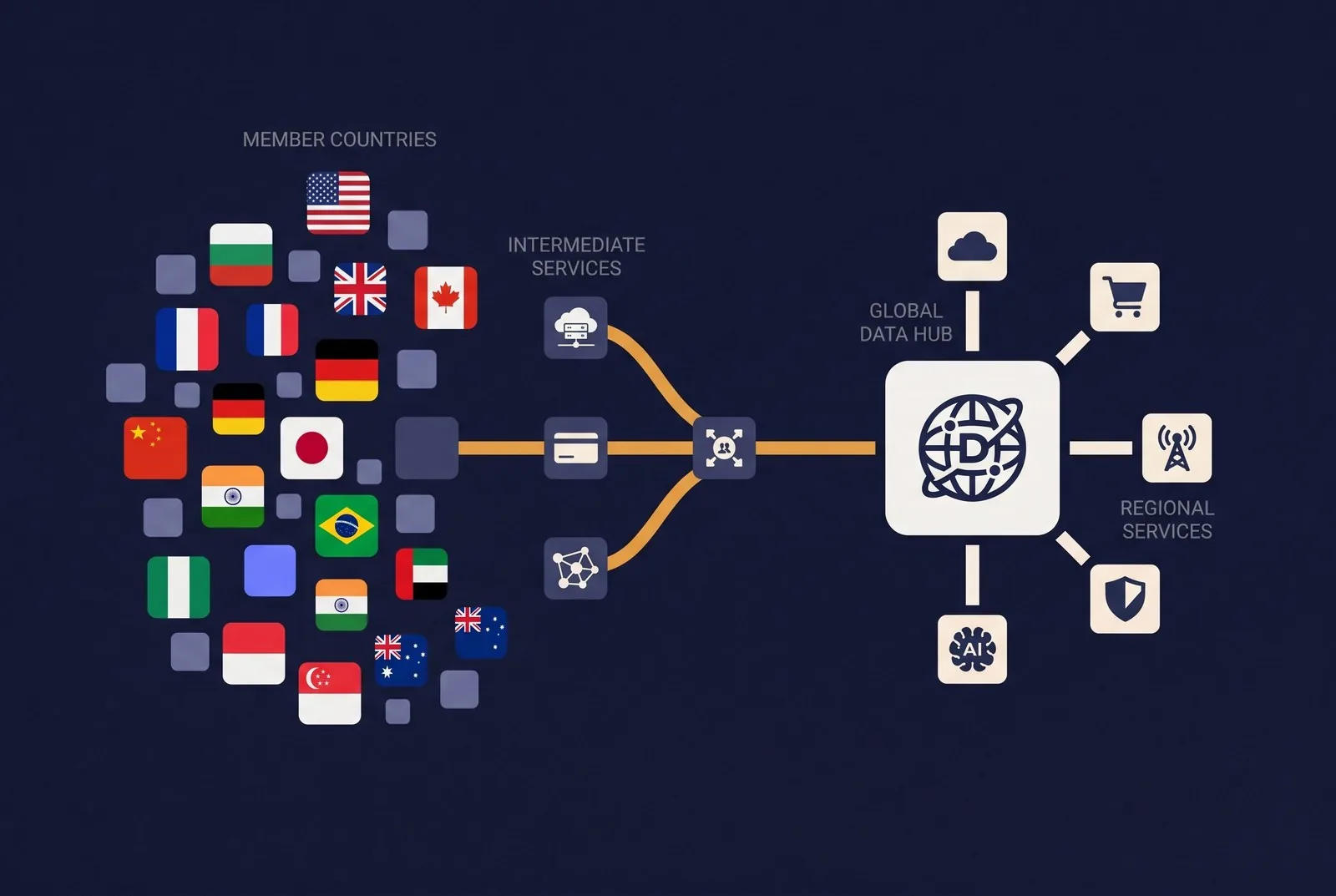
If a global program is going to fail loudly, it usually fails in payroll. Almost anything else can be corrected in the next sprint. Payroll pays real people real money on a real date, under a real regulator, and it doesn't offer partial credit.
Start with the operating-model split. The five native-payroll countries run inside Workday. The rest run through partners on the Global Payroll Cloud, connected by integrations that have been through three generations.
- PICOFThe original
- PECIArrived in 2016
- Global Payroll ConnectAPI based, launched late 2024
The practical point for a program lead: in your connected countries, the payroll partner is on your critical path and in your test plan, whether you planned for it or not. Their readiness is your readiness.
Then there's the shift almost every country has made toward real-time statutory reporting. Payroll used to be a monthly batch you reconciled after the fact. Now it's a compliance clock.
| Country | Regime | When it reports |
|---|---|---|
| United Kingdom | Real Time Information, to HMRC | On or before every pay run |
| Australia | Single Touch Payroll Phase 2, to the ATO | On or before each payday |
| Brazil | eSocial | Event by event, as employment events happen, with no monthly summary |
Each of these turns payroll from a periodic task into a live obligation, and each one has to be proven before go-live.
Latin America deserves its own warning. Brazil is the country that humbles global programs, and Mexico isn't far behind.
Brazil
- eSocial, which is a discipline on its own
- FGTS at 8%
- The mandatory 13th salary
- A history of contractor reclassification enforcement
Mexico
- IMSS
- INFONAVIT at 5% of integrated salary
- State payroll tax between 2% and 3%
- PTU, the mandatory profit sharing, paid out by the end of May
Stack those up and Brazil becomes a project inside your project. None of it bends to a global template. It has to be built to the letter, and the list of what does bend is short.
Bends to a global template
- The org structure and job architecture, mostly
- Reporting definitions, if you settle them once
- Process shape, above the statutory layer
- Anything you're willing to defend centrally
Doesn't bend at all
- Statutory calculation, filing format and filing calendar
- Works council review, which has its own queue
- Data residency
The stakes are concrete and countable. The UKG and KPMG research found that nearly 40% of employers suffer significant financial losses from payroll errors, that organizations leak 2% to 4% of total labor spend to those errors, and that 38% of companies report between $1 million and $5 million in annual payroll losses. For a large enterprise, a single percentage point of wasteful payroll spend can reach $15 million.
The rules keep moving, too. Deel tracked more than 30 countries changing payroll, employment tax or mandatory benefit rules between 2025 and 2026. Those changes land on somebody else's calendar, in several countries at once, often in the same twelve months you're trying to go live. A global payroll design is never finished, so budget it like a maintained asset: a standing owner and no end date.
- Americas US sales and use tax, Nota Fiscal in Brazil, CFDI in Mexico
- Europe E-invoicing mandates, SAF-T audit files, statutory charts
- India GST
Crossing 4 · Financials
One ledger meets 20 statutory realities
Finance is where the single-source-of-truth ambition meets the fact that every country has its own definition of truth. Your global books may run on IFRS or US GAAP. However, the German entity still closes to German statutory rules, the Brazilian entity to Brazilian ones, and the tax authority in each country expects filings in its own format, on its own calendar, in its own language.
That means parallel books, local statutory charts of accounts mapped to the global one, and statutory reporting that runs alongside the management close. It means a tax model that handles VAT and GST in most of the world and US sales and use tax at home, and those are two different problems. It means withholding regimes, local audit files like SAF-T in Portugal, Poland and Norway, and period-end procedures that differ by jurisdiction.
The item moving fastest right now is mandatory e-invoicing and continuous transaction controls, where the tax authority sits in the middle of the invoice in real time. Latin America has run this model for years through Brazil's Nota Fiscal and Mexico's CFDI. India built it into GST. Now Europe is arriving all at once.
- Already liveBrazil (Nota Fiscal), Mexico (CFDI), India (GST), for years
- BelgiumB2B mandate in effect, January 2026
- PolandKSeF phases in through 2026
- SpainPhases in through 2026
- FranceLarge and mid-size enterprises, September 2026
- GermanyIssuing mandate begins, January 2027
For a global finance deployment, that's a lot more than a footnote. Your ERP has to issue and clear invoices in each country's required format, in real time, and the deadlines are hitting on several continents in the same 12 months you're trying to go live.
- Every country in scope Mapped before the wave plan is set
At every border · The program lead
What this actually means for the program lead
None of this is a reason to avoid a global deployment. The consolidation is worth it, and I've led programs where it paid off. It's a reason to run the program differently from a domestic one. The difference comes down to a handful of disciplines.
Design global, localize deliberately
Set the global template and, just as important, the guardrails: what's non-negotiable across every country and what's allowed to flex locally. A program without that line either forces a US design onto countries where it's illegal, or lets every country reinvent everything and loses the point of one system. The line is a leadership decision, and it belongs to you. Escalations come to you, not to the integrator and not to whichever country shouts loudest.
Sequence by complexity
The instinct is to lead with the biggest population. The better move is to understand where the hard localizations are and stage around them. Don't open with Brazil, and don't leave it for last as an unpleasant surprise. Map every country in scope early (statutory, works council, data residency and filing requirements) and let that map drive the wave plan.
Put the localization owners on the plan before you need them
Country payroll SMEs, local tax and finance leads, works councils and the payroll partners for your connected countries are all on your critical path. Their calendars, lead times and approvals are program dependencies. Treat them as late-stage inputs and you'll discover in month fourteen that a council review you needed had a 3-month queue. A council review has a queue and a lead time, and no program manager under pressure can speed it up. Map every one against the wave plan the moment the country list is set.
Test to the statutory file
A payroll that balances in a sandbox has proved very little. A payroll that produces the correct eSocial event, the correct RTI submission, the correct STP report and the correct local payslip is proven. Build acceptance criteria around the statutory outputs of each country, and run parallel payroll long enough to trust the result before you turn the old system off. Only 35% of multinationals even measure first-time-right accuracy, so the program that does starts ahead. It can see accuracy before the business does.
Make governance carry the local weight
A global steering committee that only speaks the language of the global template will keep missing the things that sink these programs. The uncomfortable local facts (a council that hasn't signed off, a partner that's behind, an e-invoicing deadline colliding with your go-live) need a standing place to surface while they're still cheap to fix.
The one-system promise is real. I've seen it delivered, and it's earned one country at a time. It takes a program lead who treats every border as a place where the rules change, plans for that on purpose, and won't let the exceptions stay hidden until the weekend of the cutover. Map the countries, hold the template line and own the seams. Everything else is configuration.
Related case study: A multi-country cutover, led client-side. Independent program leadership on a global Workday deployment, holding the integrator and the local partners to the same plan.
Related: What Workday really costs, the pricing, benchmarks and TCO guide.
Sources
Panorama Consulting Group, 2026 ERP Report, and Gartner ERP research 2026, via Godlan ERP Implementation Failure Statistics (68% failure rate; 189% average budget overrun; 25% timeline extension; 32% objective achievement; change management 42% and data migration 38% as the leading failure drivers).
UKG and KPMG global payroll research, March 2026, survey of 300-plus senior leaders at large multinationals (nearly 40% suffer significant payroll-error losses; 2% to 4% of labor spend leaked; 38% report $1M to $5M in annual losses; 1% of wasteful spend up to $15M for large enterprises; 92% claim a global pay strategy but only 33% are standardized; 74% use more than two payroll vendors, 34% use three to four; only 35% measure first-time-right accuracy).
Deel, Global Payroll Compliance Checklist 2026 (150-plus countries; 30-plus countries changed payroll, tax or benefit rules between 2025 and 2026; country-specific figures for the US, Canada, UK, Germany, Netherlands, Mexico, Brazil, Australia, Singapore and India).
Workday global payroll materials and partner documentation (native payroll in the US, Canada, UK, France and Australia; Global Payroll Cloud partner coverage across 100-plus countries; PICOF, PECI in 2016, and Global Payroll Connect in late 2024).
e-Invoice.app, Global e-Invoicing Compliance 2026, and VAT IT (Belgium January 2026; Poland 2026 KSeF; France September 2026; Spain 2026; Germany January 2027; plus the established Latin American and Indian continuous transaction control regimes).
Going global? Put independent eyes on the plan first.
Most global programs break at the borders nobody sequenced. A candid, client-side read of your country map and cutover plan is the cheapest insurance you'll buy.