
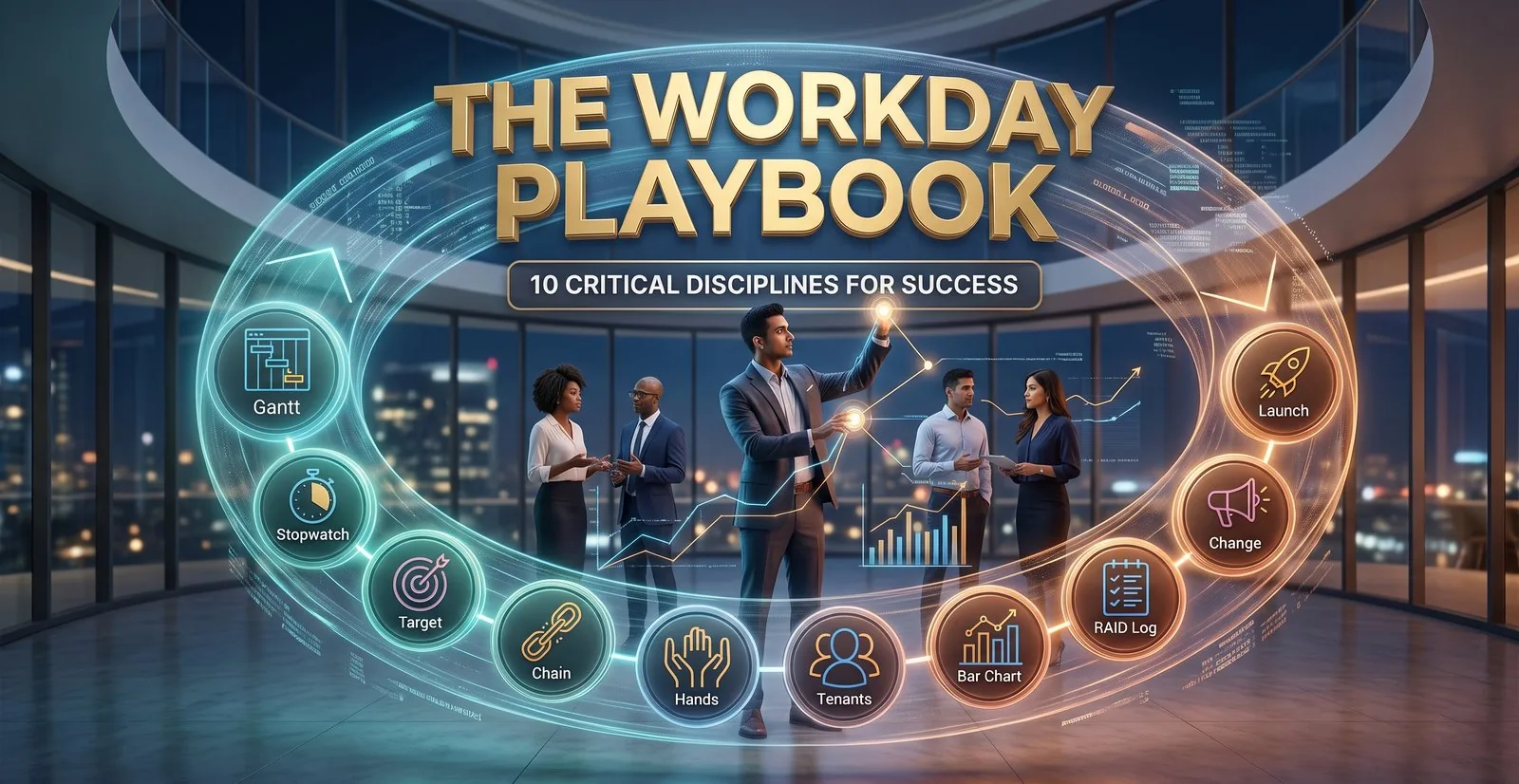
Workday is sold as configuration over code. You get a proven methodology and a partner to guide you. All of that is true, but it misses the point entirely when a program goes sideways.
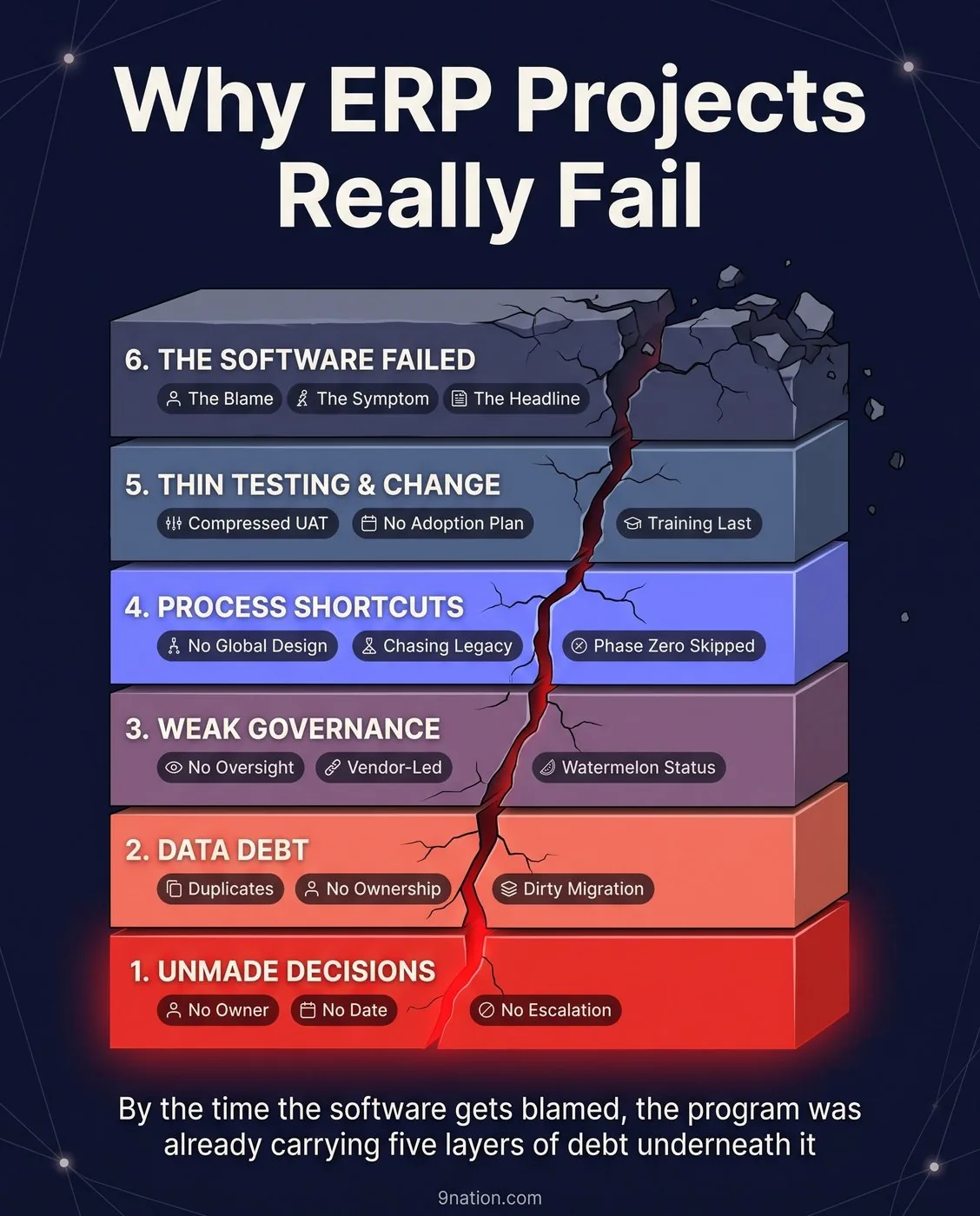
The platform compresses technical risk. However, it does almost nothing for organizational risk. An undisciplined deployment plan is the fastest way to blow a 7-figure budget and stall a corporate roadmap. Decision-making, scope discipline, data ownership, and adoption are still entirely on the client and the people steering the work.
After many years around ERP and the last several living inside Workday programs, I've watched the same handful of disciplines decide outcomes far more reliably than any configuration choice. This is the playbook I run.
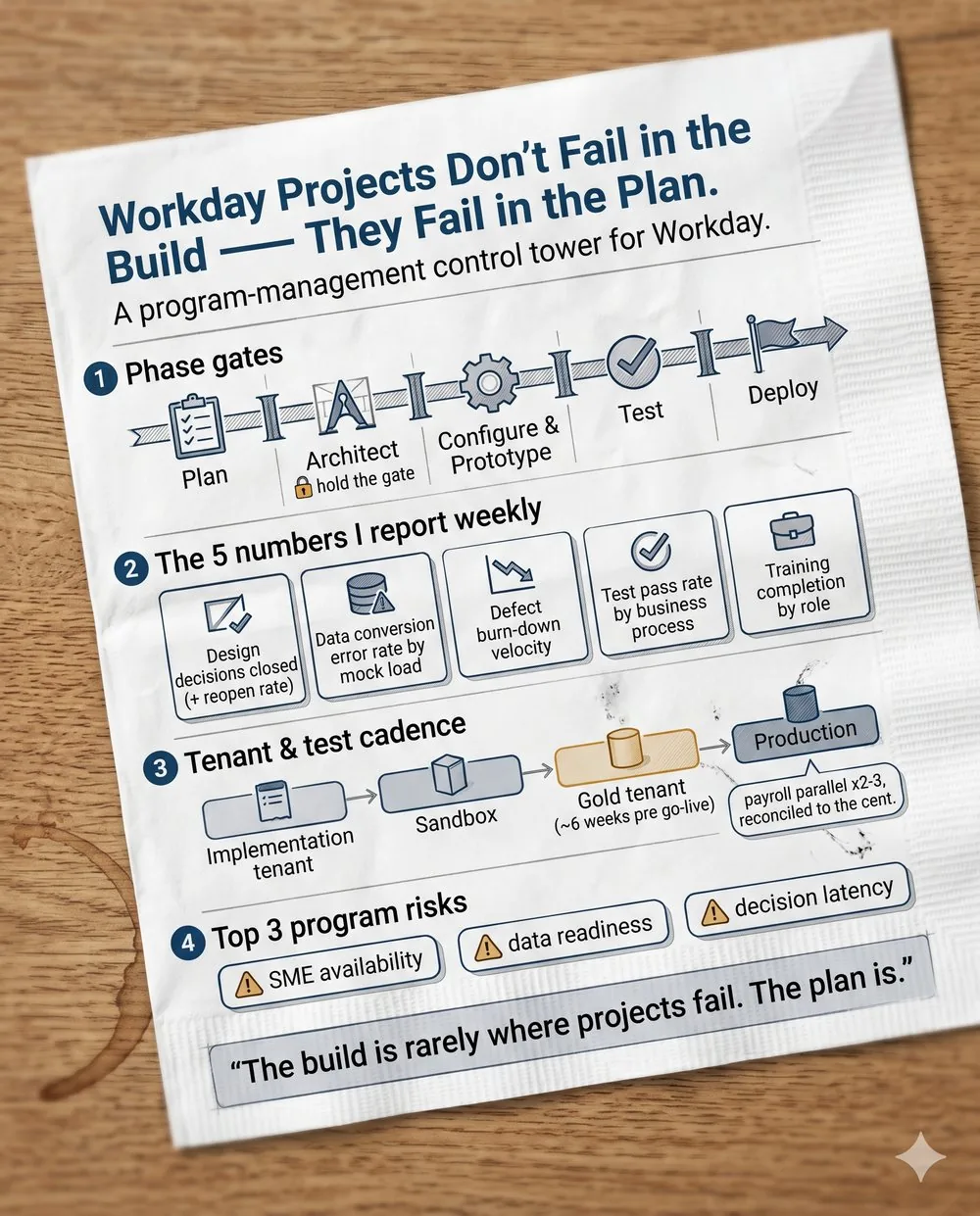
The build is rarely where Workday projects fail. The plan is.
Treat phase gates as real gates, not calendar decoration
Workday's methodology runs in five phases: Plan, Architect, Configure & Prototype, Test, and Deploy. On paper, it looks incredibly disciplined. In practice, the gates are much softer.
Configure & Prototype quietly begins while Architect decisions are still open. Testing starts on data that is still dirty. Nothing in the methodology physically stops you from dragging unfinished work across a gate, so only governance does.
Everything built afterward inherits that ambiguity. A soft gate exit doesn't save time. It simply relocates the cost to a payroll parallel where the exact same fix is ten times more expensive and twice as public.
Write explicit exit criteria for every gate and hold the line. I would rather slip a gate by a week than discover the price of a soft exit live in production.
Scope doesn't creep through change requests
It creeps through "can Workday also...?"
Workday can do almost anything you ask of it, which is precisely the trap.
Scope rarely expands through a formal change request. It expands through a hundred design-session asides like asking if Workday can route a process through a second approver or add a custom validation. Each "yes" feels trivial. In aggregate, they are the difference between adopting the platform and faithfully rebuilding your legacy mess inside it.
A bespoke condition rule or a clever EIB workaround is not free. At one client we counted it. Roughly 60 "small" customizations were adding about 3 weeks of regression effort to each R1 and R2 cycle. That is 6 weeks a year of a team's life quietly purchased through decisions no one remembered making.
Keep a living design-decisions log and treat every deviation from delivered functionality as a costed decision. Adopt the standard until standard demonstrably fails the business. Reserve true customization for the few places it creates real differentiation.
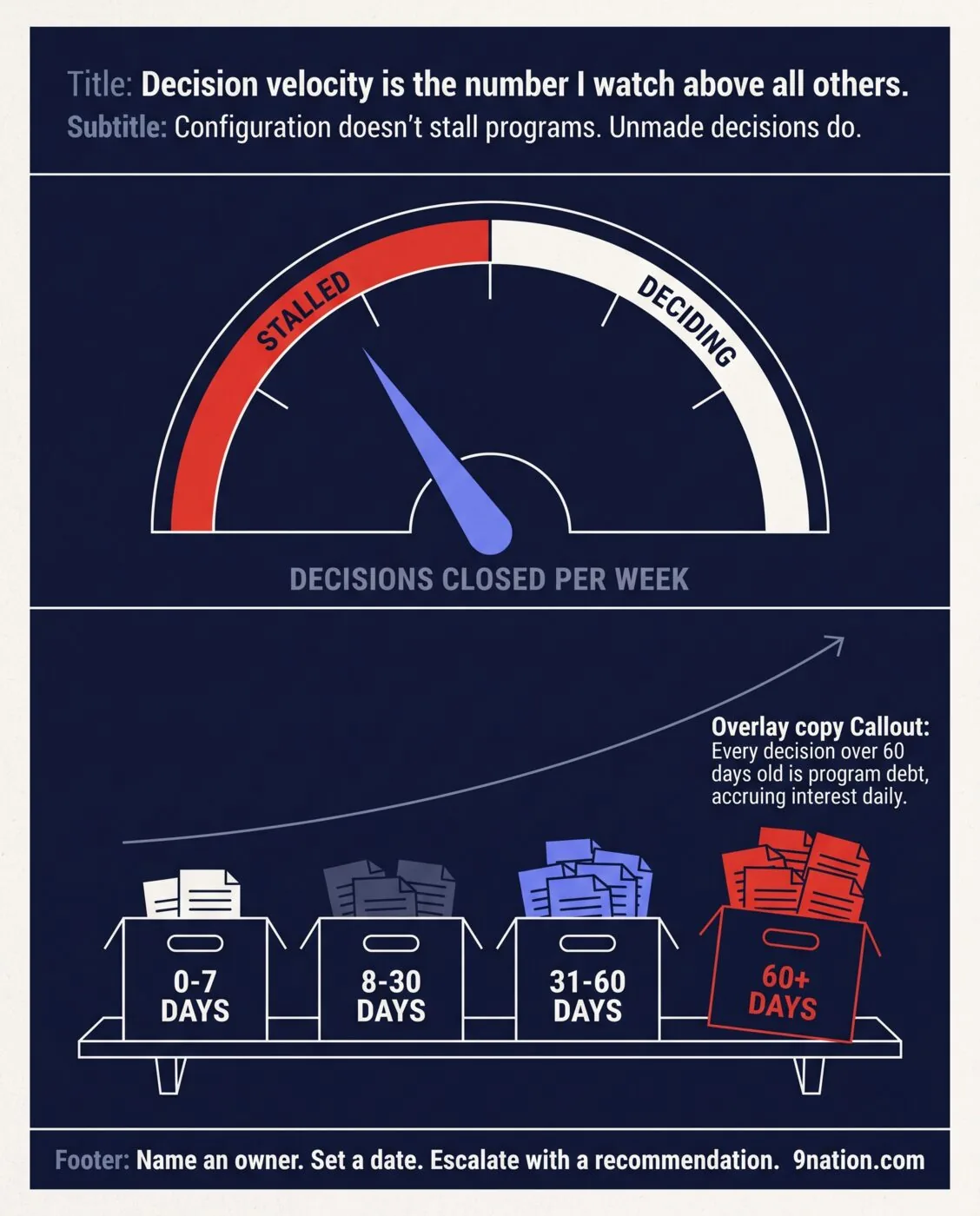
Decision velocity is the number I watch above all others
You can have a flawless plan and still bleed out slowly because the organization simply cannot decide. Workday programs generate hundreds of design decisions.
Every open decision is a small blocker accruing compound interest. The best predictor of an on-time go-live isn't team size or budget. It is decision velocity, meaning how fast the business can agree on a path forward and then not reopen it 3 weeks later.
The reopen rate is a silent killer. A program closing ten decisions a week with a sub-5% reopen rate will beat one closing three with churn every single time.
Instrument decision velocity like the core metric it is. Assign every decision a single named owner and a 72-hour response SLA. Then, auto-escalate anything older directly to the design authority.
Build a design authority that can decide
Retire the committee that only meets.
A steering committee that convenes monthly to receive a red-amber-green status is theater with catering.
Ambiguity about who decides is a larger schedule risk than any technical complexity on the build. Programs stall because leaders wait for consensus that will never arrive. This burns through consultant hours and extends the timeline indefinitely.
Build a small, standing design authority. Ideally, this means one empowered lead per pillar across HCM, Financials, Payroll, Integrations, and Security with the mandate to make binding cross-functional calls. Give that group tiered decision rights in writing.
Three people who can decide will out-deliver thirty who can only discuss.
This governance structure is one of the first things my team audits during a program review.
Your SI is an accelerator, not an owner
Never outsource the understanding.
A strong system integrator is worth every dollar. They bring the method, the muscle, and the pattern-matching from dozens of prior deployments. What they cannot bring is accountability for your business.
The programs that struggle treat the SI as the owner of the design. They will eventually roll off. When a process breaks in production months later, no internal team member can explain why it was built that way in the first place.
Demand knowledge transfer from week one rather than as a rushed closeout checkbox. For every pillar, a named client owner must sit beside the SI lead and be able to explain the configuration unaided. When the SI's hours taper, your team owns the system for the next decade.
Plan the program around tenants and test cycles
Everything else is detail.
A Workday plan lives or dies on two rhythms most Gantt charts gloss over. These are the tenant cadence and the testing cycles.
Your data conversion will not be right the first time. Skimping on testing cycles doesn't save time. It relocates the failure to production where it arrives with an audience, compliance risks, and a massive help-desk queue.
Plan backward from go-live through mock loads and payroll parallels. Run at least three mock conversions. Refuse to call data "go-live ready" until the final mock loads under a 2% error rate and finance has reconciled control totals to the dollar.
Report outcomes, not activity
“We're 80% through the task list” is the most reassuring meaningless sentence in program management.
Percent-complete measures effort, not whether you'll make it.
Executive sponsors make timeline decisions based on green status dots that hide red realities. You realize you are off track during User Acceptance Testing (UAT) when it is far too late and far too expensive to pivot.
Track the five numbers that tell the truth. These are:
- design decisions closed and reopen rate
- data conversion error rate by mock load
- defect burn-down velocity
- test pass rate by business process
- training completion by role
Put those on a single-page dashboard.
Run risk in daylight, not as a traffic light on slide 14
The risks that sink Workday programs are rarely exotic. In order, they are:
- client SMEs too buried in their day jobs
- data dirtier than anyone admitted
- decisions that will not close
None of those are visible in a single green dot.
A risk without an owner is just an anxiety.
Hidden risks detonate during parallel runs or hypercare, which turns stabilization into a crisis. None of these risks survive contact with an honest RAID log where every risk carries a named owner and a resolution date.
Change management is a workstream from day one, not a module at the end
The most expensive mistake I see is treating adoption as a go-live event with just a couple of generic webinars and a quick-reference PDF in the final month.
Workday looks and behaves differently for every manager, employee, and analyst.
Different without preparation reads as broken.
A technically perfect tenant that nobody adopts is a failed project on every metric that matters.
Change management has to run in parallel from kickoff. This means role-based training, in-app guidance, and honest communication. Track adoption like a delivery metric in the first 30 days.
Go-live is the midpoint
Plan the landing.
A plan that stops at go-live is only half a plan. Hypercare, stabilization, and the first optimization cycle are where the investment starts paying back.
Workday ships two feature releases a year. Staying current is a permanent capability, not a project you finish. Organizations bleed ROI as the system degrades and they scramble to build governance in a panic 6 months after go-live.
The clients who win stand up a dedicated Workday Center of Excellence (CoE) before go-live. The muscle to govern, test, and continuously improve already exists on Day 1 of production.
A faster path to a modern platform raises the bar on your planning
Workday gives you a faster, cleaner path to a modern platform. In doing so, it raises the bar on project management. The technical guardrails are stronger, so the differentiator moves to the human system around them. The build is rarely where Workday projects fail. The plan is. Get the plan right, and the platform will deliver what the business case promised.
Want to run this gate check with your leadership team? I've packaged this exact framework into a downloadable Workday Program Readiness Checklist, a pre-formatted template you can bring straight into your next steering committee. Get the free checklist here, or message me on LinkedIn.