
Go-live · The night shift runbook
Running a go-live command center that works
The cutover weekend is won or lost before it starts. Here's how to build a command center that holds when everything is moving at once.
There's a moment on every large program when the planning stops mattering and the room takes over. The data is loading, three things have gone sideways at once, and someone is standing in a doorway asking whether to keep going or pull back. That's cutover: the point of maximum risk and maximum coordination at the same time, and it doesn't care how good your project plan looked in April.
I run that room for a living. Over 25 years on large programs I've learned that cutover punishes improvisation. Whatever you haven't decided in advance, you'll decide badly at two in the morning with tired people and incomplete information, so the job is to make the weekend boring.
Build the command center weeks before you need it
Stand the command center up weeks before cutover and rehearse it, so that when the pressure arrives everyone already knows where they sit and what they own. Start with roles, and make them real.
| Role | Owns | The rule |
|---|---|---|
| Cutover manager | The clock and the sequence. | Can't also be running a workstream. |
| Workstream leads | Their slice end to end, with nothing falling between two of them. | One name per slice. |
| Comms lead | Keeping the right people informed, inside and outside the room. | Their whole job for the weekend. |
| Decision authority | An executive sponsor reachable on their phone all weekend. | If you get voicemail at 3am, you picked the wrong person. |
Then you need a single source of truth, and that's the cutover runbook. A status deck only summarizes it, a chat thread scrolls the current state away, and nobody's memory holds up at hour nineteen. If there are two runbooks, you effectively have none. Around the runbook, set up the war room, physical or virtual, and a communication tree that gets a message to the person who can act in minutes rather than after it has bounced through four inboxes.
| Clock1 | Task | Owner2 | Depends on3 |
|---|---|---|---|
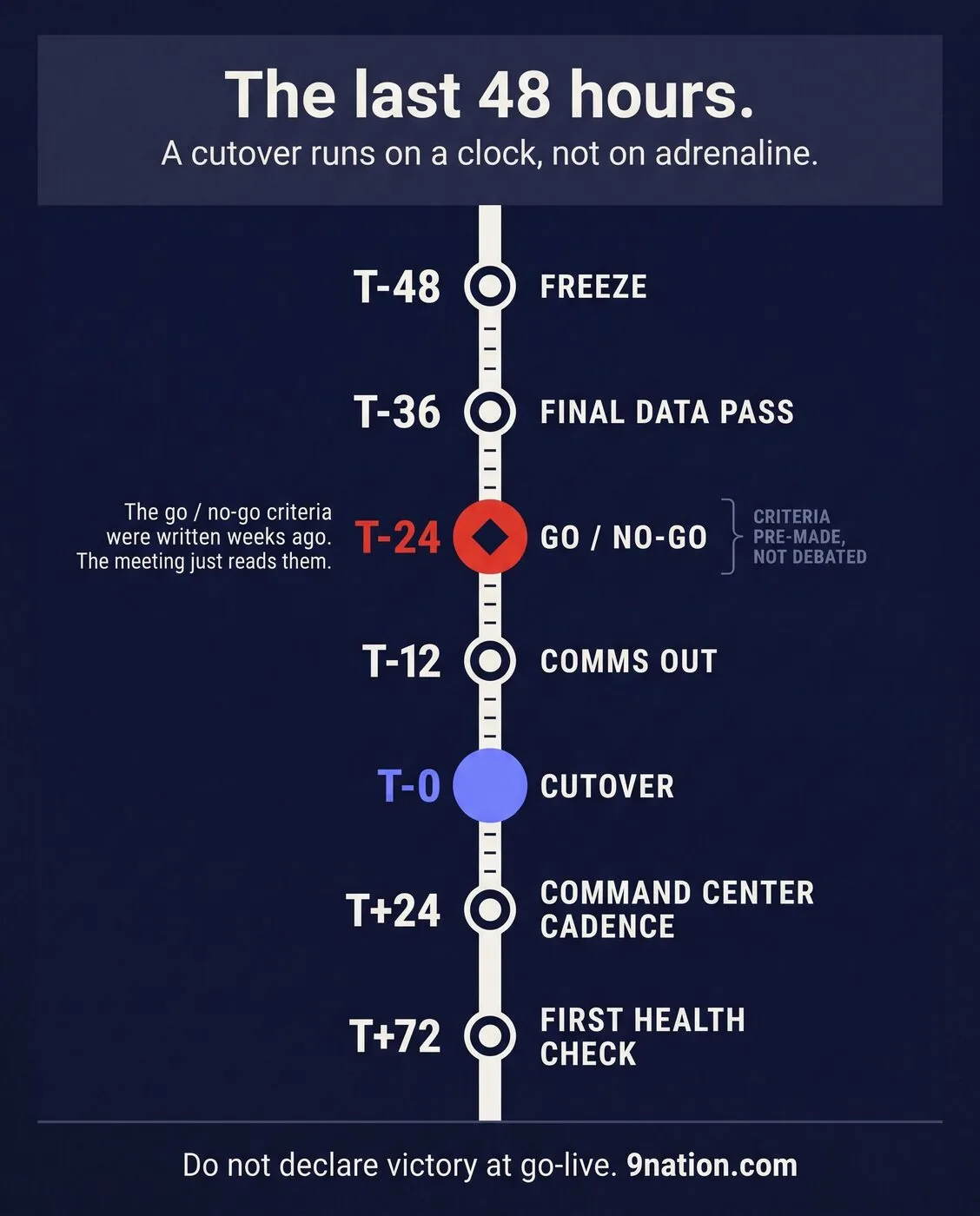
| T-36 | Final data pass | Workstream lead | Freeze at T-48 |
| T-24 | Go / no-go | Decision authority | Final data pass; signed criteria |
| T-12 | Comms out | Comms lead | The go call at T-24 |
- Checkpoints and stand-ups run against these times.
- In a real runbook this is a person's name. Roles stand in for them here.
- Comms don't go out until the go call is made.
When the room disagrees about where you are, the runbook settles it.
Run the weekend on a clock
Heroics feel productive, but on a cutover they're a warning sign. The teams that come through clean run on rhythm. Set timed checkpoints and stand-ups against the runbook. Publish status at fixed intervals so nobody has to ask where things stand. Define issue SLAs by severity, so a blocker gets a response measured in minutes and a cosmetic defect waits its turn.
The cadence keeps you honest about progress, and it gives tired people a structure to lean on when judgment starts to fray.
Make the hard calls on a Tuesday
The decisions that wreck a cutover are the ones you try to make live. Make them in advance and in writing, with clear heads, while the business isn't waiting on you. Get the go/no-go criteria signed so everyone knows what "ready" means and what failing one of those checks costs. Define the rollback triggers and the point of no return, after which you're committed and rollback is off the table.
Decide on a Tuesday
- Go and no-go criteria, signed
- What "ready" means, in evidence
- What failing one check costs
- Rollback triggers, by condition
- The point of no return
Never on a Saturday
- Whether this defect counts as critical
- Whether to keep going or pull back
- Who is allowed to make that call
- What the business is told, and when
The authority rule
Exactly one person calls go, no-go or rollback. The whole room knows who before you start, because the runbook names them. When two people think they can decide, nobody does.
Update executives on a schedule, and get ahead of the rumor mill
Executives get crisp updates on a known schedule, with no padding. Each one carries three things:
- 01Current status
- 02The top risks
- 03Any decisions you need from them
The business and end users get clear, honest comms about what's happening and what to expect when they log in Monday. Manage the rumor mill actively, because without a credible update people invent one, and the invented version is always worse than the truth.
To a business waiting on news, silence reads as something wrong that nobody will admit.
Don't let the whole room swarm the first break
When something breaks, everyone's instinct is to pile on. That's how you lose the next 3 hours and the next two problems. Most of what feels urgent at midnight turns out not to be, so the first question is always the same one.
Something breaks. Is it blocking the critical path?
Yes
One owner, by name
A response measured in minutes. Every problem gets a single name attached to it, because if everyone owns it, you'll find out the hard way that no one does.
No
The parking lot
Handled after go-live or in hypercare. Non-blockers don't get to derail the weekend just because they're visible.
The cutover manager's real job here is protecting focus: assign it, contain it, and keep the line moving.
Don't declare victory at go-live
The most expensive mistake I see is the celebration that comes too early. The system is up, the team is exhausted and relieved, and everyone wants to go home. That's when the real test begins.
Warm-hand every open issue into hypercare. The parking lot, the known workarounds and the things you watched all weekend each get a deliberate handoff to the people who will own them next, rather than a shrug and a closed laptop.
Stay staffed through the first payroll and the first close
Keep the team staffed through the first real business cycles. The first payroll run, the first period close and the first month of live transactions are where the quiet defects surface. If you've stood everyone down by then, you find out in production, with the business watching.
Done well, a command center produces something almost invisible, which is why it's undervalued. Its real product is the absence of surprise: no frantic calls, no decisions made in a panic, no Monday nobody saw coming. The system goes live and the business barely notices the seam.
Have these in writing before cutover weekend
- A cutover manager who isn't also running a workstream, and one lead per slice
- A decision authority reachable by phone all weekend, named in the runbook as the one person who calls go, no-go or rollback
- One runbook, with an owner, a clock time and dependencies on every task
- Signed go/no-go criteria, rollback triggers and the point of no return
- Status published at fixed intervals, and issue response times set by severity
- A parking lot, with an owner in hypercare for everything on it
- A staffing plan that keeps the team through the first payroll and the first close
Put independent eyes on your program.
If you're betting tens of millions on an ERP program, a candid second opinion is the cheapest insurance you'll buy.