
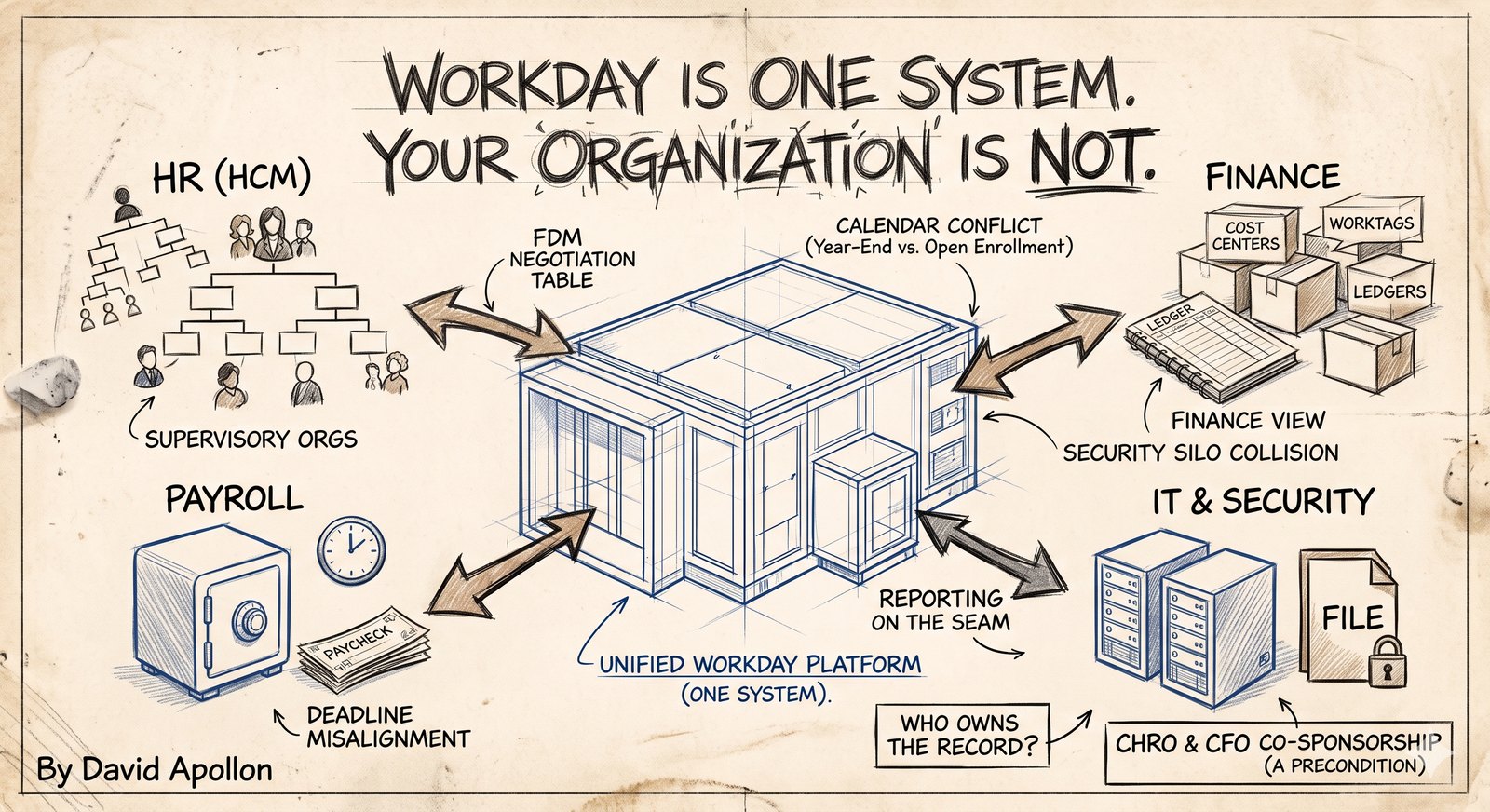
The pitch for Workday is seductive: one system, one data model, HR and Finance finally speaking the same language. This unification drives the platform's real value, but it is also the source of its hardest problems.
The moment you put HR, Finance, and IT on one shared foundation, you lose the ability to paper over the places those functions have quietly disagreed for years. Workday doesn't create cross-functional conflict. It exposes it, and it hands you a deadline to resolve it.
Here is exactly where the strain shows up, and the playbook I use to fix it.
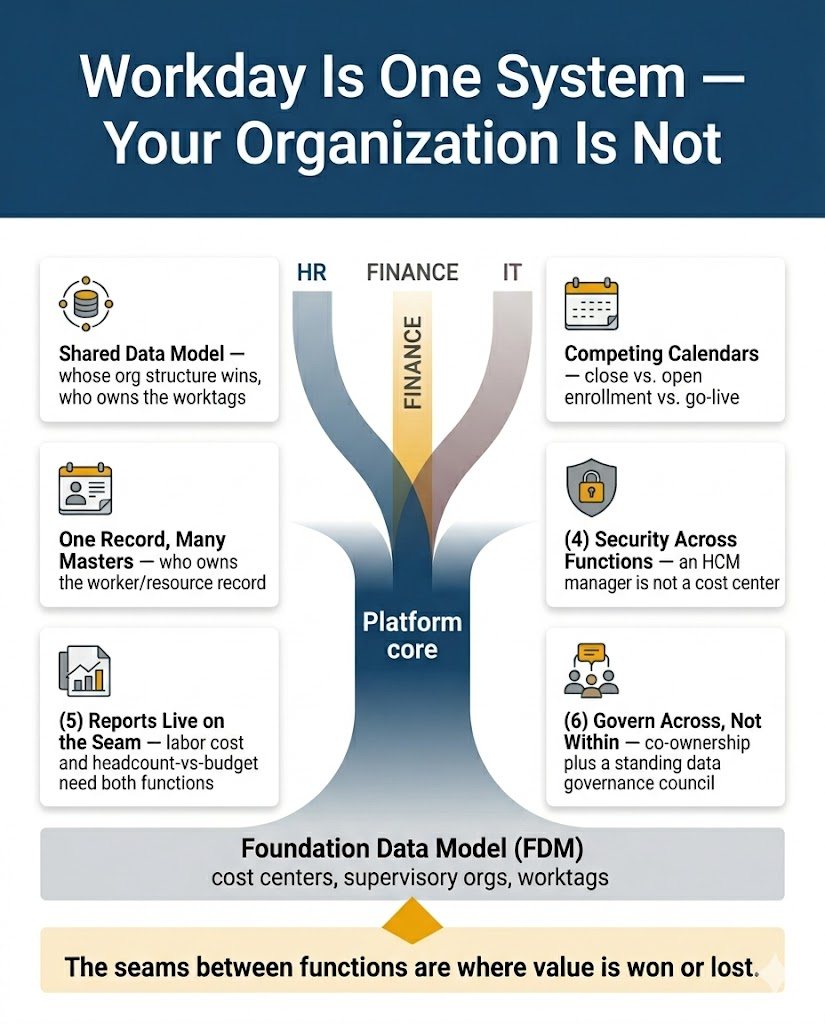
Workday doesn't create cross-functional conflict. It exposes it, and it hands you a deadline to resolve it.
1 The Foundation Data Model is the real negotiating table.
At the center of Workday sits the Foundation Data Model (FDM). It forces a conversation most organizations have never actually had: how does HR's view of the organization reconcile with Finance's view of it?
The Hidden Risk: HR thinks in supervisory hierarchies and positions. Finance thinks in cost centers, ledgers, and worktags. Both are correct, and in Workday they must coexist in one model.
The Cost: If ownership of the worktag taxonomy is fuzzy, every downstream report, allocation, and security rule inherits that fuzziness. Reconciling a misaligned FDM mid-project easily burns six unbudgeted weeks.
The Strategy: Treat FDM design as a cross-functional negotiation led by one design authority. It is never just a finance task with HR copied on the emails.
2 Competing calendars are a constraint, not a footnote.
HR runs on open enrollment and performance cycles. Finance runs on the close, quarter-end, and year-end.
The Hidden Risk: These calendars do not pause for your project, and they rarely align with each other.
The Cost: Dropping a go-live date squarely on top of year-end close creates maximum cost, maximum stress, and operational chaos.
The Strategy: Map every functional calendar first, then schedule around the genuinely immovable objects. The platform is shared, but the blackout dates are not.
3 One record, many masters.
In Workday, an employee, a worker, and a resource are increasingly the same object seen through different lenses.
The Hidden Risk: When one change to a worker ripples simultaneously into payroll, budget, and security, data ownership stops being an abstract policy debate and becomes an operational necessity.
The Cost: Teams often make a call on position versus job management inside the HCM workstream in isolation. They then spend months retrofitting it once Finance realizes it breaks their entire headcount-planning model.
The Strategy: Decide cross-functional data rules together, or pay to redo them later.
4 Security doesn't respect your org chart's functional lines.
A manager in HR and a cost center manager in Finance are often different people with different rights over overlapping data.
The Hidden Risk: Workday's security model handles this nuance beautifully, but only if the people designing the roles are looking across functions at the same time.
The Cost: Designed in silos, security becomes the place cross-functional assumptions go to collide, usually loudly during User Acceptance Testing (UAT).
The Strategy: Map approval and access rights across both functions on a single canvas.
5 Integrations are where the seams become visible.
Payroll posts to the general ledger, benefits elections drive deductions, and expenses flow into accounting.
The Hidden Risk: The seams between functions are exactly where unowned requirements hide. HR assumes Finance owns a field, and Finance assumes HR owns it.
The Cost: A single unclaimed field between benefits and payroll can quietly mis-map a deduction code, only surfacing during the first live pay run.
The Strategy: Spend a disproportionate share of attention on the seams. When I run architecture reviews, the seams between modules are the very first places I look for hidden risk.
6 Two vocabularies, one design.
Here is a quieter cross-functional tax: HR and Finance literally don't speak the same language.
The Hidden Risk: Terms like supervisory organization, cost center, company, business unit, and worktag carry entirely different meanings across the aisle.
The Cost: Entire design sessions are lost to people fiercely agreeing while believing they disagree.
The Strategy: Insist on a shared glossary written down on day one. It sounds trivial, but it prevents some of the most expensive misunderstandings on the program.
7 The reports that matter most live on the seam.
The reports executives actually care about are fully-loaded labor cost, headcount versus budget, and cost-to-hire.
The Hidden Risk: These reports braid HR and Finance data together. They cannot be specified by either function alone.
The Cost: If your reporting requirements are gathered in two separate rooms, the most valuable cross-functional reports fall straight through the gap.
The Strategy: Gather reporting requirements with both functions in the room on purpose. Treat them as first-class deliverables.
8 It starts at the top with executive co-sponsorship.
Every successful cross-functional Workday program I've been part of shared one trait: the CHRO and the CFO genuinely co-owned it.
The Hidden Risk: Struggling programs usually have an imbalance where one function drives and the other merely sends delegates.
The Cost: The disengaged function's requirements surface late as expensive change requests. Their people quietly resist a system they feel was done to them rather than built with them.
The Strategy: Treat balanced executive co-sponsorship as a strict go/no-go condition.
9 Govern across the functions, not within them.
Running HR, Finance, and IT as parallel workstreams that only integrate at the end is a structural failure.
The Hidden Risk: Different functions bring different vocabularies, vendors, and cultures. Someone has to sit at the seams and translate.
The Strategy: Stand up a cross-functional design authority with real decision rights that owns the shared model and adjudicates trade-offs.
10 The operating model outlives the project.
The cross-functional questions do not end at go-live. They just change shape.
The Hidden Risk: Someone still has to own the worktag taxonomy, approve cross-functional changes, and handle the next business reorganization.
The Strategy: The data governance council you stand up for the project should become the standing body that governs the shared model in production.
11 AI raises the stakes.
As Workday pushes deeper into Illuminate AI agents spanning HR and Finance, the value of clean, shared data skyrockets.
The Hidden Risk: Agents that reason across HR and Finance are only ever as trustworthy as the foundation beneath them.
The Cost: Organizations that skip the unglamorous cross-functional governance work end up automating on top of an unresolved argument.
Want to pressure-test your cross-functional setup? I've packaged this framework into a downloadable Workday Cross-Functional Governance Checklist, a pre-formatted template that maps shared ownership across HR and Finance. Get the free checklist here, or message me on LinkedIn.
The takeaway
Workday's greatest strength is its greatest demand on the organization. It asks HR, Finance, and IT to agree on a deadline about things they have comfortably disagreed about for years. The technology will absolutely do its part. Whether you capture the value depends on whether you are willing to do the harder, human work of governing across the lines.