
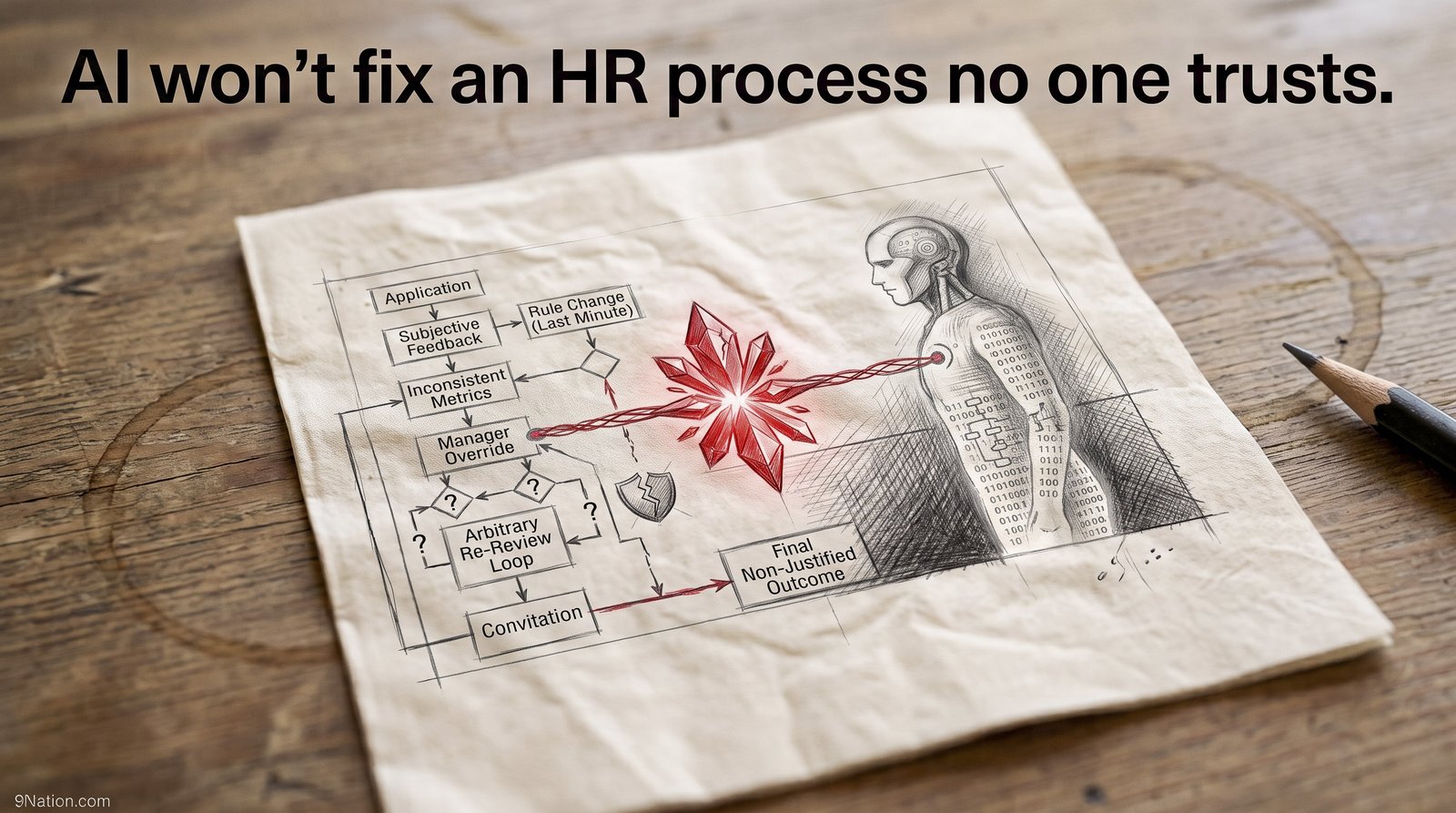
I have spent a lot of my career on the HR side of large transformations, and there is a moment I have watched play out a dozen times in the last year. A CHRO sits through a demo of the new AI agents in their HCM platform. The demo is genuinely good. The agent drafts the performance summary, surfaces the internal candidate, answers the benefits question without a ticket. Heads nod. Then the meeting ends and everyone goes back to a reality the demo never touched: a job architecture nobody has cleaned up since the last reorg, a skills “taxonomy” that is three spreadsheets and a shared drive, and a performance history that carries every bias the organization has ever had.
That gap, between what the agent does in the demo and what your data and processes can actually support, is the whole CHRO agenda for the next two years. The software is the easy part. It was always going to be the easy part.
What actually landed in your HCM this year
This is not speculative. Every major platform shipped HR agents in 2025 and into 2026, and they do real work. Workday’s Illuminate agents handle recruiting, talent mobility, and HR cases. SAP SuccessFactors layered Joule agents across performance, career development, payroll questions, and HR service. Oracle added more than a dozen agents to Fusion HCM, from interview scheduling to internal job matching. Microsoft put an Employee Self-Service agent into the flow of work and started selling skills intelligence straight through Copilot.
The operational results are not hype either. One company, Robinhood, reported deflecting 70% of employee HR requests before they ever reached a human. That is roughly 2,200 hours a month of work that simply went away. The City of Raleigh reported a 98% deflection rate. When the work is high volume and rule bound, these agents earn their keep fast.
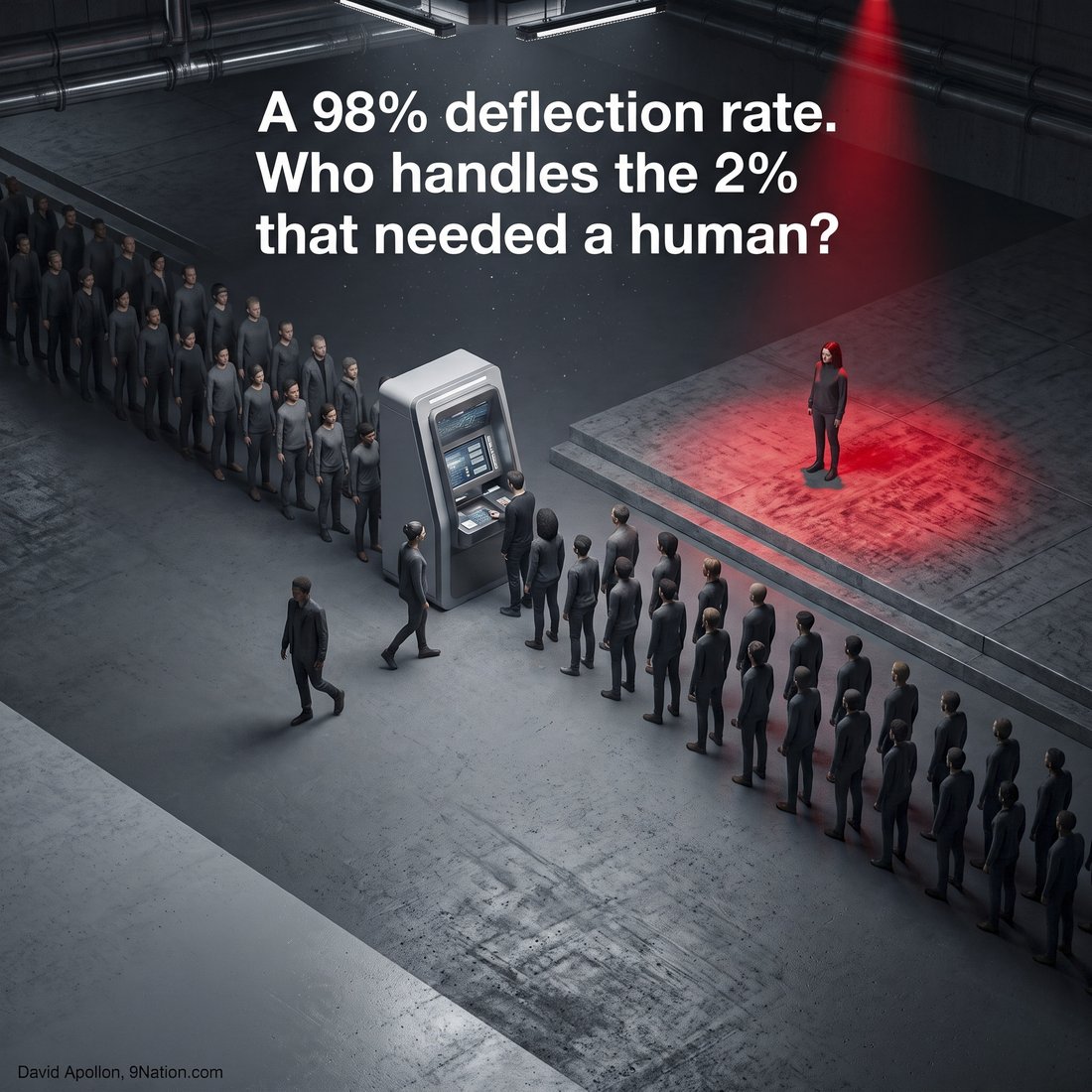
So the question is no longer whether to use AI in HR. It is which decisions you hand to a machine, where the person stays in the loop, and who answers for it when it gets someone’s livelihood wrong.
Adoption is running well ahead of value
Here is the tension every CHRO is living inside, even if nobody has named it in your leadership meeting.
About 39% of HR functions have adopted AI somewhere, by SHRM’s 2026 count. But Gartner surveyed HR leaders and found 88% say their teams have not yet seen significant business value from the tools they deployed. And even so, more than 80% plan to add agentic AI to their function inside the year.
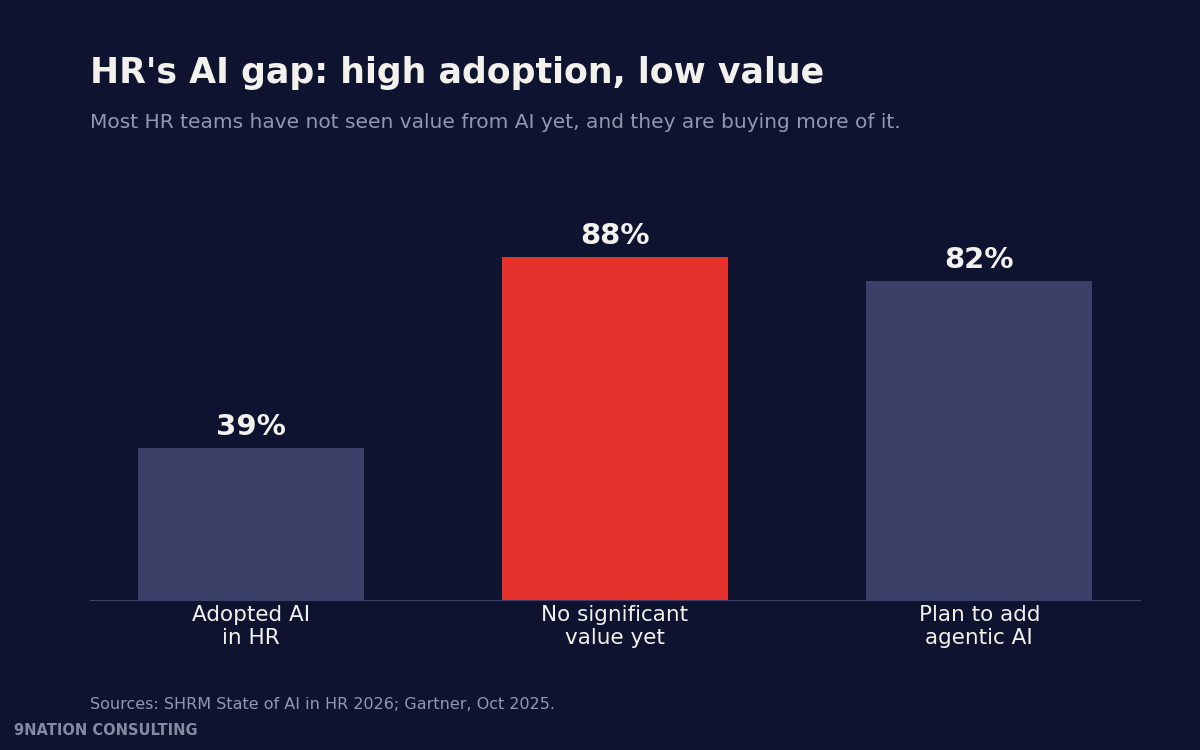
Sit with that. Most teams have not gotten value from the AI they already have, and they are speeding up into more of it. That is not a confidence curve. It is fear of being left behind. The CHROs who slow down just enough to build the foundation first are the ones who end up in the 12% that got value. Not because they bought better agents. Because they did the dull work underneath them.
Gartner put a number on where the value actually comes from. Nearly 30% of AI’s productivity gains trace to changing the HR operating model itself, not to the tool and not to training people on the tool. The operating model is the work. The license is just the permission slip.
AI on top of an HR process your people already distrust does not fix the distrust. It automates it, scales it, and removes the human who used to soften it.
What AI inherits from you
“Garbage in, garbage out” became a cliché because it is true. In HR the stakes run higher than in finance. When AI learns from your historical people data, it learns your history. All of it.
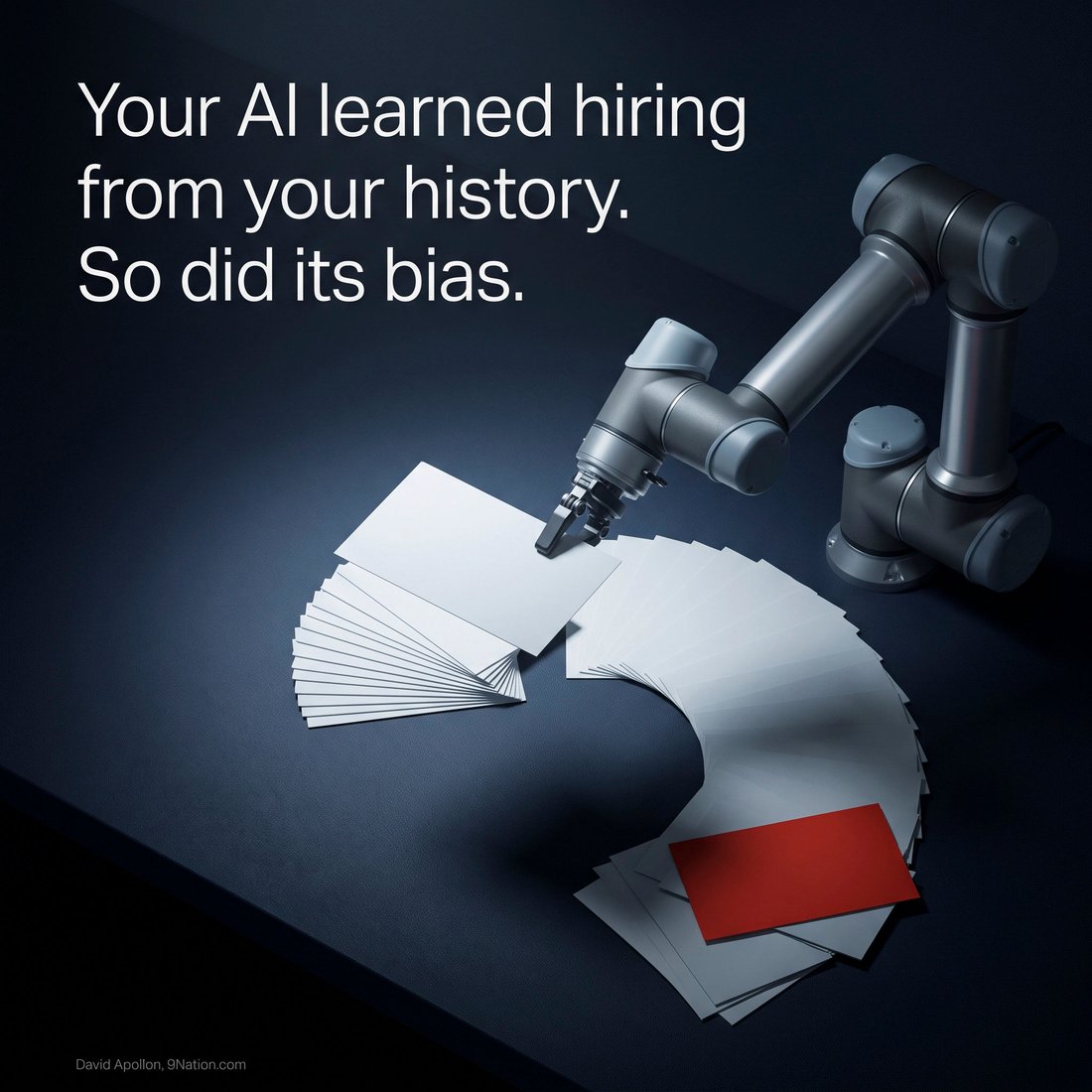
The cautionary tale everyone in HR now knows is Amazon’s early recruiting model, which taught itself to prefer male candidates because it trained on a decade of resumes from a male-dominated field. That was not a freak malfunction. It is the default outcome of pointing a learning system at biased history. If your promotion records, pay decisions, and performance ratings carry the patterns of the past, and almost every organization’s do, an AI trained on them will reproduce those patterns at scale and hand them back as objective. Bias laundered through an algorithm looks like math. That makes it harder to challenge, not easier.
This is why an AI initiative in HR is not an IT project that HR sponsors. It is an HR accountability problem that IT enables. The difference shows up the first time a rejected candidate, or a regulator, asks you to explain a decision your agent made.
The skills-based org is the architecture AI is waiting for
The thing HR leaders most want from AI, matching people to open roles, surfacing who is ready for what, targeting reskilling, depends on something most organizations have not built: a real skills foundation.
Mercer’s latest research found fewer than one in five organizations doing skills-based talent management at any real scale, even though the same research keeps showing those organizations are far more likely to hit their workforce outcomes. The agents your vendor is selling assume a clean skills model underneath. Roughly half of organizations still cannot reliably map skills to jobs, and those organizations cannot get value from the matching, mobility, and learning AI they are being sold, however good the agent is.
Skills architecture is not a someday project anymore. It is the near-term precondition for everything else on the AI roadmap. It comes first, or the rest does not work.
AI is not killing jobs yet. It is killing the path to the first one.
If you are planning your workforce strategy around current headcount, you may be solving the wrong problem.
The clearest labor-market signal so far is not mass layoffs. It is the quiet collapse of the entry-level pipeline. Researchers at Yale found employment for the youngest software developers down about 20% from its 2022 peak, with entry-level postings down by half. Companies are not laying off the people they have so much as closing the door to new ones. The World Economic Forum projects heavy churn this decade, tens of millions of roles created and displaced, with a large share of workers needing to reskill.
For a CHRO, the implication is sharp. If AI absorbs the routine work junior people used to learn on, where does your next generation of senior talent come from? That is a board-level workforce risk, and it is invisible if you only look at this year’s org chart.
Your own house is part of the redesign
HR is not exempt from what it is deploying. Josh Bersin’s research argues that AI agents could automate a large share of core HR processes and shift 30% or more of traditional HR headcount toward higher-value work. Deloitte found two-thirds of executives believe functions like HR must fundamentally change, and only 7% think they are actually making progress.
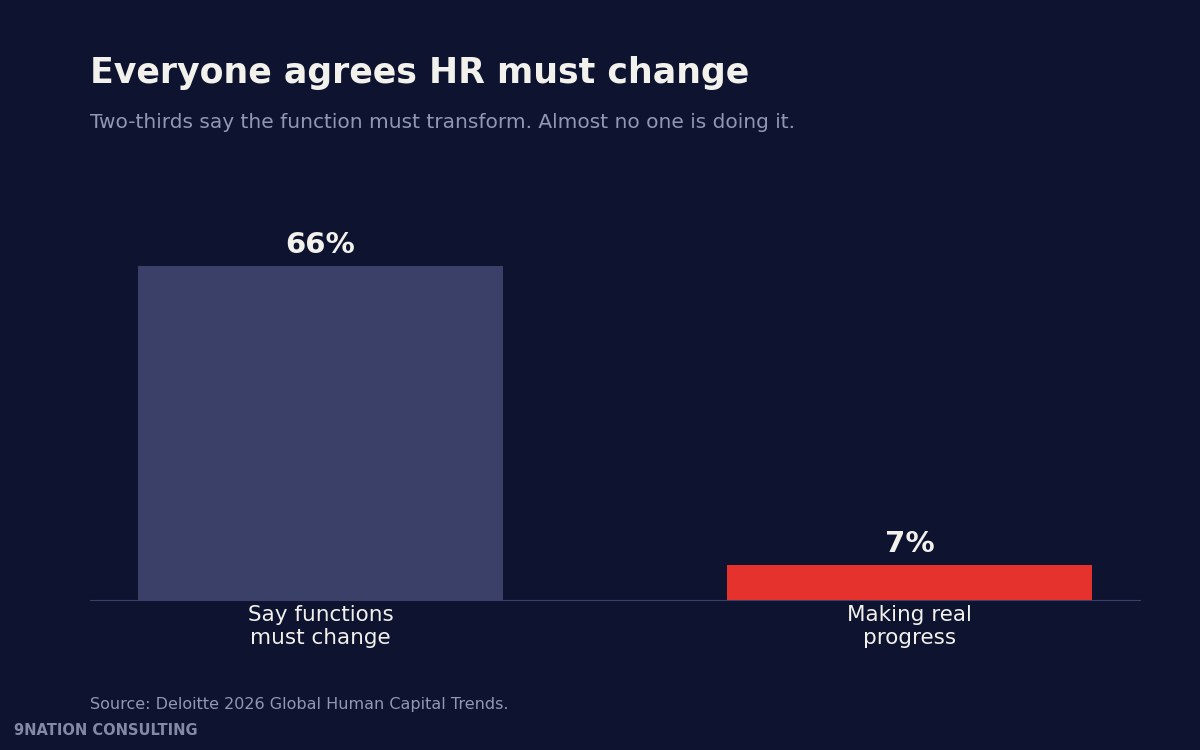
That gap is the CHRO’s risk and opportunity at once. Treat it as a cost-cutting story and you lose the narrative, and probably the function’s seat at the table. Treat it as a capability shift, fewer hands on transactions and more on judgment, governance, and the human moments a machine cannot hold, and you redefine what HR is for. Somebody is going to decide what HR looks like in two years. Better the CHRO than a finance-led automation program.
What the CHRO now owns, and cannot delegate
Some of this you assign. The technical build goes to IT. Regulatory tracking goes to legal. Change management goes to your business partners. The core cannot be handed off.
You own the operating-model call: what AI does, what people must do, and exactly where the handoff sits. You own a bias-audit discipline for every system that touches hiring, promotion, pay, or performance, not as a one-time check but as a standing one. You own the human-in-the-loop policy for consequential decisions, written down and enforced, so an agent can route a case but never, on its own, reject a candidate or end an employment relationship. You own the quality of the data feeding all of it. And you own a workforce plan for your own function.
The regulators have made this concrete, and the dates are no longer comfortably far off. Illinois’s AI employment-disclosure law took effect at the start of 2026. The EU AI Act’s high-risk obligations for employment systems land in August 2026, covering risk management, documentation, human oversight, and transparency to candidates, with penalties that reach the tens of millions or a slice of global turnover. Colorado’s revised AI law follows in January 2027. And in New York City, the state comptroller’s late-2025 audit found Local Law 144 had barely been enforced, which is exactly the kind of finding that comes right before a tougher enforcement phase. A compliance posture built on “nobody is looking” just expired.
The vendors will keep telling you the AI is ready, and for them it is. Whether it is ready for your people depends on whether your processes are trusted, your data is clean, and your governance is real. Those are not vendor questions. They are the CHRO’s. Own them, and AI becomes the lever that finally moves HR from administration to judgment. Skip them, and you have bought the fastest, most confident way yet to scale the things your people already did not trust.
Sources
SHRM, “State of AI in HR 2026,” for 39% HR adoption. Gartner, “CHROs’ Top Priorities for 2026” (Oct 2025), for 88% no significant value yet, about 29% of gains from operating-model change, and 82% planning agentic AI. Mercer, “2025/2026 Skills Snapshot,” for fewer than one in five skills-based at scale. Deloitte, “Skills-Based Organization” and “2026 Global Human Capital Trends” (66% say functions must change; 7% making progress). Josh Bersin Company, “2026 Imperatives.” Yale CELI via Fortune (Apr 2026); World Economic Forum, “Future of Jobs 2025.” ServiceNow customer results (Robinhood; City of Raleigh). Regulation: EU AI Act (Aug 2026); Illinois HB 3773 (Jan 2026); Colorado AI Act (Jan 2027); NYC Local Law 144 and the NY State Comptroller audit (Dec 2025). Amazon recruiting-AI bias, widely reported.