

Every few weeks I am in a version of the same conversation. A senior leader says, half stating it, half asking: “We are on SAP, so we have to be off ECC by 2027, right?” The way they land on “right” tells me they have already accepted the premise. They are not asking whether to move. They are asking how fast.
That premise is worth slowing down on. Almost everything expensive about an ERP migration flows from the decision you make in that moment, and the moment is usually set by a deadline that people who profit from your urgency have described to you many times.
What the clock actually says
Let me get the dates right, because the dates are where the fear lives and most of the fear is misplaced.
SAP mainstream maintenance for ECC 6.0 and Business Suite 7 ends on December 31, 2027, for enhancement packs 6 through 8. If you are on an older pack, that clock already ran out at the end of 2025. So far the urgency story holds.
Now the part that rarely makes the briefing. After mainstream maintenance ends, SAP offers extended maintenance through 2030 at a premium, and a transition option that runs into 2033 for private-cloud customers. Third parties such as Rimini Street have committed to support ECC and S/4HANA through 2040. And if you happen to run Oracle E-Business Suite instead, Oracle quietly extended Premier Support to at least 2037.
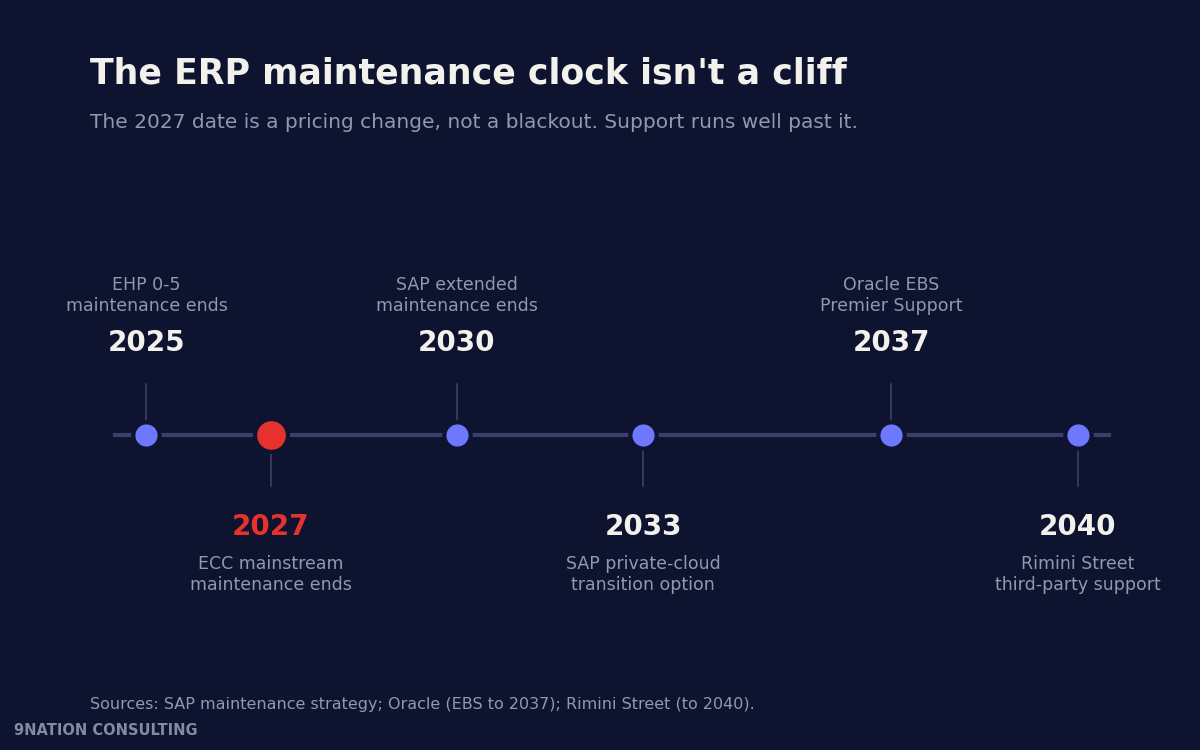
So the cliff is not the day the lights go out. It is the day the price of staying changes. That difference matters. A pricing change is something you negotiate and plan around. A blackout is something you panic into. Vendors and integrators have a strong commercial interest in which of those two pictures lives in your head.
A go-live date set by someone else’s maintenance calendar is not a transformation timeline. It is a billing schedule with your name on it.

Half of SAP’s own customers are staying, on purpose
If 2027 were the emergency it gets sold as, you would expect a stampede. There isn’t one.
Gartner projects that roughly 17,000 of SAP’s 35,000 or so ECC customers will still be on legacy at the end of 2027. About half. SAP’s own German-speaking user group, DSAG, surveyed members in early 2026 and found 54% still running ECC or Business Suite somewhere in the estate. Only 37% of ECC users were targeting a move before the deadline. Nearly half were planning to ride extended maintenance to 2030.
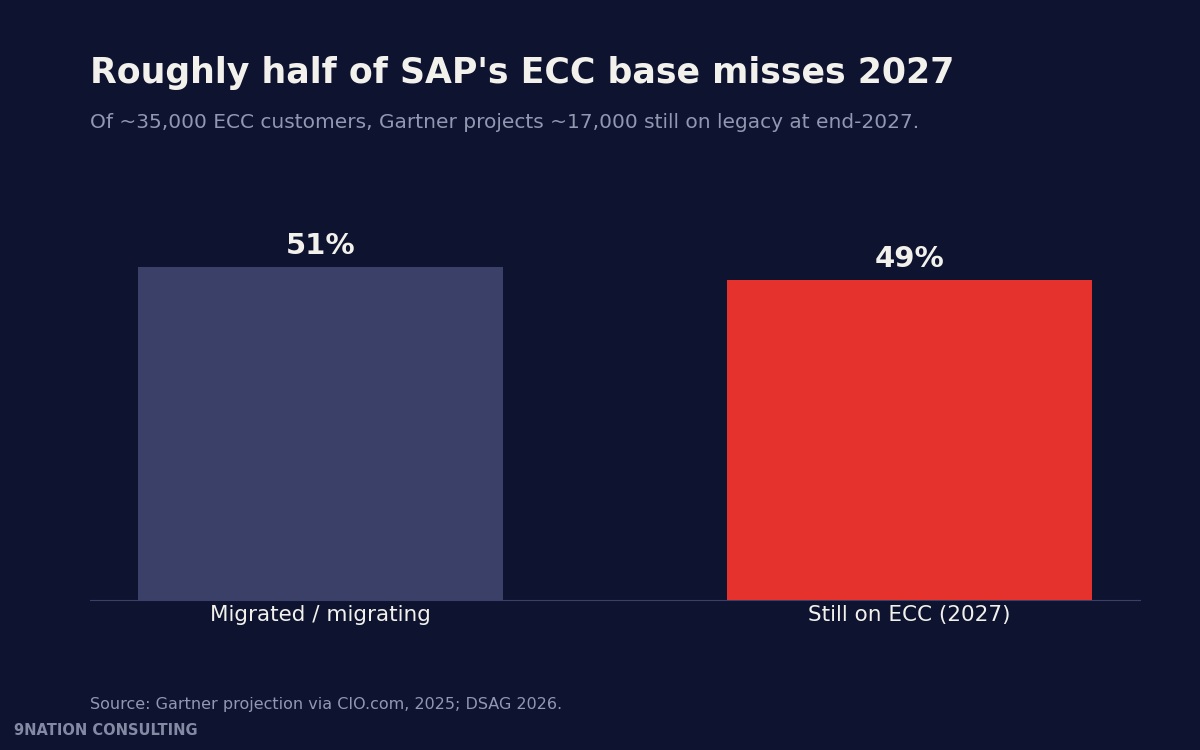
These are not unsophisticated laggards. They are large, well-run enterprises doing the math. They have decided the extra runway is worth more than hitting an arbitrary date with a rushed program. That is the calculation the urgency story hopes you will skip.
The capacity crunch nobody is selling you
Here is the thing that should actually shape your timing, and it is the one your integrator is least likely to raise, because it works in their favor.
A manufactured deadline concentrates demand. Everyone is told to move by the same date, so everyone reaches for the same finite pool of S/4HANA architects, FI/CO specialists, and program managers at the same time. The price of that talent has climbed. Specialist rates are up around 20% since 2023, and industry estimates put the value tied up in the SAP skills gap near 162 billion dollars worldwide.
The math is unforgiving. A serious migration runs 18 to 36 months. If you have not started by the middle of 2026, you are not finishing a clean program before December 2027. You are finishing a rushed one, at premium rates, with the B team, because the A team was booked eighteen months ago. The deadline does not help you. It helps whoever holds the implementation capacity and gets to price it.
RISE is a subscription, not a destination
When you do move, the default path SAP will steer you toward is its bundled cloud offer, rebranded in 2025, repriced along the way, with features pulled out of the base package and AI tooling priced on its own. Read the service levels before you sign. The standard agreement lands around 99.7% uptime, below the 99.9% most enterprises treat as table stakes, and closing that gap reportedly costs 30% to 50% more on license fees.
The deeper point is not the SLA. Signing the subscription usually means giving up the perpetual licenses you already own. You trade an asset you control for a rental whose renewal terms the landlord sets. That may still be the right move. But it is a strategic decision about leverage, not a line on a migration plan, and it deserves independent licensing eyes before a signature, not after.
And if you are reopening the platform anyway, reopen it honestly. The 2027 deadline is not just a reason to change how you deploy. It is the rare moment you can reconsider the platform itself.
The landscape you are actually choosing among
While SAP has been manufacturing urgency, its competitors have been quietly selling stability and momentum.
Oracle played the opposite hand. It extended EBS support to 2037 and sold continuity instead of a cliff, while Fusion Cloud ERP posted record numbers, with hundreds of go-lives a quarter. Workday crossed nine and a half billion dollars in revenue, sits in roughly two-thirds of the Fortune 500 for HCM, and is using that beachhead to go after the finance layer. Its pitch to a frustrated SAP customer is blunt. You are already here for HR. Add Financials instead of re-implementing on SAP. Microsoft is pressing the same advantage in the upper mid-market, where Dynamics rides the Azure and Teams ecosystem and the sticker shock of an SAP rebuild sends buyers looking.
The takeaway for a CIO is not “switch.” It is that the deadline handed you leverage you did not have a year ago. Three credible vendors want to win your finance estate. Use that in the room.
The real risk is not the deadline. It is what you carry across it.
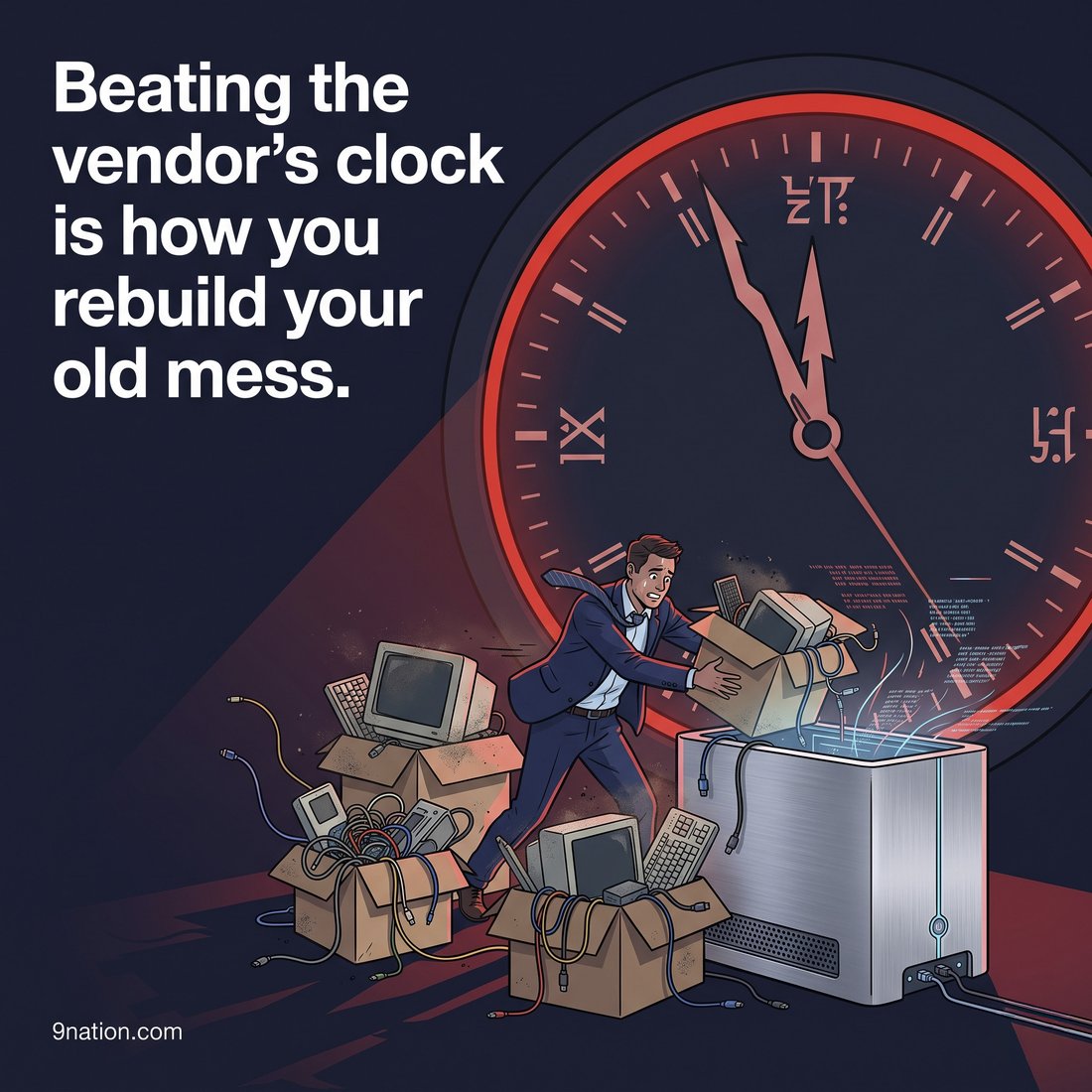
Suppose you do everything on time. The deadline is still not your biggest risk. Rebuilding your existing mess on a newer platform is.
The fastest path, a brownfield lift-and-shift, is appealing because it is fast. It also carries every customization and every data-quality problem straight across the bridge. Duplicate records stay duplicated. Stale master data stays stale. SAP’s own surveys put customization and process change among the top barriers to migration, and custom code routinely runs past 30% of a brownfield project’s scope. You spend a fortune to arrive at the same spaghetti under a fresh logo.
We have the receipts for what happens when speed and a fee incentive override governance. Zimmer Biomet sued Deloitte for 172 million dollars in 2025 over an S/4HANA program the suit says was pushed live before it was ready. Birmingham City Council’s Oracle program, budgeted near 19 million pounds, is now projected to cost north of 216 million, and the independent audit put the failure on governance and process, not the software. The technology is almost never the hardest part. The discipline around it is.
How to use the clock instead of letting it use you
Start by confirming your own facts. Check which enhancement pack you are actually on and your real end date, not the one in the sales deck. Then run a true total-cost comparison: staying on extended maintenance, migrating, or third-party support, in your numbers, over five years.
Decide greenfield versus brownfield on purpose, with your eyes open about which one carries the mess forward. Clean the data and rationalize the process before you move, not after. If you engage an SI, get named resources and milestone commitments in the contract, not a logo and a polished proposal. In a capacity crunch, the proposal team and the delivery team are rarely the same people. Weigh Oracle, Workday, and Microsoft on fit and total cost, not on whose clock is loudest. And if you genuinely cannot start until late 2026, plan for extended maintenance and negotiate from that reality. Do not let a date force a bad go-live.
Above all, run a hard governance check before anyone tells you that you are ready. The most dangerous sentence in any ERP program is “we will be fine for go-live,” and it is most dangerous when the person saying it gets paid only if it is true.
The 2027 date is real. It is also a decision, and it is yours. The people telling you it is gravity are the ones who do best when you forget that. Someone independent, sitting on your side of the table and paid to finish the program rather than bill more of it, is the cheapest hedge you will buy against a clock that was never really yours.
Sources
SAP maintenance strategy, for the mainstream end of December 31, 2027, extended maintenance to 2030, and transition to 2033 (support.sap.com; ASUG). Rimini Street support through 2040 (The Register, Jun 2025). Oracle EBS 12.2 Premier Support to at least 2037 (Oracle). Gartner projection of roughly 17,000 ECC holdouts by 2027 via CIO.com (2025). DSAG Investment Report 2026 via The Register (Feb 2026). RISE / “Cloud ERP Private” repricing and the 99.7% SLA (The Register, May 2025; CIO.com). FY results from SAP/ASUG, Oracle (Jun 2026), and Workday (Feb 2026). Zimmer Biomet v. Deloitte (UpperEdge; MassDevice, Sept 2025). Birmingham City Council Oracle program (The Register, Jan 2026). Skills-gap and rate data (ConnectingExperts/EGI; Panorama Consulting).